MCQ
Which of the following properties of atom could be explained correctly by Thomson Model of atom?
  • Overall neutrality of atom.
  • B
    Spectra of hydrogen atom.
  • C
    Position of electrons, protons and neutrons in atom.
  • D
    Stability of atom.

Answer

Correct option: A.
Overall neutrality of atom.
According to Thomson model of atom, the mass of the atom is assumed to be uniformly distributed over the atom. This model was able to explain the overall neutrality of the atom.

Need a full question paper?

Generate a complete, print-ready paper with questions like this in minutes — across 16+ boards, with answer keys.
Start Generating Free

Similar questions

${H_3}C - \mathop {\mathop {C = }\limits_{|\,\,\,\,\,\,} }\limits_{Cl\,\,} CH - \mathop {\mathop {CH - }\limits_{|\,\,\,\,\,\,\,\,\,\,\,} }\limits_{C{H_3}\,\,} C{H_3}$
Which of the following will not show geometrical isomerism ?
Ammonia carbonate when heated to $200\,^oC$ gives a mixture of $N{H_3}$ and $C{O_2}$ vapour with a density of $13.0$. What is the degree of dissociation of ammonium carbonate
The following salt shows maximum covalent character
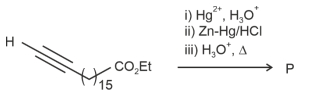
In the following reaction sequence, the major product $P$ is formed.  Glycerol reacts completely with excess $P$ in the presence of an acid catalyst to form $Q$. Reaction of $Q$ with excess $NaOH$ followed by the treatment with $CaCl _2$ yields $Ca$-soap $R$, quantitatively. Starting with one mole of $Q$, the amount of $R$ produced in gram is. . . . [Given, atomic weight: $H =1, C =12, N =14, O =16, Na =23, Cl =35, Ca =40$ ]
The element with atomic number $36$ belongs to .... block in the periodic table :-
The sulphide ion concentration $[{S^{2 - }}]$in saturated ${H_2}S$ solution is $1 \times {10^{ - 22}}.$ Which of the following sulphides should be quantitatively precipitated by ${H_2}S$ in the presence of dil. $HCl$

 $\begin{array}{|l|l|} \hline Product & Sulphide\,\,Solubility \\ \hline (I) & 1.74\,\,\times\,\,10^{-16} \\ \hline (II) & 1.2\,\,\times\,\,10^{-22} \\ \hline (III) & 8.2\,\,\times\,\,10^{-46} \\ \hline (IV) & 5.0\,\,\times\,\,10^{-34} \\ \hline \end{array}$

Assertion : Cuprous ion $(Cu^+)$ has unpaired electrons while cupric ion $(Cu^{++})$ does not.
Reason : Cuprous ion $(Cu^+)$ is colourless whereas cupric ion $(Cu^{++})$ is blue in the aqueous solution.
The correct equation for the change in enthalpy is:
Cottrell precipitator acts on which of the following principle?