MCQ
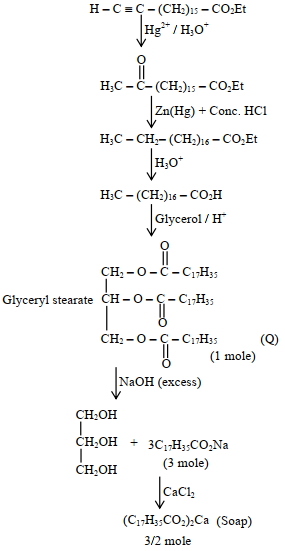
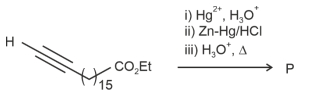
In the following reaction sequence, the major product $P$ is formed.  Glycerol reacts completely with excess $P$ in the presence of an acid catalyst to form $Q$. Reaction of $Q$ with excess $NaOH$ followed by the treatment with $CaCl _2$ yields $Ca$-soap $R$, quantitatively. Starting with one mole of $Q$, the amount of $R$ produced in gram is. . . . [Given, atomic weight: $H =1, C =12, N =14, O =16, Na =23, Cl =35, Ca =40$ ]
  • A
    $904$
  • B
    $905$
  • C
    $908$
  • $909$

Answer

Correct option: D.
$909$
d
$\frac{3}{2}$ mole soap. $=\frac{3}{2} \times 606 gm =909 gm$

Need a full question paper?

Generate a complete, print-ready paper with questions like this in minutes — across 16+ boards, with answer keys.

Start Generating Free

Similar questions

Which one of the following is not correct for reaction given below
$NH_3 + BF_3 \to NH_3.BF_3$
The photoelectric effect occurs only when the incident light has more frequency than a certain minium:
Which of the following atoms and ions are isoelectronic i.e. have the same number of electrons with the neon atom
$100\,\,ml$ of $0.2\,\,M\,\,{H_2}S{O_4}$ is added to $100\,\,ml$ of $0.2\,\,M\,\,NaOH.$ The resulting solution will be
The equilibrium concentration of $x, y$ and $yx_2$ are $4, 2$ and $2$ respectively for the equilibrium $2x + y  \rightleftharpoons   yx_2$. The value of equilibrium constant, $K_C$ is
$IUPAC$ name of $C{H_3} - \mathop {\mathop {CH}\limits_{|\,\,\,\,\,\,\,} }\limits_{C{H_3}} - C{H_2} - \mathop {\mathop {CH}\limits_{|\,\,\,\,\,\,} }\limits_{CN\,} - C{H_3}$
Energy profile diagram for dehydration of $2$ -butanol using conc. $H_2SO_4$ is given below

Product $(b)$ of above reaction is

In Dumas' method of estimation of nitrogen $0.35\, g$ of an organic compound gave $55\, mL$ of nitrogen collected at $300\, K$ temperature and $715\, mm$ pressure. The percentage composition of nitrogen in the compound would be (aqueous tension at $300\, K = 15\, mm$).
Newmann projection representation of. . . . ..  Then $X$ and $Y$ are respectively :

$\begin{array}{*{20}{c}} {{H_3}C - C{H_2} - CH - Et} \\ {\,\,\,\,\,\,\,\,\,\,\,\,\,\,\,\,\,\,\,\,\,\,\,\,\,\,\,\,\,\,\,\,\,\,\,|\,\,\,\,\,\,\,\,\,\,\,\,\,\,\,\,\,\,\,} \\ {\,\,\,\,\,\,\,\,\,\,\,\,\,\,\,\,\,\,\,\,\,\,\,\,\,\,\,\,\,\,\,\,\,\,\,\,C{H_3}\,\,\,\,\,\,\,\,\,\,\,\,\,\,\,} \end{array}$ about $C_2-C_3$ is (figure) 

How many propenyl radical is possible from propene