MCQ
Which of the following quantities remains constant during uniform circular motion?
  • A
    Centripetal acceleration
  • B
    Velocity
  • C
    Momentum
  • Speed

Answer

Correct option: D.
Speed
d
(d)

Speed remains constant.

Need a full question paper?

Generate a complete, print-ready paper with questions like this in minutes — across 16+ boards, with answer keys.
Start Generating Free

Similar questions

The coefficient of performance of a refrigerator is $5.$ If the temperature inside freezer is $-20^o C,$ the temperature of the surroundings to which it rejects heat is ........ $^oC$
The escape velocities of two planets $A$ and $B$ are in the ratio $1: 2$. If the ratio of their radii respectively is $1: 3$, then the ratio of acceleration due to gravity of planet $A$ to the acceleration of gravity of planet $B$ will be:
A hydrogen atom in ground state absorbs 10.2eV of energy. The orbital angular momentum of the electron is increased by:
  1. 1.05 × 10⁻³⁴Js
  2. 2.11 × 10⁻³⁴Js
  3. 3.16 × 10⁻³⁴Js
  4. 4.22 × 10⁻³⁴Js
$Assertion$ : On a rainy day it is difficult to drive a car or bus at high speed.
$Reason$ : The value of coefficient of friction is lowered due to wetting of the surface
In thermal equilibrium, the average velocity of gas molecules is
If the units of force, energy and velocity are respectively $10\, N, 100\, J, 5\, m/s$, then  the units of length, mass and time will be
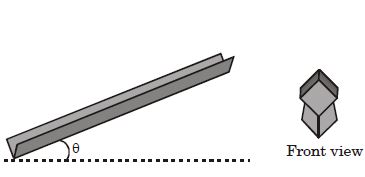
A cube of mass $m$ slides down an inclined right-angle trough. If the coefficient of kinetic friction between the cube and the trough is $\mu _k$ , then the acceleration of the block is 
$Assertion :$ Fahrenheit is the smallest unit measuring temperature.
$Reason :$ Fahrenheit was the first temperature scale used for measuring temperature.
A wheel is at rest. Its angular velocity increases uniformly and becomes $60\ rad/sec$ after $5\ sec$. The total angular displacement is ........ $rad$.
$310\,J$ of heat is required to raise the temperature of $2\,moles$ of an ideal gas at constant pressure from $25\,^oC$ to $35\,^oC$ . The amount of heat required to raise the temperature of the gas through the same range at constant volume is  .... $J$