MCQ
Which of the following rays has the maximum frequency
  • Gamma rays
  • B
    Blue light
  • C
    Infrared rays
  • D
    Ultraviolet rays

Answer

Correct option: A.
Gamma rays
a
${\nu _{\gamma - rays}} > {\nu _{UV{\rm{ - rays}}}} > {\nu _{{\rm{Blue light}}}} > {\nu _{{\rm{Infrared rays}}}}$

Need a full question paper?

Generate a complete, print-ready paper with questions like this in minutes — across 16+ boards, with answer keys.

Start Generating Free

Similar questions

An uniform thin rod of length $2 L$ and mass $m$ lies on a horizontal table. A horizontal impulse $J$ is given to the rod at one end. There is no friction. The total kinetic energy of the rod just after the impulse will be
Three waves of equal frequency having amplitudes $10\mu m,$ $4\mu m,$ $7\mu m$ arrive at a given point with successive phase difference of $\frac{\pi }{2},$ the amplitude of the resulting wave in $\mu m$ is given by
$\begin{matrix}
   \,\,\,\,\,O\,\,\,\,\,\,\,\,\,\,\,\,\,\,\,\,\,\,\,\,\,\,\,\,C{{H}_{3}}  \\
   ||\,\,\,\,\,\,\,\,\,\,\,\,\,\,\,\,\,\,\,\,\,\,\,\,\,\,\,\,|\,  \\
   C{{H}_{3}}-C-C{{H}_{2}}-C-CHO  \\
   \,\,\,\,\,\,\,\,\,\,\,\,\,\,\,\,\,\,\,\,\,\,\,\,\,\,\,\,\,\,\,|  \\
   \,\,\,\,\,\,\,\,\,\,\,\,\,\,\,\,\,\,\,\,\,\,\,\,\,\,\,\,\,\,\,\,\,\,\,\,C{{H}_{3}}  \\
\end{matrix}\xrightarrow{KOH,{{H}_{2}}O}(A);$ Product $A$ is
A block of mass $1.9\, kg$ is at rest at the edge of a table, of height $1\, m$. A bullet of mass $0.1\, kg$ collides with the block and sticks to it. If the velocity of the bullet is $20\, m / s$ in the horizontal direction just before the collision then the kinetic energy just before the combined system strikes the floor, is $....J$

[Take $g =10\, m / s ^{2}$. Assume there is no rotational motion and loss of energy after the collision is negligable. $]$
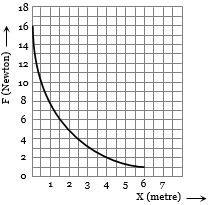
The relation between the displacement $X$  of an object produced by the application of the variable force $F$ is represented by a graph shown in the figure. If the object undergoes a displacement from $X = 0.5\,m$ to $X = 2.5\,m$ the work done will be approximately equal to .............. $J$
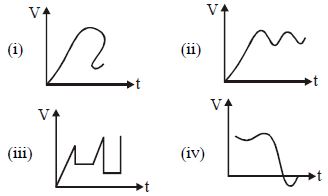
The following figures show velocity $v$ versus time $t$ curves. But only some of these can be realised in particle. These are :-
A particle is executing a simple harmonic motion. Its maximum acceleration is $\alpha$ and maximum velocity is $\beta$. Then, its time period of vibration will be
A moving coil galvanometer has resistance $50\,\Omega $ and it indicates full deflection at $4\,mA$ current. A voltmeter is made using this galvanometer and a $5\,k\Omega $ resistance. The maximum voltage, that can be measured using this voltamenter, will be close to ......$V$
Which of the following particle has similar mass to electron
The physical sizes of the transmitter and receiver antenna in a communication system are