MCQ
Which of the following relation cannot be deduced using dimensional analysis? [the symbols have their usual meanings]
  • All of these
  • B
    $v=u+ at$
  • C
    $k=\frac{1}{2} m v^2$
  • D
    $y=A \sin (\omega t+k x)$

Answer

Correct option: A.
All of these
a
(a)

Need a full question paper?

Generate a complete, print-ready paper with questions like this in minutes — across 16+ boards, with answer keys.

Start Generating Free

Similar questions

Four identical particles of mass $m$ are kept at the four corners of a square. If the gravitational force exerted on one of the masses by the other masses is $\left(\frac{2 \sqrt{2}+1}{32}\right) \frac{\mathrm{Gm}^2}{\mathrm{~L}^2}$, the length of the sides of the square is
A particle starts from rest and performing circular motion of constant radius with speed given by $v = \alpha \sqrt x$ where $\alpha$ is a constant and $x$ is the distance covered. The correct graph of magnitude of its tangential acceleration $(a_t)$ and centripetal acceleration $(a_c)$ versus $t$ will be:
There will be decrease in potential energy of the system, if work is done upon the system by
The angular velocity of the earth at present in $\omega $ . With what angular velocity should it rotate so that weight of body at the equator appears to be zero ? ....... $\omega $
The numbers 2.745 and 2.735 on rounding off to 3 significant figures will give:
A bullet moving with a velocity of $100\, m/s$ can just penetrate two planks of equal thickness. The number of such planks penetrated by the same bullet, when the velocity is doubled, will be
Match List$-I$ with List$-II.$

List$-I$ List$-II$
$(a)$ Torque $(i)$ ${MLT}^{-1}$
$(b)$ Impulse $(ii)$ ${MT}^{-2}$
$(c)$ Tension $(iii)$ ${ML}^{2} {T}^{-2}$
$(d)$ Surface Tension $(iv)$ ${MI} {T}^{-2}$

Choose the most appropriate answer from the option given below :
A $LCR$ circuit behaves like a damped harmonic oscillator. Comparing it with a physical springmass damped oscillator having damping constant $\mathrm{b}$, the correct equivalence would be:
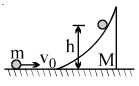
A particle of mass $m$ moving horizontally with $v_0$ strikes $a$ smooth wedge of mass $M$, as shown in figure. After collision, the ball starts moving up the inclined face of the wedge and rises to $a$ height $h$. Choose the correct statement(s) related to particle $m$ 
A man projects a coin upwards from the gate of a uniformly moving train. The path of coin for the man will be