MCQ
Which of the following relation is correct :
  • Heat capacity = specific heat $\times$ mass
  • B
    Specific heat = mass $\times$ heat capacity
  • C
    Heat capacity = mass/specific heat
  • D
    Specific heat = heat capacity

Answer

Correct option: A.
Heat capacity = specific heat $\times$ mass
A

Need a full question paper?

Generate a complete, print-ready paper with questions like this in minutes — across 16+ boards, with answer keys.
Start Generating Free

Similar questions

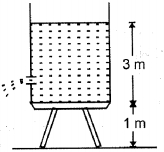
Water is filled in a tank upto $3 \,m$ height. The base of the tank is at height $1 \,m$ above the ground. What should be the height of a hole made in it, so that water can be sprayed upto maximum horizontal distance on ground?
The bottoms of utensils for cooking food are blackened to:
The weight of sphere in air is $50\ g$. Its weight $40\  g$ in a liquid, at temperature $20\,^o C$. When  temperature increases to $70\,^o C$ , it weight becomes $45\  g$, then the ratio of densities of liquid at given two temperature is
The quantities of heat required to raise the temperature of two solid copper spheres of radil $r _{1}$ and $r _{2}\left( r _{1}=1.5 r _{2}\right)$ through $1\;K$ are in the ratio
On stretching a wire, the elastic energy stored per unit volume is
$A$ and $B$ possess unequal dimensional formula then following operation is not possible in any case:-
The dimensions of four wires of the same material are given below. In which wire the increase in length will be maximum when the same tension is applied
For free expansion of the gas which of the following is true
A string of length $1\,\,m$ and linear mass density $0.01\,\,kgm^{-1}$ is stretched to a tension of $100\,\,N.$ When both ends of the string are fixed, the three lowest frequencies for standing wave are $f_1, f_2$ and $f_3$. When only one end of the string is fixed, the three lowest frequencies for standing wave are $n_1, n_2$ and $n_3$. Then
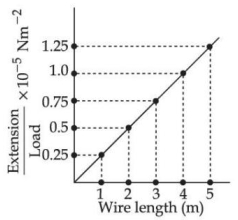
In an experiment to determine the Young's modulus, steel wires of five different lengths $(1,2,3,4$ and $5\,m )$ but of same cross section $\left(2\,mm ^{2}\right)$ were taken and curves between extension and load were obtained. The slope (extension/load) of the curves were plotted with the wire length and the following graph is obtained. If the Young's modulus of given steel wires is $x \times 10^{11}\,Nm ^{-2}$, then the value of $x$ is