MCQ
Which of the following relation is correct :
  • Heat capacity = specific heat $\times$ mass
  • B
    Specific heat = mass $\times$ heat capacity
  • C
    Heat capacity = mass/specific heat
  • D
    Specific heat = heat capacity

Answer

Correct option: A.
Heat capacity = specific heat $\times$ mass
A

Need a full question paper?

Generate a complete, print-ready paper with questions like this in minutes — across 16+ boards, with answer keys.
Start Generating Free

Similar questions

The volume of a gas at pressure $21 \times {10^4}\,N/{m^2}$ and temperature $27^o C$ is $83 $ litres. If $R = 8.3\ J/mol/K$, then the quantity of gas in $gm-mole$ will be
A piece of wood is floating in water kept in a bottle. The bottle is connected to an air pump. Neglect the compressibility of water. When more air is pushed into the bottle from the pump, the piece of wood will float with.
  1. Larger part in the water.
  2. Lesser part in the water.
  3. Same part in the water.
  4. It will sink.
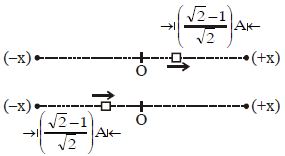
The amplitude of a particle executing $SHM$ about $O$ is $10\, cm.$ Then :
Two bodies performing $SHM$ have same amplitude and frequency. Their phases at a certain instant are as shown in the figure. The phase difference between them is
A force of $19.6\, N$ when applied parallel to the surface just moves a body of mass $10 \,kg$ kept on a horizontal surface. If a $5\, kg$ mass is kept on the first mass, the force applied parallel to the surface to just move the combined body is........ $N.$ 
A neutron exerts a force on a proton which is:
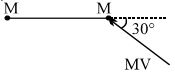
Two equal masses each of mass $M$ are joined by a massless rod of length $L$. Now an impulse $MV$ is given to the mass $M$ making an angle of $30^o$ with the length of the rod. The angular veloctiy of the rod just after imparting the impulse is
The mass of a hydrogen molecule is $3.32 \times 10^{-27 } $ $kg$. If $10^{23}$ hydrogen molecules strike, per second, a fixed wall of area $2$ $cm^2$ at an angle of $45^o $ to the normal, and rebound elastically with a speed of $10^3\ m/s$, then the pressure on the wall is nearly:
If $V$ denotes the potential difference across the plates of a capacitor of capacitance $C$, the dimensions of $C{V^2}$are
Boyls law is applicable in: