MCQ
Which of the following relation is true ?
  • A
    $3Y = K(1- \sigma )$
  • B
    $K = \frac{{9\eta Y}}{{Y + \eta }}$
  • C
    $\sigma  = \left( {6K + \eta } \right)Y$
  • $\sigma  = \frac{{0.5Y - \eta }}{\eta }$

Answer

Correct option: D.
$\sigma  = \frac{{0.5Y - \eta }}{\eta }$
d
$\sigma  = 2\eta (1 + \sigma ) \Rightarrow \sigma  = \frac{{0.5Y - \eta }}{\eta }$

Need a full question paper?

Generate a complete, print-ready paper with questions like this in minutes — across 16+ boards, with answer keys.

Start Generating Free

Similar questions

If the measurement errors in all the independent quantities are known, then it is possible to determine the error in any dependent quantity. This is done by the use of series expansion and truncating the expansion at the first power of the error. For example, consider the relation $z=x / y$. If the errors in $x, y$ and $z$ are $\Delta x, \Delta y$ and $\Delta z$, respectively, then

$z \pm \Delta z=\frac{x \pm \Delta x}{y \pm \Delta y}=\frac{x}{y}\left(1 \pm \frac{\Delta x}{x}\right)\left(1 \pm \frac{\Delta y}{y}\right)^{-1} .$

The series expansion for $\left(1 \pm \frac{\Delta y}{y}\right)^{-1}$, to first power in $\Delta y / y$, is $1 \mp(\Delta y / y)$. The relative errors in independent variables are always added. So the error in $z$ will be $\Delta z=z\left(\frac{\Delta x}{x}+\frac{\Delta y}{y}\right)$.

The above derivation makes the assumption that $\Delta x / x \ll<1, \Delta y / y \ll<1$. Therefore, the higher powers of these quantities are neglected.

($1$) Consider the ratio $r =\frac{(1- a )}{(1+ a )}$ to be determined by measuring a dimensionless quantity a.

If the error in the measurement of $a$ is $\Delta a (\Delta a / a \ll<1)$, then what is the error $\Delta r$ in

$(A)$ $\frac{\Delta a }{(1+ a )^2}$  $(B)$ $\frac{2 \Delta a }{(1+ a )^2}$  $(C)$ $\frac{2 \Delta a}{\left(1-a^2\right)}$  $(D)$ $\frac{2 a \Delta a}{\left(1-a^2\right)}$

($2$) In an experiment the initial number of radioactive nuclei is $3000$ . It is found that $1000 \pm$ 40 nuclei decayed in the first $1.0 s$. For $|x|<1$, In $(1+x)=x$ up to first power in $x$. The error $\Delta \lambda$, in the determination of the decay constant $\lambda$, in $s ^{-1}$, is

$(A) 0.04$  $(B) 0.03$  $(C) 0.02$  $(D) 0.01$

Give the answer or quetion ($1$) and ($2$)
A $2 \,kg$ mass starts from rest on an inclined smooth surface with inclination $30^°$ and length $2\, m$. ...... $m$ will it travel before coming to rest on a frictional surface with frictional coefficient of $0.25$
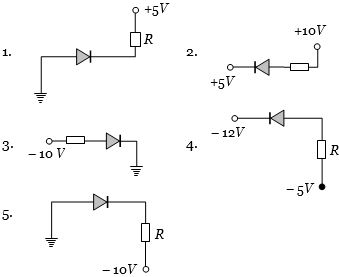
In the given figure, which of the diodes are forward biased ?.
In steel, the Young's modulus and the strain at the breaking point are $2 \times {10^{11}}\,N{m^{ - 2}}$ and $0.15$ respectively. The stress at the breaking point for steel is therefore
Power on $a$ mass is $P = (3t^2 -2t + 1)$ watt change in kinetic energy in $t = 2sec$ to $t = 4sec$ is :- .................... $\mathrm{J}$
A round uniform body of radius $R$, mass Mand moment of inertia $I$ rolls down (without slipping) an inclined plane making an angle $\theta$ with the horizontal. Then its acceleration is
If the error in the measurement of radius of a sphere is $2\%$ then the error in the determination of volume of the sphere will be ........ $\%$
A bomb of mass $12\,\,kg$  at rest explodes into two fragments of masses in the ratio $1 : 3.$  The $K.E.$  of the smaller fragment is $216\,\,J.$  The momentulm of heavier fragment is (in $kg-m/sec$ )
Imagine rolling a sheet of paper into a cylinder and placing a bar magnet near its end as shown in figure. What can you say about the sign of $\vec B.d\vec A$ for every area $d\vec A$ on the surface ?
A particle $(A)$ is dropped from a height and another particle $(B)$ is thrown in horizontal direction with speed of $5\; m/sec$ from the same height. The correct statement is
