Question
Which of the following relations are functions? If it is a function determine its domain and range.
(i) {(2, 1), (4, 2), (6, 3), (8, 4), (10, 5) (12, 6), (14, 7)}
(ii) {(0, 0), (1, 1), (1, -1), (4, 2), (4, -2), (9, 3), (9, -3), (16, 4), (16, -4)}
(iii) {(1, 1), (3, 1), (5, 2)}
Answer

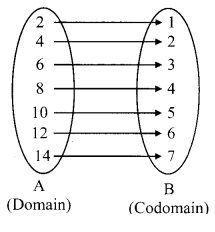
(i) {(2, 1), (4, 2), (6, 3), (8, 4), (10, 5) (12, 6), (14, 7)}

Image

Every element of set $\mathrm{A}$ has been assigned a unique element in set $\mathrm{B}$.
$\therefore$ Given relation is a function.
$
\begin{aligned}
& \text { Domain }=\{2,4,6,8,10,12,14\}, \\
& \text { Range }=\{1,2,3,4,5,6,7\}
\end{aligned}
$
(ii) $\{(0,0),(1,1),(1,-1),(4,2),(4,-2),(9,3),(9,-3),(16,4),(16,-4)\}$
$\therefore(1,1),(1,-1) \in$ the relation
$\therefore$ Given relation is not a function.
As element 1 of the domain has not been assigned a unique element of co-domain.
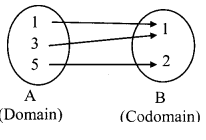
(iii) $\{(1,1),(3,1),(5,2)\}$Every element of set A has been assigned a unique element in set B.
∴ Given relation is a function.
Domain = {1, 3, 5}, Range = {1, 2}

Image

Need a full question paper?

Generate a complete, print-ready paper with questions like this in minutes — across 16+ boards, with answer keys.

Start Generating Free

Similar questions

The vertices of a triangle are A(3, 4), B(2, 0), and C(-1, 6). Find the equations of
(a) side BC
(b) the median AD
(c) the midpoints of sides AB and BC.
If $f(x)=3 x+5, g(x)=6 x-1$, then find
(i) $(f+g)(x)$
(ii) $(f-g)(2)$
(iii) $(\mathrm{fg})(3)$
(iv) $\left(\frac{\mathbf{f}}{\mathbf{g}}\right)(x)$ and its domain
Write the domain and range of the following relations.
(i) {(a, b) / a ∈ N, a < 6 and b = 4}
(ii) {(a, b) / a, b ∈ N, a + b = 12}
(iii) {(2, 4), (2, 5), (2, 6), (2, 7)}
If $\mathrm{f}(\mathrm{x})=\left\{\begin{array}{cl}4 x-2, & x \leq-3 \\ 5, & -3<x<3, \text { then fmd } \\ x^2, & x \geq 3\end{array}\right.$
(i) $\mathrm{f}(-4)$
(ii) $f(-3)$
(iii) $f(1)$
(iv) $f(5)$
Solve the following equations.
i) $\left|\begin{array}{lll}x & 2 & 2 \\ 2 & x & 2 \\ 2 & 2 & x\end{array}\right|=0$
ii) $\left|\begin{array}{ccc}1 & 4 & 20 \\ 1 & -2 & 5 \\ 1 & 2 x & 5 x^2\end{array}\right|=0$
Without expanding the determinants, show that:
i) $\left|\begin{array}{lll}b+c & b c & b^2 c^2 \\ c+a & c a & c^2 a^2 \\ a+b & a b & a^2 b^2\end{array}\right|=0$
ii)$\left|\begin{array}{ccc}x a & y b & z c \\ a^2 & b^2 & c^2 \\ 1 & 1 & 1\end{array}\right|$ =$\left|\begin{array}{ccc}x & y & z \\ a & b & c \\ b c & c a & a b\end{array}\right|$
iii) $\left|\begin{array}{lll}l & m & n \\ e & d & f \\ u & v & w\end{array}\right|=\left|\begin{array}{lll}n & f & w \\ l & e & u \\ m & d & v\end{array}\right|$
iv) $\left|\begin{array}{ccc}0 & a & b \\ -a & 0 & c \\ -b & -c & 0\end{array}\right|=0$
Out of 200 students, 35 students failed in MHT-CET, 40 in AIEEE and 40 in IIT entrance, 20 failed in MHT-CET and AIEEE, 17 in AIEEE and IIT entrance, 15 in MHT-CET and IIT entrance, and 5 failed in all three examinations. Find how many students
(i) did not fail in any examination.
(ii) failed in AIEEE or IIT entrance.
If $A=\{1,2,3\}, B=\{4,5,6\}$, which of the following are relations from $A$ to $B$.
(i) $R_1=\{(1,4),(1,5),(1,6)\}$
(ii) $R _2=\{(1,5),(2,4),(3,6)\}$
(iii) $R_3=\{(1,4),(1,5),(3,6),(2,6),(3,4)\}$
(iv) $R_4=\{(4,2),(2,6),(5,1),(2,4)\}$
If $A=\left\{x / 6 x^2+x-15=0\right\}, B=\left\{x / 2 x^2-5 x-3=0\right\}, C=\left\{x / 2 x^2-x-3=0\right\}$, then find (i) $(A \cup B \cup C)($ ii $)(A \cap B \cap C)$
If A and B are subsets of the universal set X and n(X) = 50, n(A) = 35, n(B) = 20, n(A’ ∩ B’) = 5, find
(i) n(A ∪ B)
(ii) n(A ∩ B)
(iii) n(A’ ∩ B)
(iv) n(A ∩ B’)