MCQ
Which of the following relations is true
  • A
    $3Y = K(1 - \sigma )$
  • B
    $K = \frac{{9\eta Y}}{{Y + \eta }}$
  • C
    $\sigma = (6K + \eta )Y$
  • $\sigma = \frac{{0.5Y - \eta }}{\eta }$

Answer

Correct option: D.
$\sigma = \frac{{0.5Y - \eta }}{\eta }$
d
(d)$Y = 2\eta (1 + \sigma ) \Rightarrow \sigma = \frac{{0.5Y - \eta }}{\eta }$

Need a full question paper?

Generate a complete, print-ready paper with questions like this in minutes — across 16+ boards, with answer keys.
Start Generating Free

Similar questions

The mass of a lift is $2000\, kg.$ When the tension in the supporting cable is $28000 \,N,$ then its acceleration is 
If the earth suddenly shrinks to $\frac{1}{64}$ th of its original volume with its mass remaining the same, the period of rotation of earth becomes $\frac{24}{ x } h$. The value of $x$ is $.......$
Velocity of sound waves in air is $330\; m/sec$. For a particular sound in air, a path difference of $40 \;cm$ is equivalent to a phase difference of $1.6 \pi$. The frequency of this wave is... $Hz$
If $\theta$ is angle between the velocity and acceleration of a particle moving on a circular path with decreasing speed, then .........
Newton-second is the unit of
The coefficient of static friction between a wooden block of mass $0.5\, kg$ and a vertical rough wall is $0.2$ The magnitude of horizontal force that should be applied on the block to keep it adhere to the wall will be $N$ $\left[ g =10\, ms ^{-2}\right]$
If the temperature of a wire of length $2 \,m$ and area of cross-section $1 \,cm ^2$ is increased from $0^{\circ} C$ to $80^{\circ} C$ and is not allowed to increase in length, then force required for it is ............$N$ $\left\{Y=10^{10} \,N / m ^2, \alpha=10^{\left.-6 /{ }^{\circ} C \right\}}\right.$
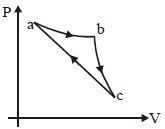
In the $P-V$ diagram shown, the gas does $5\, J$ of work in isothermal process $ab$ and $4\,J$ in adiabatic process $bc$.   .... $J$ will be the change in internal energy of the gas in straight path $c$ to $a$ ?
Viscosity of gas on increases of temperature:
A particle moves a distance $x$ in time $t$ according to equation $x = (t + 5)^{-1}$ The  acceleration of particle is proportional to