Question
Which of the following sequences are arithmetic progressions. For those which are arithmetic progressions, find out the common difference.
$3, 6, 12, 24, .....$

Answer

In the given problem, we are given various sequences.
We need to find out that the given sequences are an A.P. of not and then find its common difference (d).
$3, 6, 12, 24, .....$
Here,
First term $(a) = 3$
$ a_1=6 $
$ a_2=12$
Now, for the given to sequance to be an A.P, Common difference $(\mathrm{d})=\mathrm{a}_1-\mathrm{a}=\mathrm{a}_2-\mathrm{a}_1$
Here,
$ a_1-a=6-3$
$ =3$
Also,
$ a_2-a_1=12-6 $
$ =6$
Since $\text{a}_1-\text{a}\neq\text{a}_2-\text{a}_1$
Hence, the given sequence is not an A.P.

Need a full question paper?

Generate a complete, print-ready paper with questions like this in minutes — across 16+ boards, with answer keys.

Start Generating Free

Similar questions

Prove the following identities:

Prove that:

$\big(\sin\theta-2\sin^3\theta\big)=\big(2\cos^3\theta-\cos\theta\big)\tan\theta.$

Find the lenght of each side of a rhombus whose diagonals are $24\ cm$ and $10\ cm$. long.
Show that $a_1, a_2, ........, a_n$, form an $AP$ where $a_n= 9 - 5n.$
The distribution below gives the weights of $30$ students of a class. Find the median weight of the students.
Weight(in kg) Number of students
$40-45$ $2$
$45-50$ $3$
$50-55$ $8$
$55-60$ $6$
$60-65$ $6$
$65-70$ $3$
$70-75$ $2$
In the following, determine whether the given quadratic equation have real roots and if so, find the roots:
$\sqrt{3}\text{x}^2+10\text{x}-8\sqrt{3}=0$
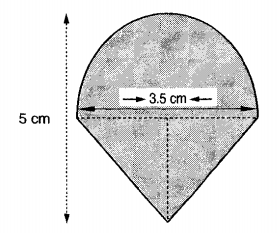
Rasheed got a playing top (lattu) as his birthday present, which surprisingly had no colour on it. He wanted to colour it with his crayons. The top is shaped like a cone surmounted by a hemisphere. The entire top is 5 cm in height and the diameter of the top is $3.5 \ cm$. Find the area he has to colour. (Take $\pi = \frac {22}7$).
Solve the following quadratic equation:
$\text{x}^2+2\sqrt{2}\text{x}-6=0$
Solve the following quadratic equation:
$ x^2-(2 b-1) x+\left(b^2-b-20\right)=0 $
The angles of elevation of the top of a tower from two points at distances of $4\ m$ and $9\ m$ from the base of the tower and in the same straight line with it are complementary. Show that the height of the tower is $6$ metres.
If $\sec2\text{A}=\text{cosec}(\text{A}-42^\circ),$ where $2A$ is an acute angle, then find the value of $A.$