Question 13 Marks
The general term of a sequence is give by $a_n= -4n + 15.$ Is the sequence an A.P.? If so, find its $15^{th}$ term and the common difference.
AnswerGeneral term of a sequence
$a_n=-4 n+15$
Let $n=1,2,3,4,5, \ldots$. , then
$ a_1=-4 \times 1+15=-4+15=11 $
$ a_2=-4 \times 2+15=-8+15=7$
$ a_3=-4 \times 3+15=-12+15=3 $
$ a_4=-4 \times 4+15=-16+15=-1 $
$ a_5=-4 \times 5+15=-20+15=-5$
We see that first term is 11 and common difference is -4
$ a_2-a_1=7-11=-4 $
$ a_3-a_2=3-7=-4 $
$ a_4-a_3=-1-3=-4 $
$ a_5-a_4=-5-(-1)=-5+1=-4$
$\therefore$ Yes, it is an A.P.
Now $15^{\text {th }}$ term $=\mathrm{a}_{15}=-4 \times 15+15$
$=-60+15=-45$
View full question & answer→Question 23 Marks
Find:
$9^{th}$ term of the A.P. $\frac{3}{4},\frac{5}{4},\frac{7}{4},\frac{9}{4}, .....$
AnswerGiven A.P. is
$\frac{3}{4},\frac{5}{4},\frac{7}{4},\frac{9}{4}, .....$
First term $(\text{a})=\frac{3}{4}$
Common difference $(d) =$ Second $-$ First term
$=\frac{5}{4}-\frac{3}{4}$
$=\frac{2}{4}$
$ n^{\text {th }} \text { term } a_n=a+(n-1) d $
$ 9^{\text {th }} \text { term } a_9=a+(9-1) d$
$=\frac{3}{4}+8.\frac{2}{4}$
$=\frac{3}{4}+\frac{16}{4}$
$=\frac{19}{4}$
View full question & answer→Question 33 Marks
Sum of $13$ terms of the $A.P. -6, 0, 6, 12, .....$
AnswerGiven,
$A.P.$ is $-6, 0, 6, 12, .....$
Here,
First term $a = -6$
Difference, $d = 0 - (-6) = 6$
We know, $\text{S}_\text{n}=\frac{\text{n}}{2}[2\text{a}+(\text{n}-1)\text{d}]$
$\Rightarrow\ \text{S}_{13}=\frac{13}{2}[2(-6)+(13-1)6]$
$\Rightarrow\ \text{S}_{13}=\frac{13}{2}[-12+12\times6]$
$\Rightarrow\ \text{S}_{13}=\frac{13}{2}\times60$
$\Rightarrow\ \text{S}_{13}=390$
Hence, Sum of $13$ terms is $390.$
View full question & answer→Question 43 Marks
Find the sum of the first $15$ terms of each of the following sequences having $n^{th}$ term as:
$b_n= 5 + 2n.$
AnswerGiven,
$b_n= 5 + 2n$
Put $n = 1, b_1= 5 + 2(1) = 7$
Put $n = 15, b_{15}= 5 + 2(15) = 35 = l$
Sum of $15$ terms $\text{S}_{15}=\frac{15}{2}(7+35)\ \Big(\therefore\text{S}_\text{n}=\frac{\text{n}}{2}(\text{a}+\text{l})\Big)$
$=\frac{15}{2}\times42$
$=315$
$\therefore\text{S}_{15}=315$
View full question & answer→Question 53 Marks
Find the sum of the first $15$ terms of each of the following sequences having $n^{th}$ term as:
$ y_n=9-5 n $.
Answer$ y_n=9-5 n \text { and number of terms }=15 $
$ y_1=9-5 \times 1=9-5=4 $
$ y_2=9-5 \times 2=9-10=-1 $
$ \therefore \text { First term (a) }=4 $
$ \text { Common dofference (d) }=y_2-y_1=-1-4=-5$
$\therefore\ \text{S}_\text{n}=\frac{\text{n}}{2}[2\text{a}+(\text{n}-1)\text{d}]$
$\text{S}_{15}=\frac{15}{2}[2\text{a}+(15 - 1)\text{d}]$
$=\frac{15}{2}[2\times4+(15 - 1)(-5)]$
$=\frac{15}{2}[8+14(-5)]=\frac{15}{2}[8-70]$
$=\frac{15}{2}(-62)=15\times(-31)=-465$
View full question & answer→Question 63 Marks
Find the indicated terms in the following sequences whose $n^{th}$ terms are:
$a_n=(-1)^n n ; a_3, a_5, a_8$
Answer$a_n=(-1)^n n \text {. }$
We need to find $a_3, a_5$ and $a_8$
Now, to find $a_3$ term we use $n=3$, we get,
$ a_3=(-1)^3 3 $
$ =(-1) 3$
$ =-3$
Also, to find $a_5$ term we use $n = 5,$ we get,
$ a_5=(-1)^5 5$
$ =(-1) 5$
$ =-5$
Similarly, to find $a_8$ term we use $n = 8,$ we get,
$a_8=(-1)^8 8$
$ =(1) 8 $
$ =8$
Thus, $a_3=-3, a_5=-5$ and $a_8=8$.
View full question & answer→Question 73 Marks
Find the common difference of the A.P. and write the next two terms:
$119, 136, 153, 170, .....$
Answer$119, 136, 153, 170, .....$
Here,
$ a_1=119 $
$a_2=136$
So, common difference of the A.P. $(d)=a_2-a_1$
$=136-119 $
$=17$
Also, we need to find the next two terms of A.P., which means we have to find the $5^{\text {th }}$ and $6^{\text {th }}$ terms.
So, for fifth term,
$ a_5=a_1+4 d $
$=119+4(17) $
$=119+68 $
$=187$
Similarly, we find the sixth term,
$ a_6=a_1+5 d $
$=119+5(17) $
$=119+85 $
$=204$
Therefore, the common difference is $d=17$ and the next two terms of the A.P. are $a_5=187, a_6=204$.
View full question & answer→Question 83 Marks
Write the first five terms of the following sequences whose $n^{th}$ terms are:
$\text{a}_\text{n}=\frac{\text{n}(\text{n}-2)}{2}$
Answer$\text{a}_\text{n}=\frac{\text{n}(\text{n}-2)}{2}$
Let $n = 1, 2, 3, 4, 5,$ then
$\text{a}_1=\frac{1(1-2)}{2}=\frac{1\times(-1)}{2}=\frac{-1}{2}$
$\text{a}_2=\frac{1(2-2)}{2}=\frac{2\times0}{2}=0$
$\text{a}_3=\frac{1(3-2)}{2}=\frac{3\times1}{2}=\frac{3}{2}$
$\text{a}_4=\frac{4(4-2)}{2}=\frac{4\times2}{2}=4$
$\text{a}_5=\frac{5(5-2)}{2}=\frac{5\times3}{2}=\frac{15}{2}$
View full question & answer→Question 93 Marks
The sum of four consecutive numbers in $A.P.$ is $32$ and the ratio of the product of the first and last terms to the product of two middle terms is $7 : 15.$ Find the number.
AnswerLet the four consecutive numbers in $A.P.$ be
$a - 3d, a - d, a + d, a + 3d$
So, $a - 3d + a - d + a + d + a + 3d = 32$
or $4a = 32$
or $a = 8$
Also, $\frac{(\text{a}-3\text{d})(\text{a}+3\text{d})}{(\text{a}-\text{d})(\text{a}+\text{d})}=\frac{7}{15}$
$\frac{\text{a}^2-9\text{d}^2}{\text{a}^2-\text{d}^2}=\frac{7}{15}$
$15\text{a}^2-135\text{d}^2=7\text{a}^2-7\text{d}^2$
$8\text{a}^2-128\text{d}^2=0$
$\text{d}^2=\frac{8\times8\times8}{128}=4$
$\text{d}=\pm2$
So, when $a = 8, d = 2$
The numbers are $2, 6, 10, 14.$
View full question & answer→Question 103 Marks
Two arithmetic progression have the same common difference. The difference between their $100^{th}$ terms is $100,$ What is the difference between their $1000^{th}$ terms$?$
AnswerLet the two $A.P.$ is be $a_1, a_2, a_3, \ldots$. and $b_1, b_2, b 3, \ldots$.
$a_n=a_1+(n-1) d \text { and } b_n=b_1+(n-1) d$
Since common difference of two equations is same given difference between $100^{\text {th }}$ terms is $100$
$ a_{100}-b_{100}=100 $
$ a_1+(99) d-b_1-99 d=100 $
$ a_1-b_1=100 \ldots . \text { (i) }$
Difference between. $1000$ th terms is
$ a_{1000}-b_{1000}=a_1+(1000-1) d-\left(b_1+(1000-1) d\right) $
$ =a_1+999 d-b_1-999 d $
$ =a_1-b_1 $
$ =100(\text { from }(1))$
$\therefore$ Hence difference between $1000^{\text {th }}$ terms of two $A.P.$ is $100 .$
View full question & answer→Question 113 Marks
In a certain A.P. the $24^{\text {th }}$ term is twice the $10^{\text {th }}$ term. Prove that the $72^{\text {nd }}$ term is twice the $34^{\text {th }}$ term.
AnswerGiven,
$24^{\text {th }}$ term is twice the $10^{\text {th }}$ term
$a_{24}=2 a_{10}$
Let, first term of a square $=a$
Common difference $=\mathrm{d}$
$\mathrm{n}^{\text {th }}$ term $\mathrm{a}_{\mathrm{n}}=\mathrm{a}+(\mathrm{n}-1) \mathrm{d}$
$a+(24-1) d=(a+(10-1) d) 2$
$a+23 d=2(a+9 d)$
$(23-18) d=a$
$a=5 d$
We have to prove
$72^{\text {nd }}$ term is twise the $34^{\text {th }}$ term
$ a_{72}=2 a_{34} $
$ a+(72-1) d=2[a+(34-1) d] $
$ a+71 d=2 a=66 d$
Substitute $a=5 d$
$ 5 d+71 d=2(5 d)+66 d$
$ 76 d=10 d+66 d $
$ 76 d=76 d$
Hence proved.
View full question & answer→Question 123 Marks
If the seventh term of an A.P. is $\frac{1}{9}$ and its ninth term is $\frac{1}{7}$, find its $(63)^{rd}$ term.
Answer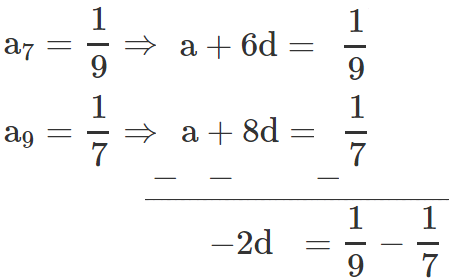
$-2\text{d}=\frac{7-9}{63}$
$-2\text{d}=\frac{-2}{63}\ \therefore\ \text{d}=\frac{1}{63}$
$\text{a}+6\Big(\frac{1}{63}\Big)=\frac{1}{9}$
$\text{a}=\frac{1}{9}-\frac{6}{63}=\frac{7-6}{63}=\frac{1}{63}$
$\text{a}_{63}=\text{a}+62\text{d}$
$=\frac{1}{63}+62\Big(\frac{1}{63}\Big)=\frac{1+ 62}{63}=\frac{63}{63}=1$ View full question & answer→Question 133 Marks
Find:
Is $-150$ a term of the A.P. $11, 8, 5, 2, .....?$
AnswerIn the given problem, we are given an $A.P.$ and the Value of one of its term.
We need to find whether it is a term of the $A.P.$ or not so here we will use the formula $a_n= a + (n - 1)d.$
Here,
$A.P.$ is $11, 8, 5, 2, .....$
$a_n= -150, a = 11$ and $d = 8 - 11 = -3$
Thus, using the above mentioned formula, we get
$- 150 = 11 + (n - 1)(-3)$
$⇒ -150 - 11 = -3n + 3$
$⇒ -161 = -3n + 3$
$⇒ -161 - 3 = -3n$
$⇒ -3n = -164$
$\Rightarrow\ \text{n}=\frac{164}{3}$
Since, the value of $n$ is a fraction. Thus, $-150$ is not the term of the given $A.P.$
View full question & answer→Question 143 Marks
Find the sum of the first $15$ terms of each of the following sequences having $n^{th}$ term as:
$x_n= 6 - n.$
AnswerHere, we are given an $A.P.$ whose $n^{th}$ term is given bt the following expression, $x_n= 6 - x,$ We need to find the sum of first $15$ terms.
So, here we can find the sum of the $n$ term of the given $A.P.$, using the formula,
$\text{S}_\text{n}=\Big(\frac{\text{n}}{2}\Big)(\text{a}+\text{l})$
Where, $a =$ the first term
$l =$ the last term
So, for the given $A.P,$
The firest term $(a)$ will be calculated using $n = 1$ in the given equation for $n^{th}$ term of A.p.
$x = 6 - 1$
$= 5$
Now, the last term (l) or the $n^{th}$ term is given
$l = a_{15}= 6 - 15$
So, on substituting the values in the formula for the sum of $n$ terms of an $A.P.,$ we get,
$\text{S}_{15}=\Big(\frac{15}{2}\Big)[(5)+6-15]$
$=\Big(\frac{15}{2}\Big)[11-15]$
$=\Big(\frac{15}{2}\Big)(-4)$
$=(15)(-2)$
$=-30$
Therefore, the sum of the $15$ terms of the given $A.P.$ is $S_{15}= -30.$
View full question & answer→Question 153 Marks
Find the number of natural numbers between $101$ and $999$ which are divisible by both $2$ and $5.$
AnswerSince, the number is divisible by both $2$ and $5,$ means it must be divisible by $10.$
In the given numbers, first number that is divisible by $10$ is $110.$
Next number is $110 + 10 = 120.$
The last number that is divisible by 10 is $990.$
Thus, the progression will be $110, 120, ....., 990.$
All the terms are divisible by $10,$ and thus forms an $A.P.$ having first term as $110$ and the common difference as $10.$
We know that, $n^{th}$ term $= a_n= a + (n - 1)d$
According to the question,
$990 = 110 + (n - 1)10$
$⇒ 990 = 110 + 10n - 10$
$⇒ 10n = 990 - 100$
$⇒ 10n = 890$
$⇒ n = 89$
Thus, the number of natural numbers $101$ and $999$ which are divisible by both $2$ and $5$ is $89.$
View full question & answer→Question 163 Marks
Find the sum of the following arithmetic progressions:
$(x-y)^2,\left(x^2+y^2\right),(x+y)^2, \ldots . .$, to $n$ terms.
AnswerIn an $A.P.$ let first term $= a$, common difference $= d,$ and there are $n$ terms. Then, sum of $n$ terms is,
$\text{S}_\text{n}=\frac{\text{n}}{2}\{2\text{a} + (\text{n} - 1)\text{d}\}$
$A.P.$ is $(x-y)^2,\left(x^2+y^2\right),(x+y)^2, \ldots . .$, to $n$ terms
Here,
$ a=(x-y)^2, d=x^2+y^2-(x-y)^2=x^2+y^2-x^2-y^2+2 x y $
$ \Rightarrow d=2 x y$
$\text{S}_\text{n}=\frac{\text{n}}{2}\{2\text{a} + (\text{n} - 1)\text{d}\}$
$=\frac{\text{n}}{2}[2(\text{x}-\text{y})^2+(\text{n}-1)(-2\text{xy})]$
$=\frac{\text{n}}{2}[2(\text{x}-\text{y})^2-2(\text{n}-1)\text{xy}]$
$=\frac{\text{n}}{2}\times2[(\text{x}-\text{y})^2-(\text{x}-1)\text{xy}]$
$=\text{n}[(\text{x}-\text{y})^2-(\text{x}-1)\text{xy}]$
View full question & answer→Question 173 Marks
Write the first five terms of the following sequences whose $n^{th}$ terms are:
$\text{a}_\text{n}=\frac{\text{n}-3}{3}$
Answer$\text{a}_\text{n}=\frac{\text{n}-3}{3}$
Here, the $n^{th}$ term is given by the above expression. So, to find the first term we use, $n = 1,$ we get,
$\text{a}_1=\frac{(1)-2}{3}$
$=\frac{-1}{3}$
Similarly, we find the other four terms,
Second term $(n = 2),$
$\text{a}_1=\frac{(2)-2}{3}$
$=\frac{0}{3}$
$=0$
Third term $(n = 3),$
$\text{a}_3=\frac{(3)-2}{3}$
$=\frac{1}{3}$
Fourh terms $(n = 4),$
$\text{a}_4=\frac{(4)-2}{3}$
$=\frac{2}{3}$
Fifth term $(n = 5),$
$\text{a}_5=\frac{(5)-2}{3}$
$=\frac{3}{3}$
$=1$
Therefore, the first five terms for the given sequence are $\text{a}_1=\frac{-1}{3},\ \text{a}_2=0,\ \text{a}_3=\frac{1}{3},\ \text{a}_4=\frac{2}{3},\ \text{a}_5=1.$
View full question & answer→Question 183 Marks
Which term of the A.P. $-2, -7, -12, …$ will be $-77?$ Find the sum of this $A.P.$ up to the term $-77.$
AnswerGiven,
A.P. $-2, -7, -12, .....$
Let the $n^{th}$ term of an $A.P.$ is $-77.$
Then, first term $(a) = -2$
Common difference $(d) = -7 - (-2) = -7 + 2 = -5$
$\because n^{th}$ term of an A.P., $T_n= a + (n - 1)d$
$⇒ -77 = -2 + (n - 1)(-5)$
$⇒ -75 = -(n - 1) × 5$
$⇒ (n - 1) = 15 ⇒ n = 16$
So, the $16^{th}$ term of the given $A.P. $ will be $-77$
Now, the sum of $n$ terms of an $A.P.$ is
$\text{S}_\text{n}=\frac{\text{n}}{2}[2\text{a}+(\text{n}-1)\text{d}]$
So, sum of $16$ terms i.e. upto the term $-77$
i.e., $\text{S}_{16}=\frac{16}{2}[2\times(-2)+(\text{n}-1)(-5)]$
$= 8[-4 + (16 - 1)(-5)] = 8(-4 - 75)$
$= 8 × -79 = -632$
Hence, the sum of this $A.P.$ upto the term $-77$ is $-632.$
View full question & answer→Question 193 Marks
If the sum of first p term of an A.P. is $ap^2+ bp,$ find its common difference.
AnswerGiven,
Sum of $p$ terms, $S_p=a p^2+b p$
Putting $\mathrm{p}=1,2,3,4, \ldots .$.
$ S_1=a(1)^2+b(1)=a \times 1+b=a+b $
$ S_2=a(2)^2+b(2)=a \times 4+2 b=4 a+2 b $
$ S_3=a(3)^3+b(3)=a \times 9+3 b=9 a+3 b$
And $S_4=a(4)^2+b(4)=a \times 16+4 b=16 a+4 b$
We know $\mathrm{a}_{\mathrm{n}}=\mathrm{S}_{\mathrm{n}}-\mathrm{S}_{\mathrm{n}-1}$
$2^{\text {nd }}$ term, $\mathrm{a}_2=\mathrm{S}_2-\mathrm{S}_1$
$\Rightarrow a_2=4 a+2 b-(a+b)$
$\Rightarrow a_2=4 a+2 b-a-b$
$\Rightarrow \mathrm{a}_2=3 \mathrm{a}+\mathrm{b}$
$3^{\text {rd }}$ term, $a_3=\mathrm{S}_3-\mathrm{S}_2$
$\Rightarrow a_3=9 a+3 b-(4 a-2 b)$
$\Rightarrow \mathrm{a}_3=9 \mathrm{a}+3 \mathrm{~b}-(4 \mathrm{a}+2 \mathrm{~b})$
$\Rightarrow a_3=5 a+b$
$4^{\text {th }}$ term, $a_4=\mathrm{S}_4-\mathrm{S}_3$
$ \Rightarrow a_4=16 a+4 b-(9 a+3 b) $
$ \Rightarrow a_4=16 a+4 b-9 a-3 b $
$ \Rightarrow a_4=7 a+b$
Now difference between two terms,
$ d_1=a_3-a_2=5 a+b-(3 a+b) $
$ =5 a+b-3 a-b $
$ \Rightarrow d_1=2 a $
$ d_2=a_4-a_3=7 a+b-(5 a+b) $
$ =7 a+b-5 a-b $
$ \Rightarrow d_2=2 a$
Hence, common difference is 2a.
View full question & answer→Question 203 Marks
How many numbers lie between $10$ and $300,$ which when divided by $4$ leave a remainder $3?$
AnswerHere, the first number is $11,$ which divided by $4$ leave remainder $3$ between $10$ and $300.$
Last term before $300$ is $299$, which divided by $4$ leave remainder $3.$
$11, 15, 19, 23, ...., 299.$
Here, first term $(a) = 11,$
Common differnce $(d) = 15 - 11 = 4$
$n^{th}$ term, $a_n= a + (n - 1)d = l[$last term$]$
$⇒ 299 = 11 + (n - 1)4$
$⇒ 299 - 11 = (n - 1)4$
$⇒ 4(n - 1) = 288$
$⇒ (n - 1) = 72$
$n = 73.$
View full question & answer→Question 213 Marks
Find:
$n^{th}$ term of the A.P. $13, 8, 3, -2, ....$
AnswerGiven A.P., $13, 8, 3, -2, .....$
Here,
First term, $a = 13$
Difference, $d = (8 - 13) = -5$
We have to find $n^{th}$ term,
So putting $n = n$
We know, $n^{th}$ term of A.P.
$ a_n=a+(n-1) d$
$ \Rightarrow a_n=13+(n-1)(-5) $
$ \Rightarrow a_n=13+(-5 n+5) $
$ \Rightarrow a_n=13-5 n+5 $
$ \Rightarrow a_n=18-5 n$
Hence, $n^{th}$ term of given A.P. is $18 - 5n.$
View full question & answer→Question 223 Marks
Which of the following sequences are arithmetic progressions. For those which are arithmetic progressions, find out the common difference.
$1^2, 3^2, 5^2, 7^2, \ldots \ldots$
AnswerIn the given problem, we are given various sequences.
We need to find out that the given sequences are an A.P. of not and then find its common difference $(d),$
Given,
$1^2, 3^2, 5^2, 7^2, \ldots \ldots$
Here, $a_1=1^2, a_2=3^2, a_3=5^2, a_4=7^2$
Difference between terms,
$ d_1=a_2-a_1=3^2-1^2=9-1=8 $
$ d_2=a_3-a_2=5^2-3^2=25-9=16,$
$ \text { and } d_3=a_4-a_3=7^2-5^2=49-25=24$
Hence, difference $d_1, d_2$ and $d_3$ are not equal, trem sequence not in an $A.P.$
View full question & answer→Question 233 Marks
Show that the sequence defined by $a_n=3 n^2-5$ is not an $A.P.$
AnswerGiven sequence is,
$a_n=3 n^2-5 .$
$\mathrm{n}^{\text {th }}$ term of given sequence $\left(a_n\right)=3 n^2-5$.
$(n+1)^{\text {th }}$ term of given sequence $\left(a_n+1\right)=3(n+1)^2-5$
$ =3\left(n^2+1^2+2 n \cdot 1\right)-5 $
$ =3 n^2+6 n-2$
$\therefore$ The common difference $(\mathrm{d})=\mathrm{a}_{\mathrm{n}}+1 - an$
$d=\left(3 n^2+6 n-2\right)-\left(3 n^2-5\right) $
$ =3 a^2+6 n-2-3 n^2+5 $
$ =6 n+3$
Common difference $(d)$ depends on $'n'$ value
$\therefore$ Given sequence is not in $A.P.$
View full question & answer→Question 243 Marks
The $9^{th}$ term of an $A.P.$ is equal to $6$ times its second term. If its $5^{th}$ term is $22,$ find the $A.P.?$
AnswerLet $a$ be the first term and be the common difference and
$ T_n=a+(n-1) d $
$ \therefore T_9=a+(9-1) d=a+8 d $
$ T_2=a+(2-1) d=a+d$
$\text { According to question }$
$ T_9=6 T_2 $
$ a+8 d=6(a+d) $
$ a+8 d=6 a+6 d $
$ \Rightarrow 8 d-6 d=6 a-a \Rightarrow 5 a=2 d$
$\Rightarrow\ \text{a}=\frac{2}{5}\text{d}\ .....(\text{i})$
and $\text{T}_5=\text{a}+(5-1)\text{d}=\text{a}+4\text{d}$
$\therefore\ \text{a}+4\text{d}=22$
$\Rightarrow\ \frac{2}{5}\text{d}+4\text{d}=22\ [\text{From (i)}]$
$\Rightarrow\ 2\text{d}+20\text{d}=22\times5\Rightarrow\ 22\text{d}=22\times5$
$\Rightarrow\ \text{d}=\frac{22\times5}{22}=5$
$\therefore\ \text{a}=\frac{2}{5}\text{d}=\frac{2}{5}\times5=2$
$\therefore\ \text{A.P.}=2,7,12,17, .....$
View full question & answer→Question 253 Marks
Find the common difference and write the next four terms of the following arithmetic progressions:
$1, -2, -5, -8, .....$
AnswerHere, $a_1=1, a_2=-2, a_3=-5, a_4=-8, \ldots .$.
Now $a_2-a_1=-2-1=-3$
$a_3-a_2=-5-(-2)=-5+2=-3$
$ a_4-a_3=-8-(-5)=-8+5=-3$
$\therefore$ It is an A.P. whose common difference is $= -3$
Now next four terms will be
$-8 - 3 = -11$
$-11 - 3 = -14$
$-14 - 3 = -17$
$-17 - 3 = -20$
$\therefore -11, -14, -17, -20$ are four term next to these.
View full question & answer→Question 263 Marks
The sum of the first $n$ terms of an $A.P.$ is $3 n^2+6 n$. Find the $n^{th}$ term of this $A.P.$
AnswerSum of $n$ terms $\left(S_n\right)=3 n^2+6 n$
Let $T_n$ of $a_n$ be the $n^{\text {th }}$ term, then
$ a_n=s_n-S_{n-1} $
$ =\left(3 n^2+6 n\right)-\left\{3(n-1)^2+6(n-1)\right\} $
$ =\left(3 n^2+6 n\right)-\left\{3\left(n^2-2 n+1+6 n-6\right)\right\} $
$ =\left(3 n^2+6 n\right)-\left(3 n^2-6 n+3+6 n-6\right) $
$ =3 n^2+6 n-3 n^2+6 n-3-6 n+6 $
$ =6 n+3$
View full question & answer→Question 273 Marks
Justify whether it is true to say that the sequence, having following $n^{th}$ term is an A.P.
$a_n= 2n - 1.$
AnswerYes, here $a_n=2 n-1$
Put $n=1, a_1=2(1)-1=1$
Put $n=2, a_2=2(2)-1=3$
Put $n=3, a_3=2(3)-1=5$
Put $n=4, a_4=2(8)-1=7$
List of numbers becomes $1,3,5,7, \ldots .$.
Here,
$ a_2-a_1=3-1=2 $
$ a_3-a_2=5-3=2 $
$ a_4-a_3=7-5=2 $
$ a_2-a_1=a_3-a_2=a_4-a_3=\ldots \ldots . .$
Hence, $2 n-1$ is the $\mathrm{n}^{\text {th }}$ term of A.P.
View full question & answer→Question 283 Marks
An $A.P.$ consists of $60$ terms. If the first and the last terms be $7$ and $125$ respectively, find the $ 32^{n d}$ term.
AnswerGiven
$ \text { No of terms }=n=60$
$ \text { First term }(a)=7$
$ \text { Last term } a_{60}=125$
$ a_{60}=a+(60-1) \times d\left(\therefore a_n=a+(n-1) d\right)$
$ 125=7+59 \times d$
$ 118=59 d$
$ d=\frac{118}{59}=2$
$ 32^{n d} \text { term } a_{32}=a+(32-1) d$
$ =7+31 \times 2$
$ =7+62$
$ =69$
View full question & answer→Question 293 Marks
The sum of first n terms of an $A.P.$ is $5n - n^2$. Find the $n^{th}$ term of this $A.P.$
AnswerLet $a$ be the first term and $d$ be the common difference.
We know that, sum of first $n$ terms $=\text{S}_\text{n}=\frac{\text{n}}{2}[2\text{a}+(\text{n}-1)\text{d}]$
It is given that sum of the first n terms of an $A.P.$ is $5n - n^2$.
$ \therefore \text { First term }=\mathrm{a}=\mathrm{S}_1=5(1)-(1)^2=4 . $
$ \text { Sum of first two terms }=\mathrm{S}_2=5(2)-(2)_2=6 . $
$ \therefore \text { Second term }=S_2-S_1=6-4=2 . $
$ \therefore \text { Common difference }=\mathrm{d}=\text { Second term - First term } $
$ =2-4=-2$
Also, $n^{\text {th }}$ term $=a_n=a+(n-1) d$
$\Rightarrow a_n=a+(n-1)(-2) $
$ \Rightarrow a_n=4-2 n+2 $
$ \Rightarrow a_n=6-2 n$
Thus, $\mathrm{n}^{\text {th }}$ term of this $A.P.$ is $6-2 \mathrm{n}$.
View full question & answer→Question 303 Marks
Solve the question: $(-4) + (-1) + 2 + 5 + ..... + x = 437.$
AnswerSuppose $x$ is $n^{th}$ term of the given $A.P.$
$a_n= x$
Here, $a = -4, d = 3.$
It is given that, $S_n= 437.$
$\Rightarrow\ \frac{\text{n}}{2}[2(-4)+(\text{n}-1)3]=437$
$\Rightarrow\ 3\text{n}^2-11\text{n}-874=0$
$\Rightarrow\ 3\text{n}^2-57\text{n}+46\text{n}-874=0$
$\Rightarrow\ 3\text{n}(\text{n}-19)+46(\text{n}-19)=0$
$\Rightarrow\ \text{n}=-\frac{46}{3}, 19$
Since, $n$ cannot be in fraction so $n = 19.$
Now $a_n= x$
$⇒ (-4) + (19 - 1)3 = x$
$⇒ -4 + 54 = x$
$⇒ x = 50.$
View full question & answer→Question 313 Marks
Divide $56$ in four parts in $A.P.$ such that the ratio of the product of their extremes to the product of their means is $5 : 6.$
AnswerLet the four terms of the $A.P.$ be $a - 3d, a - d, a + d$ and $a + 3d.$
Given:
$(a - 3d) + (a - d) + (a + d) + (a + 3d) = 56$
$⇒ 4a = 56$
$⇒ a = 14$
Also,
$\frac{(\text{a}-3\text{d})(\text{a}+3\text{d})}{(\text{a}-\text{d})(\text{a}+\text{d})}=\frac{5}{6}$
$\Rightarrow\ \frac{\text{a}^2-9\text{d}^2}{\text{a}^2-\text{d}^2}=\frac{5}{6}$
$\Rightarrow\ \frac{(14)^2-9\text{d}^2}{(14)^2-\text{d}^2}=\frac{5}{6}$
$\Rightarrow\ \frac{196-9\text{d}^2}{196-\text{d}^2}=\frac{5}{6}$
$\Rightarrow\ 1176 - 54\text{d}^2=980-5\text{d}^2$
$\Rightarrow\ 196=49\text{d}^2$
$\Rightarrow\ \text{d}^2=4$
$\Rightarrow\ \text{d}=\pm2$
When $d = 2,$ the terms of the $AP$ are $8, 12, 16, 20$. When $d = -2,$ the terms of the $AP$ are $20, 18, 12, 8.$
View full question & answer→Question 323 Marks
Which of the following sequences are arithmetic progressions. For those which are arithmetic progressions, find out the common difference.
$1^2, 5^2, 7^2, 73, .....$
AnswerIn the given problem, we are given various sequences.
We need to find out that the given sequences are an $A.P.$ of not and then find its common difference $(d),$
Here,
First term $(a)=1^2$
$ a_1=5^2 $
$ a_2=7^2$
Now, for the given to sequence to be an $A.P.$
Common difference $(\mathrm{d})=\mathrm{a}_1-\mathrm{a}=\mathrm{a}_2-\mathrm{a}_1$
Here,
$ a_2-a_1=5^2-1^2 $
$ =25-1$
$ =24$
Also,
$a_3-a_2=7^2-5^2=49-25=24$
Since $a_1- a = a_2 - a_1$
Hence, the given sequence is an $A.P.$ with the common difference $d = 24.$
View full question & answer→Question 333 Marks
How many numbers of two digit are divisible by $3?$
AnswerTwo digit numbers divisible by $3$
are, $12, 15, 18, ....., 99$
Hence, First term $a = 12$
Difference $d = 15 - 12 = 3$
and Last term $\mathrm{a}_{\mathrm{n}}=99$
We know $n^{\text {th }}$ term of an $A.P.$
$ a_n=a+(n-1) d $
$ \Rightarrow 99=12+(n-1) 3 $
$ \Rightarrow 99=12+3 n-3 $
$ \Rightarrow 99=9+3 n $
$ \Rightarrow 90=3 n $
$ \Rightarrow n=30$
Hence, Total number of two digit which one divisible by $3$ is $30.$
View full question & answer→Question 343 Marks
All integers from $1$ to $500$ which are multiplies $2$ as well as of $5.$
AnswerSince, multiples of $2$ as well as of $5 = LCM$
of $(2, 5) = 10$
Multiples of $2$ as wekk as of $5$ from $1$ to $500$ is $10, 20, 30, ....., 500$
$ \therefore a=10, d=10, a_n=1=500 $
$ \because a_n=a+(n-1) d=1 $
$ \Rightarrow 500=10+(n-1) 10 $
$ \Rightarrow 490=(n-1) 10 $
$ \Rightarrow n-1=49 \Rightarrow n=50$
$\therefore\ \text{S}_\text{n}=\frac{\text{n}}{2}(\text{a}+\text{l})$
$\Rightarrow\ \text{S}_{50}=\frac{50}{2}(10 + 500)=\frac{50}{2}\times510$
$=50\times255=12750$
View full question & answer→Question 353 Marks
If $9^{\text {th }}$ term of an A.P is zero, prove that its $29^{\text {th }}$ term is double the $19^{\text {th }}$ term.
AnswerGiven
$9^{\text {th }}$ term of an A.P. $a_9=0 a_n=a+(n-1) d$
$a + (9 - 1)d = 0$
$a + 8d = 0$
$a = -8d$
We have to prove
$29^{\text {th }}$ term is double the $19^{\text {th }}$ term $a_{29}=2 \cdot a_{19}$
$a + 28d = 2[a + 18a]$
Put $a = -8d$
$-8d + 28d = 2[-8d + 18d]$
$20d = 2 × 10d$
$20d = 20d$
Hence proved.
View full question & answer→Question 363 Marks
In an $A.P.,$ the first term is $2,$ the last term is $29$ and the sum of the terms is $155.$ Find the common difference of the $A.P$.
AnswerIn the given problem, we have the first and the last term of an $A.P.$ along with the sum of all the terms of $A.P.$ Here, we need to find the common difference of the $A.P.$
Here,
The first term of the $A.P (a) = 2$
The last term of the $A.P (l) = 29$
Sum of all the terms $(S_n) = 155$
Let the common difference of the $A.P.$ be $d.$
So, let us first find the number of the terms $(n)$ using the formula,
$155=\Big(\frac{\text{n}}{2}\Big)(2+29)$
$155=\Big(\frac{\text{n}}{2}\Big)(31)$
$155(2)=\text{(n)}(31)$
$\text{n}=\frac{310}{31}$
$\text{n}=10$
Now, to find the common difference of the $A.P.$ we use the following formula,
$l = a + (n - 1)d$
We get
$29 = 2 + (10 - 1)d$
$29 = 2 + (9)d$
$29 - 2 = 9d$
$\text{d}=\frac{27}{9}$
$d = 3$
Therefore, the common difference of the $A.P.$ is $d = 3.$
View full question & answer→Question 373 Marks
Find the indicated terms in the following sequences whose $\mathrm{n}^{\text {th }}$ terms are:
$a_n=(n-1)(2-n)(3+n) ; a_1, a_2, a_3 .$
Answer$a_n=(n-1)(2-n)(3+n)$
We need to find $a_1, a_2$ and $a_3$
Now, to find $\mathrm{a}_1$ term we use $\mathrm{n}=1$, we get,
$ a_1=(1-1)(2-1)(3+1) $
$=(0)(1)(4) $
$=0$
Also, to find $a_2$ term we use $n=2$, we get
$ a_2=(2-1)(2-2)(3-2) $
$=(1)(0)(5) $
$=0$
Similarly, to find $a_3$ term we use $n=3$, we get,
$ a_3=(3-1)(2-3)(3+3) $
$=(2)(-1)(6) $
$=-12$
Thus, $a_1=0, a_2=0$ and $a_3=-12$.
View full question & answer→Question 383 Marks
How many terms are there in the $A.P.?$
$7, 13, 19, ....., 205.$
AnswerGiven,
A.P. $7, 13, 19, ....., 205$
Here,
First term, $a = 7,$
Difference $d = 13 - 7 = 6$
Last $\mathrm{n}^{\text {th }}$ term $\mathrm{a}_{\mathrm{n}}=205$
We know, $\mathrm{n}^{\text {th }}$ term of $A.P.$
$a_n=a+(n-1) d$
$⇒ 205 = 7 + (n - 1)6$
$⇒ 205 = 7 + 6n - 6$
$⇒ 205 = 1 + 6n$
$⇒ 6n = 204$
$\Rightarrow\ \text{n}=\frac{204}{6}$
$⇒ n = 34$
Hence, Total $34$ terms in given $A.P.$
View full question & answer→Question 393 Marks
For the following arithmetic progressions write the first term a and the common difference $d:
-5, -1, 3, 7, ....$
AnswerA.P. is, $-5, -1, 3, 7, .......$
Here,
First term$ a = -5$
Common difference,
$ a_1-a=-1-(-5)=4 $
$ a_2-a_1=3-(-1)=4 $
$d = 4$
Therefore $a = -5$ and $d = 4.$
View full question & answer→Question 403 Marks
Write the sum of first n odd natural numbers.
AnswerLet,
Odd numbers are $1, 3, 5, 7, ....., n$
Here,
First term $a = 1$
Difference $d = 3 - 1 = 2$
We know, Sum of n terms
$\text{S}_\text{n}=\frac{\text{n}}{2}[2\text{a}+(\text{n}-1)\text{d}]$
$\Rightarrow\ \text{S}_\text{n}=\frac{\text{n}}{2}[2(1)+(\text{n}-1)2]$
$\Rightarrow\ \text{S}_\text{n}=\frac{\text{n}}{2}[2+2\text{n}-2]$
$\Rightarrow\ \text{S}_\text{n}=\frac{\text{n}}{2}\times2\text{n}$
$\Rightarrow\ \text{S}_\text{n}=\text{n}^2$
Hence, Sum of first n odd numbers is $n^2$.
View full question & answer→Question 413 Marks
Justify whether it is true to say that the sequence, having following $n^{th}$ term is an A.P.
$a_n=3 n^2+5$.
AnswerNo, here $a_n=3 n^2+5$
Put $\mathrm{n}=1, \mathrm{a}_1=3(1)^2+5=8$
Put $n=2, a_2=3(2)^2+5=3(4)+5=17$
Put $n=3, a_3=3(3)^2+5=3(9)+5=27+5=32$
So, the list of number becomes $8,17,32, \ldots$.
Here,
$a_2-a_1=17-8=9 $
$ a_3-a_2=32-17=15$
$\therefore\ \text{a}_2-\text{a}_1\neq\text{a}_3-\text{a}_2$
Since, the successive difference of the list is not same. So, it does not from an A.P.
View full question & answer→Question 423 Marks
How many three digit numbers are divisible by $7?$
AnswerThe three digit numbers are $100, ..... 999, 105$ is the first $3$ digit number which is divisible by $7$ when we divide $999$ with $7$ remainder is $5.$
So, $999 - 5 = 994$ is the last three digits divisible by $7$ so, the sequence is
$105, ....., 994$
First term $(a) = 105$
Last term $(1) = 994$
Common difference $(d) = 7$
Let there are n numbers in the sequence
$an = 994$
$a + (n - 1)d = 994$
$a + (n - 1)d = 994$
$105 + (n - 1)7 = 994$
$(n - 1)7 = 889$
$\text{n}-1=\frac{889}{7}=127$
$n = 128$
$\therefore$ There are $128$ numbers between $105, 994$ which are divisible by $7.$
View full question & answer→Question 433 Marks
Let there be an A.P. with first term 'a', common difference ' $d$ '. If $a_n$ denotes in $n^{\text {th }}$ term and $S_n$ the sum of first $n$ terms, find.
$\mathrm{S}_{22}$, if $\mathrm{d}=22$ and $\mathrm{a}_{22}=149$
AnswerGiven $d = 22, a_{22}= 149, n = 22$
We know that
$a_n= a + (n - 1)d$
$149 = a + (22 - 1)22$
$149 = a + 462$
$a = -313$
Now, Sum is given by
$\text{S}_\text{n}=\frac{\text{n}}{2}[2\text{a}(\text{n}-1)\text{d}]$
Where; $a =$ first term for the given A.P.
$d =$ common difference of the given A.P.
$n =$ number of terms
So, using the formula for $n = 22,$ we get
$\text{S}_{22}=\frac{22}{2}\{2\times(-313)+(22-1)\times22)\}$
$\text{S}_{22}=11\{-626+462\}$
$\text{S}_{22}=-1804$
Hence, the sum of $22$ terms is $-1804.$
View full question & answer→Question 443 Marks
Find the next five terms of the following sequences given:
$\text{a}_1=1,\text{a}_\text{n}=\text{a}_{\text{n}-1}+2,\text{n}\geq2.$
Answer$ a_1=1, a_n-a_{n-1}+2$
$ \text { Let } n=2,3,4,5,6$
$ \therefore a_2=a_{2-1}+2=a_1+2$
$ =1+2=3\left(\because a_1=1\right)$
$ a_3=a_{3-1}+2=a_2+2$
$ =3+2=5$
$ a_4=a_{4-1}+2=a_3+2$
$ =5+2=7$
$ a_5=a_{5-1}+2=a_4+2$
$ =7+2=9$
$ a_6=a_{6-1}+2=a_5+2$
$ =9+2=11$
View full question & answer→Question 453 Marks
Find the common difference and write the next four terms of the following arithmetic progressions:
$0, -3, -6, -9, .....$
AnswerHere, first term $\left(a_1\right)=0$
Common difference $(d)=a_2-a_1$
$ =-3-0 $
$ =-3$
Now, we need to find the next four terms of the given A.P.
That is we need to find $a_5, a_6, a_7, a_8$
So, using the formula $a_n=a+(n-1) d$
Substituting $\mathrm{n}=5,6,7,8$ in the above formula
Substituting $\mathrm{n}=5$, we get
$a_5=0+(5-1)(-3) $
$ a_5=0-12 $
$ a_5=-12$
Substituting $n=6$, we get
$ a_6=0+(6-1)(-3) $
$ a_6=0-15 $
$ a_6=-15$
Substituting $\mathrm{n}=7$, we get
$ a_7=0+(7-1)(-3) $
$ a_7=0-18 $
$ a_7=-18$
Substituting $n=8$, we get
$a_8=0+(8-1)(-3) $
$ a_8=0-21 $
$ a_8=-21$
Therefore, the common difference is $d = -3$ and the next four terms are $-12, -15, -18, -21.$
View full question & answer→Question 463 Marks
Find the sum of first $51$ terms of an $A.P.$ whose second and third terms are $14$ and $18$ respectively.
AnswerGiven,
$a_2= 14 ⇒ a + d = 14 .....(i)$
$a_3= 18 ⇒ a + 2d = 18 .....(ii)$
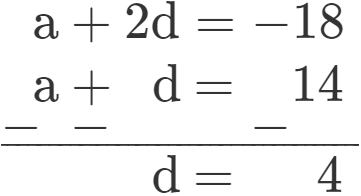
Put $d = 4$ is $(i) a + 4 = 14$
$a = 10$
$\therefore\ \text{S}_{51}=\frac{51}{2}\{2\times10+(51-1)\times4\}$
$\Big(\text{S}_\text{n}=\frac{\text{n}}{2}\{2\text{a}+(\text{n}-1)\text{d}\}\Big)$
$=\frac{51}{2}\{20+200\}$
$=\frac{51}{2}\times220$
$=5610$
$\therefore\ \text{S}_{51}=5610$ View full question & answer→Question 473 Marks
The sum of the first n terms of an A.P. is $4 n^2+2 n$. Find the $n^{th}$ term of this A.P.
Answer$S_n=4 n^2+2 n$
$\therefore a_n=S_n-S_{n-1}$
$=\left(4 n^2+2 n\right)-\left[4(n-1)^2+2(n-1)\right]$
$=\left(4 n^2+2 n\right)-\left[4\left(n^2-2 n+1\right)+2 n-2\right]$
$=\left(4 n^2+2 n\right)-\left[4 n^2-8 n+4+2 n-2\right]$
$=4 n^2+2 n-4 n^2+8 n-4-2 n+2$
$=8 n-2=2(4 n-1)$
View full question & answer→Question 483 Marks
Ramkali would need $Rs. 1800$ for admission fee and books etc., for her daughter to start going to school from next year. She saved $Rs. 50$ in the first month of this year and increased her monthly saving by $Rs. 20.$ After a year, how much money will she save$?$ Will she be able to fulfil her dream of sending her daughter to school$?$
AnswerAdmission fee and books etc. $= Rs. 1800$
First month's savings $= Rs. 50$
Increase in monthly savings $= Rs. 20$
Period $= 1$ year $= 12$ months
Here $a = 50, d = 20$ and $n = 12$
$\text{S}_{12}=\frac{\text{n}}{2}[2\text{a}+(\text{n}-1)\text{d}]$
$=\frac{12}{2}[2\times50+(12-1)\times20]$
$= 6[100 + 11 × 20]$
$= 6[100 + 220]$
$= 6 × 320 = Rs. 1920$
Savings $= Rs. 1920$
Yes, she will be able to send her daughter.
View full question & answer→Question 493 Marks
If $\frac{4}{5}, a, 2$ are three consecutive terms of an $A.P.?$
AnswerHere, we are given three consecutive terms of an $A.P.$
First term $(a_1) = \frac{4}{5}$
Second term $(a_2) = a$
Third term $(a_3) = 2$
We need to find the value of a. So, in an $A.P.$ the difference of two adjacent terms is always constant. So, we get,
$d = a_2- a_1$
$\text{d}=\text{a}-\frac{4}{5}\ ....\text{(i)}$
Also,
$d = a_3- a_2$
$d = 2 - a$
Now, on equating $(i)$ and $(ii),$ we get,
$\text{a}-\frac{4}{5}=2-\text{a}$
$\text{a}+\text{a}=2+\frac{4}{5}$
$2\text{a}=\frac{10+4}{5}$
$\text{a}=\frac{14}{10}$
$\text{a}=\frac{7}{5}$
Therefore, $\text{a}=\frac{7}{5}$.
View full question & answer→Question 503 Marks
Find the common difference of the $A.P.$ and write the next two terms:
$51, 59, 67, 75, .....$
Answer$51, 59, 67, 75, .....$
Here,
$a_1= 51$
$a_2= 59$
So, common difference of the $A.P. (d) = a_2- a_1$
$= 59 - 51$
$= 8$
Also, we need to find the next two terms of $A.P.,$ which means we have to find the $5^{th}$ and $6^{th}$ term.
So, for fifth term,
$a_5= a_1+ 4d$
$= 51 + 4(8)$
$= 51 + 32$
$= 83$
Similarly, we find the sixth term,
$a_6= a_1+ 5d$
$= 51 + 5(8)$
$= 51 + 40$
$= 91$
Therefore, the common difference is $d = 8$ and the next two terms of the $A.P.$ are $a_5 = 83, a_6= 91.$
View full question & answer→