Question
Which of the following sets cannot enter into the list of fundamental quantities in any system of units?
  1. Length, mass and velocity.
  2. Length, time and velocity.
  3. Mass, time and velocity.
  4. Length, time and mass.

Answer

  1. Length, time and velocity.
Explanation:

We define length and time separately as it is not possible to define velocity without using these quantities. This means that one fundamental quantity depends on the other. So, these quantities cannot be listed as fundamental quantities in any system of units.

Need a full question paper?

Generate a complete, print-ready paper with questions like this in minutes — across 16+ boards, with answer keys.

Start Generating Free

Similar questions

A player hits a baseball at some angle. The ball goes high up in space. The player runs and catches the ball before it hits the ground. Which of the two (the player or the ball) has greater displacement?
Consider a gravity-free hall in which an experimenter of mass $50kg$ is resting on a $5kg$ pillow, 8ft above the floor of the hall. He pushes the pillow down so that it starts falling at a speed of $8ft/s$. The pillow makes a perfectly elastic collision with the floor, rebounds and reaches the experimenter's head. Find the time elapsed in the process.
The electron beam in a colour TV is accelerated through 32kV and then strikes the screen. What is the wavelength of the most energetic X-ray photon?
A collision experiment is done on a horizontal table kept in an elevator. Do you expect a change in the results if the elevator is accelerated up or down because of the noninertial character of the frame?
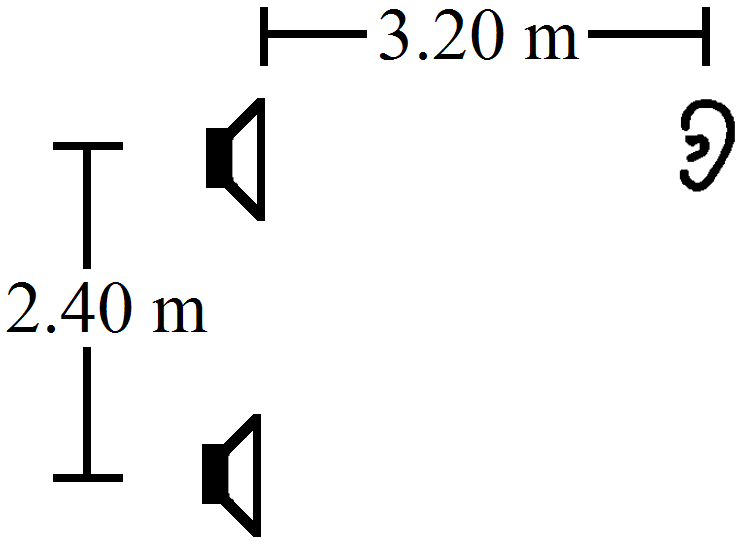
Two stereo speakers are separated by a distance of 2.40m. A person stands at a distance of 3.20m directly in front of one of the speakers as shown in figure, Find the frequencies in the audible range (20-2000Hz) for which the listener will hear a minimum sound intensity. Speed of sound in air = 320m/s.
A plate current of 10mA is obtained when 60 volts are applied across a diode tube. Assuming the Langmuir-Child equation $\text{i}_\text{p}\propto\text{V}_\text{p}^{\frac{3}{2}}$ to hold, find the dynamic resistance $\text{r}_\text{p}$ in this operating condition.
Read the passage given below and answer the following questions from $1$ to $5$. Surface Tension The property due to which the free surface of liquid tends to have minimum surface area and behaves like a stretched membrane is called surface tension. It is a force per unit length acting in the plane of interface between the liquid and the bounding surface i.e., $\text{S}=\frac{\text{F}}{\text{L}},$ where F = force acting on either side of imaginary line on surface and L = length of imaginary line. Surface tension decreases with rise in temperature. Highly soluble impurities increases surface tension and sparingly soluble impurities decreases surface tension.
  1. The excess pressure inside a soap bubble is three times than excess pressure inside a second soap bubble, then the ratio of their surface area is:
  1. 9 : 1
  2. 1 : 3
  3. 1 : 9
  4. 3 : 1
  1. Which of the following statements is not true about surface tension?
  1. A small liquid drop takes spherical shape due to surface tension.
  2. Surface tension is a vector quantity.
  3. Surface tension of liquid is a molecular phenomenon.
  4. Surface tension of liquid depends on length but not on the area.
  1. Which of the following statement is not true about angle of contact?
  1. The value of angle of contact for pure water and glass is zero.
  2. Angle of contact increases with increase in temperature of liquid.
  3. If the angle of contact of a liquid anda solid surface is less than 90°, then the liquid spreads on the surface of solid.
  4. Angle of contact depend upon the inclination of the solid surface to the liquid surface.
  1. Which of the following statements is correct?
  1. Viscosity is a vector quantity.
  2. Surface tension is a vector quantity.
  3. Reynolds number is a dimensionless quantity.
  4. Angle of contact is a vector quantity.
  1. A liquid does not wet the solid surface if the angle of contact is:
  1. Equal to 90°
  2. Equal to 45°
  3. Greater than 90°
The dimensions $\text{ML}^{-1}\text{T}^{-2}$ may correspond to:
  1. Work done by a force.
  2. Linear momentum.
  3. Pressure.
  4. Energy per unit volume.
The combination of two bar magnets makes 10 oscillations per second in an oscillation magnetometer when like poles are tied together and 2 oscillations per second when unlike poles are tied together. Find the ratio of the magnetic moments of the magnets. Neglect any induced magnetism.
An amount $n$ (in moles) of a monatomic gas at an initial temperature $T_0$ is enclosed in a cylindrical vessel fitted with a light piston. The surrounding air has a temperature $T_5\left(>T_0\right)$ and the atmospheric pressure is $\mathrm{P}_{\mathrm{a}} \cdot$ Heat may be conducted between the surrounding and the gas through the bottom of the cylinder. The bottom has a surface area A, thickness $x$ and thermal conductivity K. Assuming all changes to be slow, find the distance moved by the piston in time t.