Question
Read the passage given below and answer the following questions from $1$ to $5$. Surface Tension The property due to which the free surface of liquid tends to have minimum surface area and behaves like a stretched membrane is called surface tension. It is a force per unit length acting in the plane of interface between the liquid and the bounding surface i.e., $\text{S}=\frac{\text{F}}{\text{L}},$ where F = force acting on either side of imaginary line on surface and L = length of imaginary line. Surface tension decreases with rise in temperature. Highly soluble impurities increases surface tension and sparingly soluble impurities decreases surface tension.
  1. The excess pressure inside a soap bubble is three times than excess pressure inside a second soap bubble, then the ratio of their surface area is:
  1. 9 : 1
  2. 1 : 3
  3. 1 : 9
  4. 3 : 1
  1. Which of the following statements is not true about surface tension?
  1. A small liquid drop takes spherical shape due to surface tension.
  2. Surface tension is a vector quantity.
  3. Surface tension of liquid is a molecular phenomenon.
  4. Surface tension of liquid depends on length but not on the area.
  1. Which of the following statement is not true about angle of contact?
  1. The value of angle of contact for pure water and glass is zero.
  2. Angle of contact increases with increase in temperature of liquid.
  3. If the angle of contact of a liquid anda solid surface is less than 90°, then the liquid spreads on the surface of solid.
  4. Angle of contact depend upon the inclination of the solid surface to the liquid surface.
  1. Which of the following statements is correct?
  1. Viscosity is a vector quantity.
  2. Surface tension is a vector quantity.
  3. Reynolds number is a dimensionless quantity.
  4. Angle of contact is a vector quantity.
  1. A liquid does not wet the solid surface if the angle of contact is:
  1. Equal to 90°
  2. Equal to 45°
  3. Greater than 90°

Answer

  1. (c) 1 : 9
Explanation:
Piecare, $\text{P}=\frac{4\text{S}}{\text{r}}$ or $\text{P}\propto\frac{1}{\text{r}}$
$\therefore\frac{\text{P}_1}{\text{p}_2}=\frac{\text{r}_2}{\text{r}_1}=\frac{3}{1}\ ...(\text{i})$ or $r_2 = 3r_1$
Also $\frac{\text{A}_1}{\text{A}_2}=\frac{4\pi\text{r}_1^2}{4\pi\text{r}_2^2}=\Big(\frac{\text{r}_1}{\text{r}_2}\Big)^2=\Big(\frac{\text{r}_1}{3\text{r}_1}\Big)^2=\frac{1}{9}$ (Using (i))
  1. (b) Surface tension is a vector quantity.
Explanation:
Surface tension is a scalar quantity because it has no specific direction for a given liquid.
  1. (b) Angle of contact depend upon the inclination of the solid surface to the liquid surface.
Explanation:
Angle of contact does not depend upon the inclination of the solid surface to the liquid surface.
  1. (c) Reynolds number is a dimensionless quantity.
Explanation:
Viscosity is a scalar quantity. Surface tension is a scalar quantity.
Reynolds number is a dimensionless quantity.
  1. (d) Greater than $90^\circ$
Explanation:
A liquid does not wet the solid surface if the angle of contact is obtuse (i.e. 8 > 90°).

Need a full question paper?

Generate a complete, print-ready paper with questions like this in minutes — across 16+ boards, with answer keys.

Start Generating Free

Similar questions

Which of the following sets cannot enter into the list of fundamental quantities in any system of units?
  1. Length, mass and velocity.
  2. Length, time and velocity.
  3. Mass, time and velocity.
  4. Length, time and mass.
Read the passage given below and answer the following questions from (i) to (v). Boyle’s law is a gas law which states that the pressure exerted by a gas (of a given mass, kept at a constant temperature) is inversely proportional to the volume occupied by it. In other words, the pressure and volume of a gas are inversely proportional to each other as long as the temperature and the quantity of gas are kept constant. For a gas, the relationship between volume and pressure (at constant mass and temperature) can be expressed mathematically as follows.$\text{P}\infty(\frac{1}{\text{V}})$ Where P is the pressure exerted by the gas and V is the volume occupied by it. This proportionality can be converted into an equation by adding a constant, k.
Charles law states that the volume of an ideal gas is directly proportional to the absolute temperature at constant pressure. The law also states that the Kelvin temperature and the volume will be in direct proportion when the pressure exerted on a sample of a dry gas is held constant. Charles law and Boyle’s law applied to low density gas only. The total pressure of a mixture of ideal gases is the sum of partial pressures. This is Dalton’s law of partial pressures.
  1. Boyle’s law is obeyed by high as well as low density gases. True or False?
  1. True
  2. False
  1. Charles law is states that volume of an ideal gas is directly proportional to temperature at constant
  1. Temperature
  2. Pressure
  3. Volume
  4. None of these
  1. State Daltons law of partial pressures
  2. State Boyle’s law
  3. State Charles law
A narrow pencil of parallel light is incident normally on a solid transparent sphere of radius r. What should be the refractive index if the pencil is to he focused.
  1. At the surface of the sphere.
  2. At the centre of the sphere.
Read the passage given below and answer the following questions from (i) to (v). Maximum absolute error in the sum or difference of two quantities is equal to sum of the absolute error in the individual quantities, i.e. Z = A + B, then, $\pm\triangle\text{Z}=\pm\triangle\text{A}\pm\text{B}$ Maximum fractional error in a product or division of quantities is equal to the sum of fractional errors in the individual quantities i.e. AB or $\frac{\text{A}}{\text{B}},$ then, $\frac{\triangle\text{Z}}{\text{Z}}=\pm\frac{\triangle\text{A}}{\text{A}}+\frac{\triangle\text{B}}{\text{B}}$ Two resistors of resistances $\text{R}_1=100\pm3\Omega$ are connected (a) in series and (b) in parallel.
  1. The percentage error in the value of $R_1$ is:
  1. 3%
  2. 4%
  3. 6%
  4. 0.3%
  1. The fractional error in the value of $R_2$ is:
  1. $\frac{1}{40}$
  2. $\frac{1}{50}$
  3. $\frac{1}{100}$
  4. $\frac{1}{200}$
  1. Find the equivalent resistance of the series combination.
  1. $(250\pm7)\Omega$
  2. $(320\pm6)\Omega$
  3. $(300\pm7)\Omega$
  4. $(300\pm1)\Omega$
  1. The percentage error in equivalent resistance in series combination is:
  1. 2%
  2. 2.3%
  3. 2.5
  4. 3%
  1. Find the equivalent resistance of the parallel combination having error of $1.8\Omega.$
  1. $(66\pm1)\Omega$
  2. $(66.7\pm1.18)\Omega$
  3. $(66.3\pm2)\Omega$
  4. $(67\pm3)\Omega$
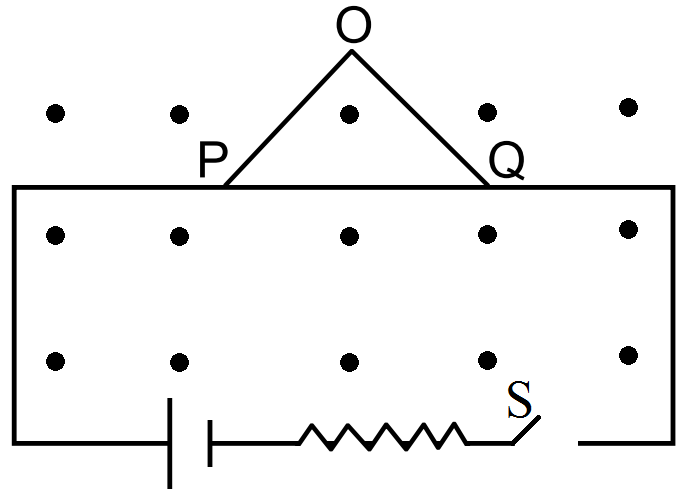
Shows a rod PQ of length 20.0cm and mass 200g suspended through a fixed point O by two threads of lengths 20.0cm each. A magnetic field of strength 0.500T exists in the vicinity of the wire PQ, as shown in the figure. The wires connecting PQ with the battery are loose and exert no force on PQ.
  1. Find the tension in the threads when the switch S is open.
  2. A current of 2.0A is established when the switch S is closed. Find the tension in the threads now.
The absolute temperature of air in a region linearly increases from $T_1$ to $T_2$ in a space of width d . Find the time taken by a sound wave to go through the region in terms of $\mathrm{T}_1, \mathrm{~T}_2, \mathrm{~d}$ and the speed v of sound at 273 K . Evaluate this time for $T_1=280 \mathrm{~K}, T_2=310 \mathrm{~K}, d=33 \mathrm{~m}$ and $\mathrm{v}=330 \mathrm{~m} / \mathrm{s}$.
Read the passage given below and answer the following questions from (i) to (v).
When a system (such as a simple pendulum or a block attached to a spring) is displaced from its equilibrium position and released, it oscillates with its natural frequency $\omega,$ and the oscillations are called free oscillations. All free oscillations eventually die out because of the ever present damping forces. However, an external agency can maintain these oscillations. These are called forced or driven oscillations. We consider the case when the external force is itself periodic, with a frequency wd called the driven frequency. The most important fact of forced periodic oscillations is that the system oscillates not with its natural frequency $\omega,$ but at the frequency $\omega,$ d of the external agency; the free oscillations die out due to damping. The most familiar example of forced oscillation is when a child in a garden swing periodically presses his feet against the ground (or someone else periodically gives the child a push) to maintain the oscillations. The maximum possible amplitude for a given driving frequency is governed by the driving frequency and the damping, and is never infinity. The phenomenon of increase in amplitude when the driving force is close to the natural frequency of the oscillator is called resonance. In our daily life, we encounter phenomena which involve resonance. Your experience with swings is a good example of resonance. You might have realized that the skill in swinging to greater heights lies in the synchronization of the rhythm of pushing against the ground with the natural frequency of the swing.
  1. When a system oscillates with its natural frequency ω, and the oscillations are called:
  1. Free oscillations.
  2. Forced oscillations.
  1. All free oscillations eventually die out because of:
  1. Damping force.
  2. electromagnetic force.
  3. None of these.
  1. What is free oscillation?
  2. What is forced oscillations?
  3. What is resonance?
Read the passage given below and answer the following questions from $i$ to $v.$ When an object follows a circular path at a constant speed, the motion of the object is called uniform circular motion. The word “uniform” refers to the speed, which is uniform (constant) throughout the motion. Suppose an object is moving with uniform speed $v$ in a circle of radius $R$ Since the velocity of the object is changing continuously in direction, the object undergoes acceleration. Let us find the magnitude and the direction of this acceleration. Thus, the acceleration of an object moving with speed v in a circle of radius $R$ has a magnitude $V^2/R$ and is always directed towards the centre. This is why this acceleration is called centripetal acceleration (a term proposed by Newton). A thorough analysis of centripetal acceleration was first published in $1673$ by the Dutch scientist Christiaan Huygens $(1629-1695)$ but it was probably known to Newton also some years earlier. “Centripetal” comes from a Greek term which means ‘centre-seeking’. Since $v$ and $R$ are constant, the magnitude of the centripetal acceleration is also constant. However, the direction changes pointing always towards the centre. Therefore, a centripetal acceleration is not a constant vector. We can express centripetal acceleration ac in terms of angular speed as $\text{a}_\text{c}=\omega^2\text{R}$ The time taken by an object to make one revolution is known as its time period T and the number of revolution made in one second is called its frequency $v (=1/T).$ However, during this time the distance moved by the object is $\text{s}=2\pi\text{R}.$ Therefore, $\text{v}=2\pi\frac{\text{R}}{\text{T}}=2\pi\text{ Rv}$ In terms of frequency n, we have $\omega=2\pi\text{v}$
$\text{V}=2\pi\text{ RV}$
$\text{ac}=4\pi^2\text{v}^2\text{R}$
  1. SI unit of angular velocity is
  1. Rev/ sec
  2. $m/ s$
  3. $m/ s^2$ 
  4. None of these
  1. A centripetal acceleration is not a constant vector. True or false?
  1. True
  2. False
  1. Define Uniform circular motion
  2. What is meaning of word centripetal?
  3. What is centripetal acceleration? Give its relation with angular velocity
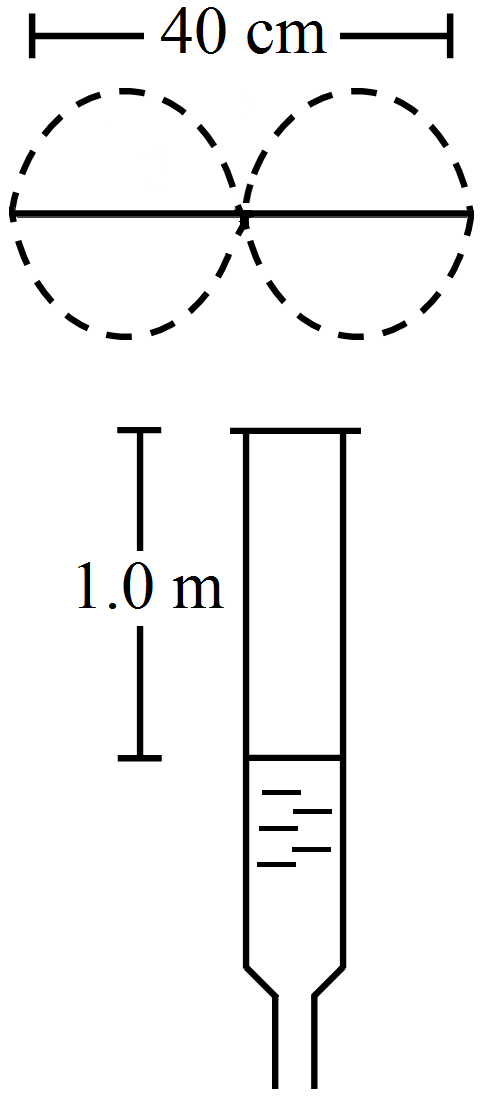
Consider the situation shown in figure. The wire which has a mass of $4.00g$ oscillates in its second harmonic and sets the air column in the tube into vibrations in its fundamental mode. Assuming that the speed of sound in air is $340m/s$, find the tension in the wire.
In one of the exercises to strengthen the wrist and fingers, a person squeezes and releases a soft rubber ball. Is the work done on the ball positive, negative or zero during compression? During expansion?