MCQ
Which of the following sets of concurrent forces may be in equilibrium
  • A
    $F_1=3 N, F_2=5 N, F_3=9 N$
  • B
    $F_1=3 N, F_2=5 N, F_3=1 N$
  • C
    $F_1=3 N, F_2=5 N, F_3=15 N$
  • $F_1=3 N, F_2=5 N, F_3=6 N$

Answer

Correct option: D.
$F_1=3 N, F_2=5 N, F_3=6 N$
(d) Range of resultant of $F_1$ and $F_2$ varies between $(3+5)=8\mathrm{~N$and((5-3)=2 N$. lt means for some value of angle $(\theta)$, resultant 6 canbeobtained.So,theresultant of $3 N, 5 N$ and $6 N$ may be zero and the forces may be in equilibrium.

Need a full question paper?

Generate a complete, print-ready paper with questions like this in minutes — across 16+ boards, with answer keys.
Start Generating Free

Similar questions

The aperture of a telescope is made large, because
A spring $40 \mathrm{~mm}$ long is stretched by the application of a force. If 10 $N$ force required to stretch the spring through $1 \mathrm{~mm}$, then work done in stretching the spring through $40 \mathrm{~mm}$ is
Some electric bulbs are connected in series across a $220 V$ supply in a room. If one bulb is fused then remaining bulbs are connected again in series across the same supply. The illumination in the room will
A body radiates energy $5 \mathrm{~W}$ at a temperature of $127^{\circ} \mathrm{C}$. If the temperature is increased to $927^{\circ} \mathrm{C}$, then it radiates energy at the rate of
A tennis ball dropped from a height of $2 \mathrm{~m}$ rebounds only $1.5 \mathrm{~m}$ after hitting the ground. What fraction of its energy is lost in the impact
A mass $m$ is suspended from the two coupled springs connected in series. The force constant for springs are $K_1$ and $K_2$. The time period of the suspended mass will be
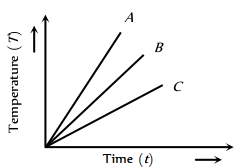
Which of the substances $A, B$ or $C$ has the highest specific heat ? The temperature $v s$ time graph is shownImage
An electric bulb rated for 500 watts at 100 volts is used in a circuit having a 200-volt supply. The resistance $R$ that must be put in series with the bulb, so that the bulb draws $500 W$ is
A concave lens and a convex lens have same focal length of $20 \mathrm{~cm}$ and both put in contact this combination is used to view an object 5 $\mathrm{cm}$ long kept at $20 \mathrm{~cm}$ from the lens combination. As compared to object the image will be
A whistle of frequency $500 \mathrm{~Hz}$ tied to the end of a string of length $1.2 \mathrm{m}$ revolves at $400 \mathrm{rev} / \mathrm{min}$. A listener standing some distance away in the plane of rotation of whistle hears frequencies in the range $($speed of sound $=340 \mathrm{~m} / \mathrm{s})$