MCQ
Which of the following solutions cannot act as a buffer
  • A
    $Na{H_2}P{O_4} + {H_3}P{O_4}$
  • B
    $C{H_3}COOH + C{H_3}COONa$
  • $HCl + N{H_4}Cl$
  • D
    ${H_3}P{O_4} + N{a_2}HP{O_4}$

Answer

Correct option: C.
$HCl + N{H_4}Cl$
(c)A strong acid is not used to make a buffer.

Need a full question paper?

Generate a complete, print-ready paper with questions like this in minutes — across 16+ boards, with answer keys.

Start Generating Free

Similar questions

$A{l_2}{O_3}$ formation involves evolution of a large quantity of heat, which makes its use in
Which of the following alcohols cannot be prepared from hydration of an alkene?
$IUPAC$ name of succinic acid is 
The number of bent-shaped molecule/s from the following is $.....$. $N _3^{-}, NO _2^{-}, I _3^{-}, O _3, SO _2$
Although $CN^-$ ion and $N_2$ molecule are isoelectronic, yet $N_2$ molecule is chemically inert because of
Which set contain molecules with $\mu\,= 0$
Who laid the foundation of chemical sciences by experimentally establishing laws of chemical combination along with other scientists?
Bond polarity of diatomic molecule is because of
Consider, $PF _{5}, BrF _{5}, PCl _{3}, SF _{6},\left[ ICl _{4}\right]^{-}, ClF _{3}$ and $IF _{5}$

Amongst the above molecule(s)/ion(s), the number of molecule(s)/1on(s) having $sp ^{3} d ^{2}$ hybridisation is $........$

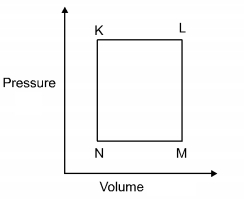
A fixed mass ' $m$ ' of a gas is subjected to transormation of states from $K$ to $L$ to $M$ to $N$ and back to $K$ as shown$Image$

$1.$ The succeeding operations that enable this transformation of states are

$(A)$ Heating, cooling, heating, cooling

$(B)$ Cooling, heating, cooling, heating

$(C)$ Heating, cooling, cooling, heating

$(D)$ Cooling, heating, heating, cooling

$2.$ The pair of isochoric processes among the transormation of states is

$(A)$ $K$ to $L$ and $L$ to $M$

$(B)$ $L$ to $M$ and $N$ to $K$

$(C)$ $L$ to $M$ and $M$ to $N$

$(D)$ $M$ to $N$ and $N$ to $K$

Give the answer question $1$ and $2.$