MCQ
Who laid the foundation of chemical sciences by experimentally establishing laws of chemical combination along with other scientists?
  • A
    Proust.
  • Antoine Lavoisier.
  • C
    Dalton.
  • D
    None of the above.

Answer

Correct option: B.
Antoine Lavoisier.
Lavoisier was the first one who established important laws of chemical combination.

Need a full question paper?

Generate a complete, print-ready paper with questions like this in minutes — across 16+ boards, with answer keys.
Start Generating Free

Similar questions

As one moves along a given row in the periodic table, ionization energy
Last molecule of $\ce{H_2O}$ is evolved from $\ce{H_2​O_2}$​ by :
One mole of $O_{2(g)}$ and two moles of $SO_{2(g)}$ were heated in a closed vessel of one-litre capacity at $1098\, K$. At equilibrium $1.6\, moles$ of $SO_{3(g)}$ were found. The equilibrium constant $K_c$ of the reaction would be
The $IUPAC$ name of (figure) is
The solubility product of $SnS _2$ is represented as :
Calculate the amount of $\text{NaOH}$ required to neutralise $\text{100 mL 0.1M} \ \  \mathrm{H}_2 \mathrm{SO}_4$ :
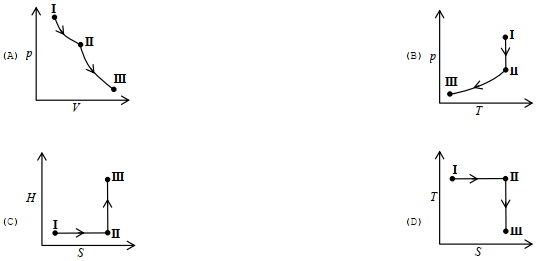
An ideal gas undergoes a reversible isothermal expansion from state $I$ to state $II$ followed by a reversible adiabatic expansion from state $II$ to state $III$. The correct plot($s$) representing the changes from state $I$ to state $III$ is(are)

( $p$ : pressure, $V$ : volume, $T$ : temperature, $H$ : enthalpy, $S$ : entropy)
The matter is neither created nor destroyed during any physical or chemical change. This statement is of the :
Zirconium phosphate $[Zr_3(PO_4)_4]$ dissociates into three zirconium cations of charge $+4$ and four phosphate anions of charge $-3$. If molar solubility of zirconium phosphate is denoted by $S$ and its solubility product by $K_{sp}$ then which of the following relationship between $S$ and $K_{sp}$ is correct?
Zinc sulphate contains $22.65\%$ of zinc and $43.9\%$ of water of crystallization. If the law of constant proportions is true, then the weight of zinc required to produce $20\, g$ of the crystals will be ............. $\mathrm{g}$