MCQ
Which of the following sources gives best monochromatic light?
  • A
    A candle.
  • B
    A bulb.
  • C
    A mercury tube.
  • A laser.

Answer

Correct option: D.
A laser.

Among the given sources, laser is the best coherent source providing monochromatic light with constant phase difference.

Need a full question paper?

Generate a complete, print-ready paper with questions like this in minutes — across 16+ boards, with answer keys.
Start Generating Free

Similar questions

Two electric bulbs marked $25\ W - 220\ V$ and $100\ W - 220\ V$ are connected in series to a $440\ V$ supply. Which of the bulbs will fuse?
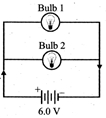
A $6.0\,volt$ battery is connected to two light bulbs as shown in figure. Light bulb $1$ has resistance $3\,ohm$ while light bulb $2$ has resistance $6\,ohm.$ Battery has negligible internal resistance. Which bulb will glow brighter?
A radioactive nucleus undergoes a-emission to form a stable element. What will be the recoil velocity of the daughter nucleus if V is the velocity of a-emission and A is the atomic mass of radioactive nucleus
Two identical capacitors are joined in parallel, charged to potential $V$, separated and then, connected in series, $i.e.$, the positive plate of one is connected to the negative plate of the other. Then
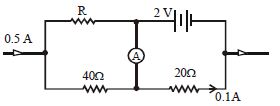
In the circuit shown in the figure, no current flows through the ideal ammeter. If the internal resistance of the cell is negligible, the value of unknown resistance $R $ is .............. $\Omega$
A given charge is situated at a certain distance from an electric dipole in the end-on position experiences a force F. If the distance of the charge is doubled, the force acting on the charge will be
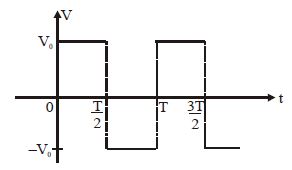
The mean and $rms$ value of an alternating voltage for half cycle as shown in figure are  respectively:-
Equipotentials at a great distance from a collection of charges whose total sum is not zero are approximately.
An inductor $(L)$ -resistance $(R)$, battery circuit is switched on at $t = 0$. If the $e.m.f.$ of battery is $E,$ the charge passing through the battery in time constant $T$ is
Statement $-1$ : A nucleus having energy $E _{1}$ decays $\beta^{-}$ emission to daughter nucleus having energy $E _{2}$ but the $\beta^{-}$rays are emitted with a continuous energy spectrum having end point energy $E _{1}- E _{2}$

Statement $-2$ : To conserve energy and momentum in $\beta$ decay at least three particles must take part in the transformation.