MCQ
Which of the following statement is correct
  • A
    A good absorber is a bad emitter
  • B
    Every body absorbs and emits radiations at every temperature
  • C
    The energy of radiations emitted from a black body is same for all wavelengths
  • The law showing the relation of temperatures with the wavelength of maximum emission from an ideal black body is Plank’s law

Answer

Correct option: D.
The law showing the relation of temperatures with the wavelength of maximum emission from an ideal black body is Plank’s law
d
(d) A good absorber is a good emitter hence option $(a)$ is wrong. Every body stops absorbing and emitting radiation at $0\,K$ hence option $(b)$ is wrong.

The energy of radiation emitted from a black body is not same for all wavelength hence option $(c)$ is wrong.

Plank’s law relates the wavelength ($\lambda$) and temperature $(T)$ according to the relation

${E_\lambda }{d_\lambda } = \frac{{8\pi \,hc}}{{{\lambda ^5}}}\frac{1}{{[{e^{hc/kT}} - 1]}}{d_\lambda }$. Hence option $(d)$ is correct.

Need a full question paper?

Generate a complete, print-ready paper with questions like this in minutes — across 16+ boards, with answer keys.

Start Generating Free

Similar questions

Two particles of identical mass are moving in circular orbits under a potential given by $V(r)=K r^{-n}$, where $K$ is a constant. If the radii of their orbits are $r_1 \cdot r_2$ and their speeds are $v_1 \cdot v_2$, respectively. Then,
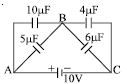
In the circuit shown in figure, four capacitors are connected to a battery. The charge on the $5$ $\mu$$F$ capacitor is.......$ \mu C$
$2$ particles $p$ and $q$ describe $SHM$ of same amplitude $a$ and same frequency $f$ along straight line, the maximum distance between the two particle $a\sqrt 2 $ . The initial phase difference between particle is
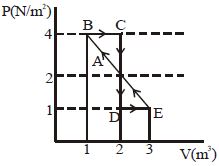
One mole of a monoatomic gas is carried along process $ABCDEA$ as shown in diagram. Find the net work done by gas ......... $J$
Students $I$, $II$ and $III$ perform an experiment for measuring the acceleration due to gravity $(g)$ using a simple pendulum.

They use different lengths of the pendulum and /or record time for different number of oscillations. The observations are shown in the table.

Least count for length $=0.1 \mathrm{~cm}$

Least count for time $=0.1 \mathrm{~s}$

Student Length of the pendulum $(cm)$ Number of oscillations $(n)$ Total time for $(n)$ oscillations $(s)$ Time period $(s)$
$I.$ $64.0$ $8$ $128.0$ $16.0$
$II.$ $64.0$ $4$ $64.0$ $16.0$
$III.$ $20.0$ $4$ $36.0$ $9.0$

If $\mathrm{E}_{\mathrm{I}}, \mathrm{E}_{\text {II }}$ and $\mathrm{E}_{\text {III }}$ are the percentage errors in g, i.e., $\left(\frac{\Delta \mathrm{g}}{\mathrm{g}} \times 100\right)$ for students $\mathrm{I}, \mathrm{II}$ and III, respectively,
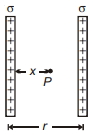
For two infinitely long charged parallel sheets, the electric field at $P$ will be
A body rotating with uniform angular acceleration covers $100 \pi$ (radian) in the first $5 \,s$ after the start. Its angular speed at the end of $5 \,s$ (in radian/s) is .........$\pi$
Compare the dispersive powers of two prisms if one of them deviates the blue and red rays through $10^{\circ}$ and $6^{\circ}$ respectively and the second prism through $8^{\circ}$ and $4.5^{\circ}$
Complete the reaction

$n + \,_{92}^{235}U \to \,_{56}^{144}Ba + .... + 3n$

A generator produces a voltage that is given by $V = 240\,sin \,120\,t$, where t is in seconds. The frequency and $ r.m.s.$ voltage are