Question
Which of the following statement is correct?

Answer

In primary rainbow, red colour is at top and violet is at bottom.

Intensity of secondary rainbow is less in comparison to primary rainbow.

Need a full question paper?

Generate a complete, print-ready paper with questions like this in minutes — across 16+ boards, with answer keys.

Start Generating Free

Similar questions

To double the covering range of a $TV$ transition tower, its height should be multiplied by
In a $P-N$ junction diode if $P$ region is heavily doped than n region then the depletion layer is
Match List $- I$ (Fundamental Experiment) with List $- II$ (its conclusion) and select the correct option from the choices given below the list

$\begin{array}{|p{0.35\linewidth}|p{0.55\linewidth}|} \hline List\,\,-1  & List\,\,-II\,\,  \\ \hline a\,\,Franck-Hertz\,\,Experiment & i\,\,Particle\,\,nature\,\,of\,\,light \\ \hline b\,\,Photo\,\,-electric\,\,Experiment & ii\,\,Discrete\,\,energy \,\, levels\,\,of\,\,atom \\ \hline c\,\,Davison-Germer\,\,Experiment & iii\,\,Wave\,\,nature\,\,of\,\,electron \\ \hline  & iv\,\,Structure\,\,of\,\,atom  \\ \hline \end{array}$
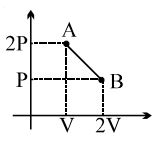
The process $AB$ is shown in the diagram. As the gas is taken from $A$ to $B$, its temperature
In a simple harmonic oscillator, at the mean position
A slender rod of mass $M$ and length $L$ is hinged about an end to swing freely in a vertical plane. However, its density is nonuniform and varies linearly from hinged end to the free end doubling its value. The moment of inertia of the rod, about the rotation axis passing through the hinge point is
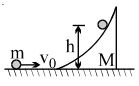
A particle of mass $m$ moving horizontally with $v_0$ strikes $a$ smooth wedge of mass $M$, as shown in figure. After collision, the ball starts moving up the inclined face of the wedge and rises to $a$ height $h$. The maximum height h attained by the particle is 
The thermal capacity of $40\, gm$ of aluminium (specific heat $= 0.2\, cal/gm/°C)$ is ........ $cal/^oC$
Kinetic energy of emitted cathode rays is dependent on
For a given velocity, a projectile has the same range $R$ for two angles of projection if $t_1$ and $t_2$ are the times of flight in the two cases then