Question
Which of the following statement is false:

Answer

  1. Sound wave exhibits polarization while light wave does not.
Explanation:
Polarization is a property of waves that can oscillate with more than one orientation. Electromagnetic waves such as light exhibit polarization, as do some other types of wave, such as gravitational waves.
Sound waves in a gas or liquid do not exhibit polarization, since the oscillation is always in the direction the wave travels.

Need a full question paper?

Generate a complete, print-ready paper with questions like this in minutes — across 16+ boards, with answer keys.
Start Generating Free

Similar questions

In a double slit experiment, instead of taking slits of equal widths, one slit is made twice as wide as the other. Then in the interference pattern(a) The intensities of both the maxima and the minima increase  (b) The intensity of maxima increases and the minima has zero intensity (c) The intensity of maxima decreases and that of the minima increases(d) The intensity of maxima decreases and the minima has zero intensity


Three bulbs of 40 W, 60 W, 100 W are arranged in series with 220 volt supply which bulb has minimum resistance(a) 100 W(b) 40 W(c) 60 W   (d) Equal in all bulbs
       
The magnitude of the electric field due to a point charge at a distance of 4.0 m is 9 N/C. Distance of this point charged substance due to electric field of magnitude 16 N/C will be:
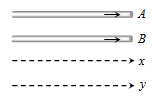
$A$ and $B$ are two conductors carrying a current $i$ in the same direction. $x$ and $y$ are two electron beams moving in the same direction
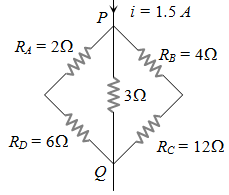
Potential difference between the points $P$ and $Q$ in the electric circuit shown is
Two identical charged spherical drops each of capacitance C merge to form a single drop. The resultant capacitance is(a) Equal to 2C (b) Greater than 2C (c) Less than 2C but greater than C(d) Less than C
   
   
A parallel plate condenser is connected to a battery of emf 4 volt. If a plate of dielectric constant 8 is inserted into it, the potential difference on the condenser will be:
Which one of the following is not electromagnetic in nature(a) X-rays(b) Gamma rays(c) Cathode rays(d) Infrared rays
       
In an AC circuit containing only capacitance, the current:
Which of the following statement is correct(a) Both Peltier and Joule effects are reversible(b) Both Peltier and Joule effects are irreversible(c) Joule effect is reversible, whereas Peltier effect is irreversible(d) Joule effect is irreversible, whereas Peltier effect is reversible