Which of the following statement is false
Easy


Download our appand get started for free
Experience the future of education. Simply download our apps or reach out to us for more information. Let's shape the future of learning together!No signup needed.*
Similar Questions
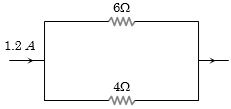
- 1In the figure given below, the current passing through $6\,\Omega $ resistor is ........... $ampere$View Solution
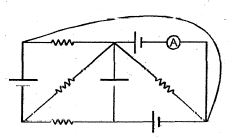
- 2In the circuit diagram shown, each battery is ideal having an e.m.f. of $1\ volt$. Each resistor has a resistance of $1\Omega $ Ammotor$(A)$ has a resistance of $1\Omega $ Find the reading of the ammeter and the total thermal power produced in the circuitView Solution
- 3A uniform heating wire of resistance $36\, \Omega$ is connected across a potential difference of $240\, {V}$ The wire is then cut into half and potential difference of $240\, {V}$ is applied across each half separately. The ratio of power dissipation in first case to the total power dissipation in the second case would be $1: {x}$, where ${x}$ is........... .View Solution
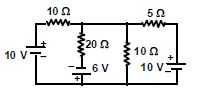
- 4The value of current through the $20\,\Omega $ resistor is ............ $amp$View Solution
- 5In an experiment to measure the internal resistance of a cell by potentiometer, it is found that the balance point is at a length of $2\,m$ when the cell is shunted by a $5\,\Omega $ resistance; and is at a length of $3\,m$ when the cell is shunted by a $10\,\Omega $ resistance. The internal resistance of the cell is, then ................ $\Omega $View Solution
- 6The resistance of the series combination of two resistance is $S$. When they are joined in parallel the total resistance is $P$. If $S = nP$, then the minimum possible value of $n$ isView Solution
- 7When two resistance $R_1$ and $R_2$ connected in series and introduced into the left gap of a meter bridge and a resistance of $10 \Omega$ is introduced into the right gap, a null point is found at $60 cm$ from left side. When $R_1$ and $R_2$ are connected in parallel and introduced into the left gap, a resistance of $3 \Omega$ is introduced into the right-gap to get null point at 40 cm from left end. The product of $R_1 R_2$ is $.............\Omega$View Solution
- 8A heater of $220\, V$ heats a volume of water in $5\,\min$ time. A heater of $110\, V$ heats the same volume of water in ............... $min$View Solution
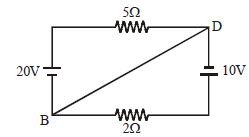
- 9Calculate the current in wire $BD$ ................ $A$View Solution
- 10Two resistances ${R_1}$ and ${R_2}$ are made of different materials. The temperature coefficient of the material of ${R_1}$ is $\alpha $ and of the material of ${R_2}$ is $ - \beta $. The resistance of the series combination of ${R_1}$ and ${R_2}$ will not change with temperature, if ${R_1}/{R_2}$ equalsView Solution