MCQ
Which of the following statement is true
  • A
    $78^{\mathrm{Pt}^{192}}$ has $78$ neutrons
  • B
    $84^{\mathrm{PO}^{214}} \rightarrow 82^{\mathrm{Pb}^{210}}+\beta^{-}$
  • $92^{\mathrm{U}^{288}} \rightarrow 90^{\mathrm{Th}^{284}}+2^{\mathrm{He}^4}$
  • D
    $90^{\mathrm{Th}^{234}} \rightarrow 91^{\mathrm{Pa}^{234}}+2^{\mathrm{He}^4}$
Answer

Correct option: C.
$92^{\mathrm{U}^{288}} \rightarrow 90^{\mathrm{Th}^{284}}+2^{\mathrm{He}^4}$

Need a full question paper?

Generate a complete, print-ready paper with questions like this in minutes — across 16+ boards, with answer keys.

Start Generating Free

Similar questions

A metal sheet is placed in front of a strong magnetic pole. A force needed to:
The axis of rotation of a purely rotating body:
  1. Must pass through the centre of mass.
  2. May pass through the centre of mass.
  3. Must pass through a particle of the body.
  4. May pass through a particle of the body.
When a test charge is brought from infinity to near the dipole along the neutral line of an electric dipole, then the work done will be:
Which theory of light explains the photoelectric effect?
A parallel plate capacitor is charged. If the plates are pulled apart:
Assertion  :   Electric lines of force cross each other.
Reason      : Electric field at a point superimpose to give one resultant electric field.(a) If both assertion and reason are true and the reason is the correct explanation of the assertion.(b) If both assertion and reason are true but reason is not the correct explanation of the assertion.(c) If assertion is true but reason is false.(d) If assertion is false but reason is true.


In annihilation process, in which an electron and a positron transform into two gamma rays, which property of electric charge is displayed?
Assertion :   Environmental damage has increased the amount of ozone in the atmosphere.
Reason     : Increase of ozone increases the amount of ultraviolet radiation on earth.(a) If both assertion and reason are true and the reason is the correct explanation of the assertion.(b) If both assertion and reason are true but reason is not the correct explanation of the assertion.(c) If assertion is true but reason is false.(d) If the assertion and reason both are false.


Which one of the following gives the resultant capacitor when capacitors are joined in series?
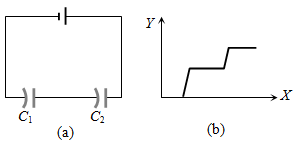
Figure $(a)$ shows two capacitors connected in series and joined to a battery. The graph in figure $(b)$ shows the variation in potential as one moves from left to right on the branch containing the capacitors, if