MCQ
Which of the following statement is wrong
  • Diethyl ketone and methyl propyl ketone are position isomers
  • B
    $2-$ chloro pentane and $1-$ chloro pentane are position isomers
  • C
    $n-$butane and $2-$methyl propane are chain isomers
  • D
    Acetone and propinaldehyde are functional isomers
Answer

Correct option: A.
Diethyl ketone and methyl propyl ketone are position isomers
a
It’s obvious.

Need a full question paper?

Generate a complete, print-ready paper with questions like this in minutes — across 16+ boards, with answer keys.

Start Generating Free

Similar questions

Point out the correct relation between $\mathrm{K}_{\mathrm{a}}, \mathrm{K}_{\mathrm{b}}$ and $\mathrm{K}_{\mathrm{w}},$
Given

$(i)$ $\begin{gathered}
  HCN\left( {aq} \right) + {H_2}O\left( l \right) \rightleftharpoons {H_3}{O^ + }\left( {aq} \right) + C{N^ - }\left( {aq} \right) \hfill \\
  {K_a} = 6.2 \times {10^{ - 10}} \hfill \\ 
\end{gathered} $

$(ii)$ $\begin{gathered}
  C{N^ - }\left( {aq} \right) + {H_2}O\left( l \right) \rightleftharpoons HCN\left( {aq} \right) + O{H^ - }\left( {aq} \right) \hfill \\
  {K_b} = 1.6 \times {10^{ - 5}} \hfill \\ 
\end{gathered} $

These equilibria show the following order of the relative base strength

Match List $I$ with List $II$

List $-I$  (Atomic Number) List $-II$ (Block of periodic table)
$A$ $37$ $I$ $p-$block
$B$ $78$ $II$ $d-$block
$C$ $52$ $III$ $f-$block
$D$ $65$ $IV$ $s-$block

નીચે આપેલા વિકલ્પોમાંથી યોગ્ય ઉત્તરની પસંદગી કરો.

The radius of an atom is of the order of
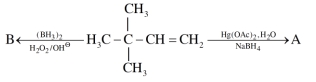
Choose the correct option for the following reactions.
Name the alkene with molecular formula ${C_{10}}{H_{20}}$
Which scientist discovered that the same amount of space was occupied by equal numbers of molecules of gases, irrespective of whether it was hydrogen or chlorine or fluorine?
Enthalpy change for reaction, $\frac{1}{2}{H_2} + \frac{1}{2}C{l_2} \to HCl$, is called
The wave function $(\Psi)$ of $2 s$ is given by

$\Psi_{2 s}=\frac{1}{2 \sqrt{2 \pi}}\left(\frac{1}{a_0}\right)^{1 / 2}\left(2-\frac{ r }{ a _0}\right) e ^{- r / 2 a _0}$

At $r=r_0$, radial node is formed. Thus, $r_0$ in terms of $a_0$

If the bond distance in chlorine molecule $\ce{(Cl_2)}$ is $\ce{198pm},$ then the radius of chlorine is :