MCQ
Which of the following statement must always be true?
  1. If an objects acceleration is zero, then its speed must remain constant.
  2. If an objects acceleration is constant, then it must move in a straight line. 
  3. If an objects speed remains constant, then its acceleration must be zero.
  • A
    I and III only
  • B
    I only
  • C
    III only
  • D
    II and II only

Answer

  1. I only

Explanation:

Acceleration is the rate of change of speed of the object. Thus when acceleration is zero, the speed of object remains constant.

Acceleration of an object moving in a circular path is $\frac{\text{v}^2}{\text{R}}.$ Thus an object with constant acceleration may not move in a straight line.

Again in case of circular path, the speed remains same, but acceleration is finite.

Need a full question paper?

Generate a complete, print-ready paper with questions like this in minutes — across 16+ boards, with answer keys.

Start Generating Free

Similar questions

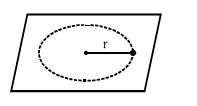
A small mass attached to a string rotates on a frictionless table top as shown. If the tension in the string is increased by pulling the string cauusing the radius of the circular motion to decrease by a factor of $2$ , the kinetic energy of the mass will
If mass is written as $\mathrm{m}=\mathrm{kc}^{\mathrm{p}} \mathrm{G}^{-1 / 2} \mathrm{~h}^{1 / 2}$ then the value of $P$ will be : (Constants have their usual meaning with $\mathrm{k}$ a dimensionless constant)
The cross sectional area of a horizontal tube increases along its length linearly, as we move in the direction of flow. The variation of pressure, as we move along its length in the direction of flow ($x-$ direction), is best depicted by which of the following graphs
The amplitude of the vibrating particle due to superposition of two $SHMs,$

$y_1 = \sin \left( {\omega t + \frac{\pi }{3}} \right)$ and $y_2 = \sin \omega t$ is :

The moment of inertia of a solid sphere, about an axis parallel to its diameter and at a distance of $x$ from it, is $I(x)$. Which one of the graphs represents the variation of $I(x)$ with $x$ correctly?
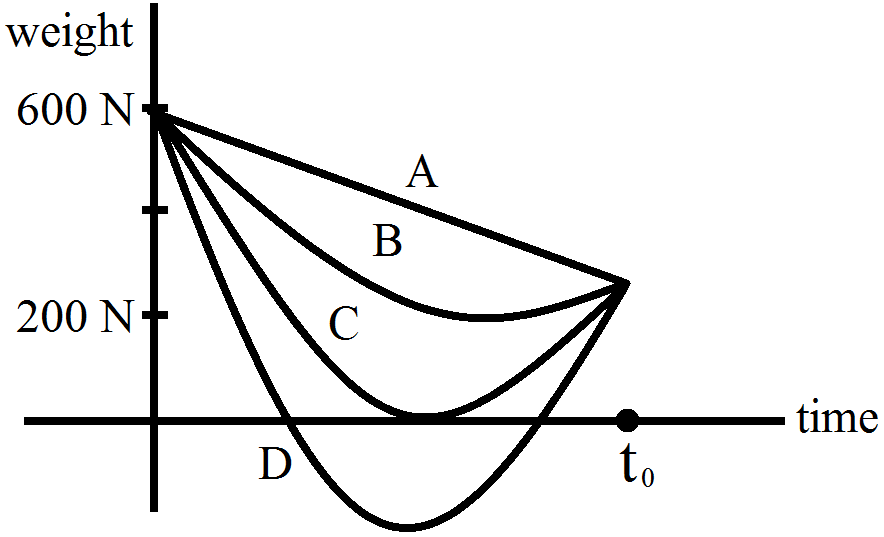
Suppose, the acceleration due to gravity at the earth's surface is 10ms-2 and at the surface of Mars it is 4⋅0ms-2. A 60kg passenger goes from the earth to the Mars in a spaceship moving with a constant velocity. Neglect all other objects in the sky. Which part of best represents the weight (net gravitational force) of the passenger as a function of time?

  1. A
  2. B
  3. C
  4. D
$A$ particle is moving along a circular path of radius $R$ in such a way that at any instant magnitude of radial acceleration & tangential acceleration are equal. If at $t = 0$ velocity of particle is $V_0$, the time period of first revolution of the particle is 
A person running horizontally observes that rain is falling on his head vertically with speed $10\,m/s$. He stops and observes that rain is coming at an angle $30^o$ with vertical. Find the speed of rain w.r.t. ground
Two $SHM$ are represented by equations, $y_1 = 6\cos \left( {6\pi t + \frac{\pi }{6}} \right)\,,{y_2} = 3\left( {\sqrt 3 \sin 3\pi t + \cos 3\pi t} \right)$
What will be the potential energy of a body of mass 5kg kept at a height of 10m ?