MCQ
Which of the following statements are correct?
$a.$ Cationic detergents have germicidal properties.
$b.$ Bacteria can degrade the detergents containing highly branched chains.
$c.$ Some synthetic detergents can give foam even in ice cold water.
$d.$ Synthetic detergents are not soaps.
  • A
    $a$ and $b$
  • B
    $a,b$ and $c$
  • C
    $a,b,c$ and $d$
  • $a,c$ and $d$

Answer

Correct option: D.
$a,c$ and $d$
Cationic detergents have germicidal properties and are expensive, therefore, these are of limited use. Synthetic detergents are cleansing agents which have all the properties of soap, but which actually do not contain any soap. These can be used both in soft and hard water as they give foam even in hard water.

Need a full question paper?

Generate a complete, print-ready paper with questions like this in minutes — across 16+ boards, with answer keys.

Start Generating Free

Similar questions

Which of the following compound decolourise $Br_2 / H_2O$ and also give positive test with neutral $FeCl_3$ :
In $\text{fcc},$ a tetrahedral void is formed by atoms at:
Relation between rate constant and temperature by Arrhenius equation is
$CH_2(CO_2Me)_2 +?  \xrightarrow[(ii)\,AcOH]{(i)\,Na}  CH(CO_2Me)_3$

Which of the following reactants will complete the above reaction ?

Phthalic acid reacts with resorcinol in the presence of concentrated $H_2SO_4$ to give
When methyl bromide is heated with $Zn$ it gives
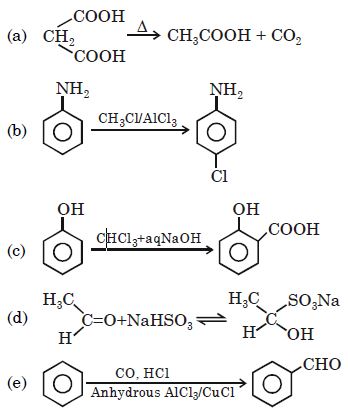
Which of the following reaction is incorrect
The number of given statement/s which is/are correct is $.....$.

$(A)$ The stronger the temperature dependence of the rate constant, the higher is the activation energy.

$(B)$ If a reaction has zero activation energy, its rate is independent of temperature.

$(C)$ The stronger the temperature dependence of the rate constant, the smaller is the activation energy.

$(D)$ If there is no correlation between the temperature and the rate constant then it means that the reaction has negative activation energy.

Consider the following transformation involving first order elementary reaction in each step at constant temperature as shown below.

$\mathrm{A}+\mathrm{B} \underset{\text { Step } 3}{\text { Step } 1} \mathrm{C} \xrightarrow{\text { Step } 2} \mathrm{P}$

Some details of the above reaction are listed below.

Step

Rate constant $\left(\sec ^{-1}\right)$

Activation energy 

$\left(\mathrm{kJ} \mathrm{mol}^{-1}\right)$

$1$ ${k}_1$ $300$
$2$ ${k}_2$ $200$
$3$ ${k}_3$ $\mathrm{Ea}_3$

If the overall rate constant of the above transformation (k) is given as $\mathrm{k}=\frac{\mathrm{k}_1 \mathrm{k}_2}{\mathrm{k}_3}$ and the overall activation energy $\left(E_2\right)$ is $400 \mathrm{~kJ} \mathrm{~mol}^{-1}$, then the value of $\mathrm{Ea}_3$ is $\qquad$ $\mathrm{kJ} \mathrm{mol}^{-1}$ (nearest integer)

The correct order of spin only magnetic moments for the following complex ions is