MCQ
Which of the following statements are true for a moving body?
  • A
    If its speed changes, its velocity must change and it must have some acceleration
  • B
    If its velocity changes, its speed must change and it must have some acceleration
  • C
    If its velocity changes, its speed may or may not change, and it must have some acceleration
  • Both $(A)$ and $(C)$

Answer

Correct option: D.
Both $(A)$ and $(C)$
d

Need a full question paper?

Generate a complete, print-ready paper with questions like this in minutes — across 16+ boards, with answer keys.

Start Generating Free

Similar questions

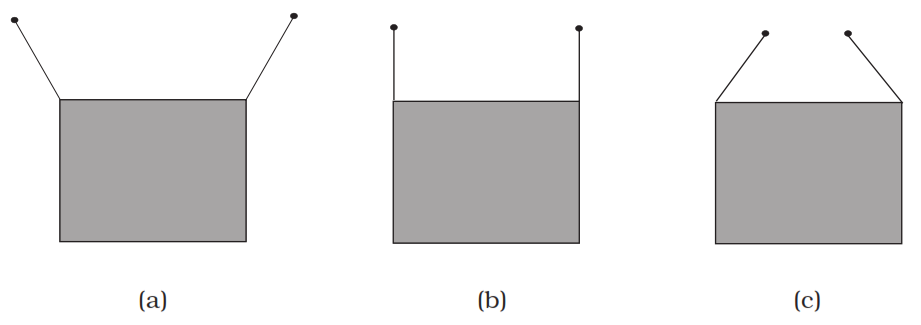
A rectangular frame is to be suspended symmetrically by two strings of equal length on two supports. It can be done in one of the following three ways;

The tension in the strings will be
Unit of energy in $SI$ system is
A thin wire of length $l$ and mass $M$ is bent in the form of a semi-circle. What is its moment of inertia about an axis passing through the ends of the wire
Number of particles is given by $n = - D\frac{{{n_2} - {n_1}}}{{{x_2} - {x_1}}}$ crossing a unit area perpendicular to X-axis in unit time, where ${n_1}$ and ${n_2}$ are number of particles per unit volume for the value of $x$ meant to ${x_2}$ and ${x_1}$. Find dimensions of $D$ called as diffusion constant
$\text{SI}$ unit of capacitance is:
If a force of constant magnitude acts in direction perpendicular to the motion of a particle, then its
Two moles of helium are mixed with $n$  with moles of hydrogen. If $\frac{{{C_P}}}{{{C_V}}}\, = \,\frac{3}{2}$  for the mixture, then the value of $n$  is
A particle in $S.H.M.$ is described by the displacement function $x(t) = a\cos (\omega t + \theta )$. If the initial $(t = 0)$ position of the particle is $1\, cm  $ and its initial velocity is $\pi \,cm/s$. The angular frequency of the particle is $\pi \,rad/s$, then it’s amplitude is
To maintain a speed of $80\,km / h$ by a bus of mass $500\,kg$ on a plane rough road for $4\,km$ distance, the work done by the engine of the bus will be $........\,kJ$. [The coefficient of friction between tyre of bus and road is $0.04]$.
A ball of mass $1 \;kg$ is thrown vertically upwards and returns to the ground after $3\; seconds$. Another ball, thrown at $60^{\circ}$ with vertical also stays in air for the same time before it touches the ground. The ratio of the two heights are