MCQ
Which of the following statements are true for a stationary wave?
  • A
    Every particle has a fixed amplitude which is different from the amplitude of its nearest particle.
  • B
    All the particles cross their mean position at the same time.
  • C
    There is no net transfer of energy across any plane.
  • All of the above

Answer

Correct option: D.
All of the above
In stationary waves $[\text{y}(\text{x, t})=\text{a}\sin\text{kx}\cos\omega\text{t}]$ the particles between two nodes vibrates with different amplitude which increases fron nodes.
The amplitude of a particle will remain constant a $\cos kx,$ but varies with $\lambda$
$\because\text{k}=\frac{2\pi}{\lambda}.$
Hence verifies the option $(a)$
particles between two nodes are in same phase
i.e., motion of particles between two nodes will be either upward or downward and crosses the mean position at same time.
Hence the verifies option $(b)$
Hence the reject option $(c)$
As the particles at nodes are rest so energy does not transfer verifies option $(c)$
The amplitude of particles at nodes has amplitude zero verifies option $(c)$

Need a full question paper?

Generate a complete, print-ready paper with questions like this in minutes — across 16+ boards, with answer keys.

Start Generating Free

Similar questions

Two projectiles $A$ and $B$ are projected with angle of projection $15^{\circ}$ for the projectile $A$ and $45^{\circ}$ for the projectile $B$. If $R_A$ and $R_B$ be the horizontal range for the two projectiles, then:
A solid square plate is spun around different axes with the same angular speed. In which of the following choice of axis of rotation will the kinetic energy of the plate be the largest?
The kinetic energy of a particle executing $S.H.M.$ is $16\, J$ when it is at its mean position. If the mass of the particle is $0.32 \,kg$, then what is the maximum velocity of the particle ..... $m/s$
The scale of a spring balance reading from $0$ to $10 \,kg$ is $0.25\, m$ long. A body suspended from the balance oscillates vertically with a period of $\pi /10$ second. The mass suspended is ..... $kg$ (neglect the mass of the spring)
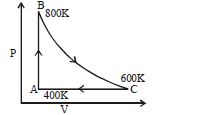
One mole of diatomic ideal gas undergoes a cyclic process $ABC$ as shown in figure. The process $BC$ is adiabatic. The temperatures at $A, B$ and $C$ are $400\,K, 800\,K$ and $600\,K$ respectively. Choose the correct statement
In a $p-n$ junction:
  1. New holes and conduction electrons are produced continuously throughout the material.
  2. New holes and conduction electrons are produced continuously throughout the material except in the depletion region.
  3. Holes and conduction electrons recombine continuously throughout the material.
  4. Holes and conduction electrons recombine continuously throughout the material except in the depletion region.
A particle of mass $m$ in a unidirectional potential field have potential energy $U(x)=\alpha+2 \beta x^2$, where $\alpha$ and $\beta$ are positive constants. Find its time period of oscillation.
Consider a $1\, c.c.$ sample of air at absolute temperature ${T_0}$ at sea level and another $1 cc$ sample of air at a height where the pressure is one-third atmosphere. The absolute temperature $T$ of the sample at that height is
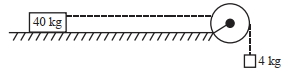
A block of mass $40 \,kg$ slides over a surface, when a mass of $4 \,kg$ is suspended through an inextensible massless string passing over frictionless pulley as shown below. The coefficient of kinetic friction between the surface and block is $0.02$. The acceleration of block is ............ $ms ^{-2}$ (Given $g =10 \,ms ^{-2}$.)
The pressure and density of a diatomic gas $(\gamma = 7/5)$ change adiabatically from $(P, d)$ to $(P', d')$. If $\frac{{d'}}{d} = 32$, then $\frac{{P'}}{P}$ should be