MCQ
Which of the following statements is correct?
  • In case of a wave, traveling in a string, oscillation energy of an elemental length remains constant.
  • B
    In case of a wave, traveling in a string, oscillation energy of an elemental length varies periodically.
  • C
    In case of a wave, traveling in a string, kinetic energy of all elemental parts having equal length is same.
  • D
    none of these

Answer

Correct option: A.
In case of a wave, traveling in a string, oscillation energy of an elemental length remains constant.
a
When wave travels in a medium then the displacement and velocity at a point varies with time. Hence, for an elemental length, its $K. E.$ and $P . E . ,$ both vary with time. But the total energy remains constant.

Need a full question paper?

Generate a complete, print-ready paper with questions like this in minutes — across 16+ boards, with answer keys.

Start Generating Free

Similar questions

The frequency $(v)$ of an oscillating liquid drop may depend upon radius $(r)$ of the drop, density $(\rho)$ of liquid and the surface tension $(s)$ of the liquid as : $v=r^{ a } \rho^{ b } s ^{ c }$. The values of $a , b$ and $c$ respectively are
The angular momentum of a system of particles is not conserved when:
Two rings of radii 1 meter and 5 meter start rolling simultaneously on an inclined plane without slipping. Which ring will reach the earth's surface first?
If $L , C$ and $R$ denote the inductance, capacitance and resistance respectively, the dimensional formula for $C ^{2} LR$ is
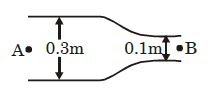
Water is flowing through a horizontal tube according to the figure. Its diameter at two points are $0.3\,m$ and $0.1\,m$  respectively. Pressure difference between these two points is equal to $0.8\,m$ of water column. Find rate of flow of water in the tube ..... $ltr/s$
At $10^o C$ the value of the density of a fixed mass of an ideal gas divided by it pressure is $x.$ At  $110^o C$ this ratio is
In $a$ one dimensional collision between two identical particles $A$ and $B, B$ is stationary and $A$ has momentum $p$ before impact. During impact, $B$ gives impulse $J$ to $A.$
A uniform rod $AB$ of length $l$ and mass $m$ is free to rotate about point $A$ . The rod is released from rest in the horizontal position. Given that the moment of inertia of the rod about $A$ is $\frac {ml^2}{3}$ , the initial angular acceleration of the rod will be 
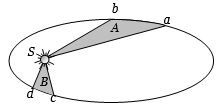
The figure shows the motion of a planet around the sun in an elliptical orbit with sun at the focus. The shaded areas $A$ and $B$ are also shown in the figure which can be assumed to be equal. If ${t_1}$ and ${t_2}$ represent the time for the planet to move from $a$ to $b$ and $d$ to $c$ respectively, then
Which is the correct unit for measuring nuclear radii