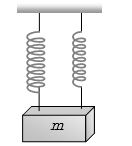
Which of the following statements is not true ? In the case of a simple pendulum for small amplitudes the period of oscillation is
Easy
Download our app for free and get started
(c)

Download our appand get started for free
Experience the future of education. Simply download our apps or reach out to us for more information. Let's shape the future of learning together!No signup needed.*
Similar Questions
- 1The displacement of a particle executing periodic motion is given by :View Solution
$y = 4cos^2\,(t/2)sin\,(1000t)$
This expression may be considered to be a result of superposition of - 2A particle is subjected to two mutually perpendicular simple harmonic motions such that its $x$ and $y$ coordinates are given by ?View Solution
$ x = 2 \sin \omega t \,;$ $ y = 2 \sin \left( {\omega t + \frac{\pi }{4}} \right)$
The path of the particle will be :
- 3A body is executing $S.H.M.$ When its displacement from the mean position is $4\, cm$ and $5\, cm$, the corresponding velocity of the body is $10 \,cm/sec$ and $8\, cm/sec$. Then the time period of the body isView Solution
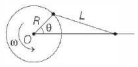
- 4One end of a rod of length $L$ is fixed to a point on the circumference of a wheel of radius $R$. The other end is sliding freely along a straight channel passing through the centre of the wheel as shown in the figure below. The wheel is rotating with a constant angular velocity $\omega$ about $O$. Taking $T=\frac{2 \pi}{\omega}$, the motion of the rod isView Solution
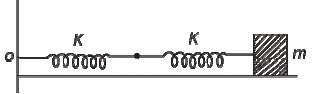
- 5The frequency of oscillations of a mass $m$ connected horizontally by a spring of spring constant $k$ is $4 Hz$. When the spring is replaced by two identical spring as shown in figure. Then the effective frequency is,View Solution
- 6The amplitude of a particle executing $SHM$ is made three-fourth keeping its time period constant. Its total energy will beView Solution
- 7A body executing simple harmonic motion has a maximum acceleration equal to $ 24\,metres/se{c^2} $ and maximum velocity equal to $ 16\;metres/sec $. The amplitude of the simple harmonic motion isView Solution
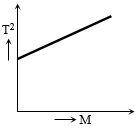
- 8The graph shown was obtained from experimental measurements of the period of oscillations $T$ for different masses $M$ placed in the scale pan on the lower end of the spring balance. The most likely reason for the line not passing through the origin is that theView Solution
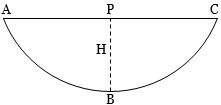
- 9A simple pendulum with a bob of mass $‘m’$ oscillates from $A$ to $ C$ and back to $A$ such that $PB$ is $H.$ If the acceleration due to gravity is $‘g’$, then the velocity of the bob as it passes through $B$ isView Solution
- 10A mass $m$ is suspended separately by two different springs of spring constant $K_1$ and $K_2$ gives the time-period ${t_1}$ and ${t_2}$ respectively. If same mass $m$ is connected by both springs as shown in figure then time-period $t$ is given by the relationView Solution