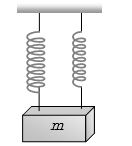
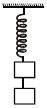
A mass $m$ is suspended separately by two different springs of spring constant $K_1$ and $K_2$ gives the time-period ${t_1}$ and ${t_2}$ respectively. If same mass $m$ is connected by both springs as shown in figure then time-period $t$ is given by the relation
AIPMT 2002, Medium
Download our app for free and get started
(d) ${t_1} = 2\pi \sqrt {\frac{m}{{{K_1}}}} $ and ${t_2} = 2\pi \sqrt {\frac{m}{{{K_2}}}} $
Equivalent spring constant for shown combination is
$K_1 + K_2$. So time period $t$ is given by $t = 2\pi \sqrt {\frac{m}{{{K_1} + {K_2}}}} $
By solving these equations we get ${t^{ - 2}} = t_1^{ - 2} + t_2^{ - 2}$
Equivalent spring constant for shown combination is
$K_1 + K_2$. So time period $t$ is given by $t = 2\pi \sqrt {\frac{m}{{{K_1} + {K_2}}}} $
By solving these equations we get ${t^{ - 2}} = t_1^{ - 2} + t_2^{ - 2}$

Download our appand get started for free
Experience the future of education. Simply download our apps or reach out to us for more information. Let's shape the future of learning together!No signup needed.*
Similar Questions
- 1A simple pendulum performs simple harmonic motion about $X = 0$ with an amplitude $A$ and time period $T$. The speed of the pendulum at $X = \frac{A}{2}$ will beView Solution
- 2A particle executes linear simple harmonic motion with an ampilitude of $3\,cm$ . When the particle is at $2\,cm$ from the mean position , the magnitude of its velocity is equal to that of its acceleration. Then its time period in seconds isView Solution
- 3The oscillation of a body on a smooth horizontal surface is represented by the equation $x= Acos$$\omega t$View Solution
where $x=$ displacement at time $t$
$\omega =$ frequency of oscillation
Which one of the following graphs shows correctly the variation $a$ with $t$ ?
Here $a=$ acceleration at time $t$
$T=$ time period
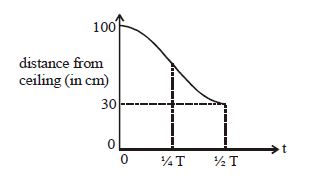
- 4A spring hangs vertically from the ceiling and a mass is attached to its free end. When the mass is pulled down and released, it oscillates vertically with simple harmonic motion of period $T$ . The variation with time $t$ of its distance from the ceiling is as shown. Which statement gives a correct deduction from this graph?View Solution
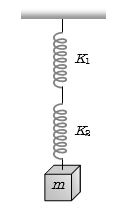
- 5A mass $M$ is suspended by two springs of force constants $K_1$ and $K_2$ respectively as shown in the diagram. The total elongation (stretch) of the two springs isView Solution
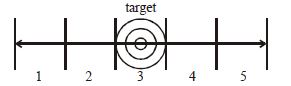
- 6View SolutionA shooting game involves using a gun that fires by itself at random times. The player can only point the gun in a fixed direction while the target moves from side to side with simple harmonic motion, as shown. At which of the given region should the player aim in order to score the greatest number of hits?
- 7The equation of motion of a particle is $x = a\,cos (\alpha\, t)$ . The motion isView Solution
- 8The variation of the acceleration $a$ of the particle executing $S.H.M.$ with displacement $x$ is as shown in the figureView Solution
- 9Two small bodies of mass of $2\, kg$ each attached to each other using a thread of length $10\, cm$, hang on a spring whose force constant is $200\, N/m$, as shown in the figure. We burn the thread. What is the distance between the two bodies when the top body first arrives at its highest position .... $cm$ ? (Take $\pi^2 = 10$)View Solution
- 10View SolutionIf a body is released into a tunnel dug across the diameter of earth, it executes simple harmonic motion with time period