MCQ
Which of the following statements is true/correct
  • A
    During clear nights, the temperature rises steadily upward near the ground level
  • Newton's law of cooling, an approximate form of Stefan's law, is valid only for natural convection
  • C
    The total energy emitted by a black body per unit time per unit area is proportional to the square of its temperature in the Kelvin scale
  • D
    Two spheres of the same material have radii $1m$ and ${S_1}$ and temperatures $4000 K$ and $2000 K$ respectively. The energy radiated per second by the first sphere is greater than that radiated per second by the second sphere
Answer

Correct option: B.
Newton's law of cooling, an approximate form of Stefan's law, is valid only for natural convection
b
(b) During clear nights object on surface of earth radiate out heat and temperature falls. Hence option $(a)$ is wrong.

The total energy radiated by a body per unit time per unit area $E \propto T^4$. Hence option $(c)$ is wrong.

Energy radiated per second is given by $\frac{Q}{t} = PA\varepsilon \sigma {T^4}$

==> $\frac{{{P_1}}}{{{P_2}}} = \frac{{{A_1}}}{{{A_2}}}.{\left( {\frac{{{T_1}}}{{{T_2}}}} \right)^4} = {\left( {\frac{{{r_1}}}{{{r_2}}}} \right)^2}.{\left( {\frac{{{T_1}}}{{{T_2}}}} \right)^4} = {\left( {\frac{1}{4}} \right)^2}\left( {\frac{{4000}}{{200}}} \right) = \frac{1}{1}$
 $\because P1 = P2$ , hence option $(d)$ is wrong.

Newton's law is an approximate form of Stefan's law of radiation and works well for natural convection. Hence option $(b)$ is correct.

Need a full question paper?

Generate a complete, print-ready paper with questions like this in minutes — across 16+ boards, with answer keys.

Start Generating Free

Similar questions

Newton's law of cooling is a special case of:
  1. Wien's displacement law.
  2. Kirchhoff's law.
  3. Stefan's law.
  4. Planck's law.
Consider the motion of the tip of the second hand of a clock. In one minute (R be the length of second hand), its ......
Consider two satellites $S_{1}$ and $S_{2}$ with periods of revolution $1\, hr$. and $8\, hr$. respectively revolving around a planet in circular orbits. The ratio of angular velocity of satellite $S_{1}$ to the angular velocity of satellites $S _{2}$ is
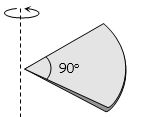
One quarter sector is cut from a uniform circular disc of radius $R$.  This sector has mass $M$. It is made to rotate about a line perpendicular to its plane and passing through the centre of the original disc.  Its moment of inertia about the axis of rotation is
According to Bernoulli's equation, $\frac{\text{P}}{\rho\text{g}}+\text{h}+\frac{1\text{v}^2}{2\text{g}}=\text{constant}.$ The term, $\frac{\text{P}}{\rho\text{g}},\text{h}$ and $\frac{1\text{v}^2}{\text{2g}}$ are generally called respectively:
Two masses $M$ and $m$ are attached to a vertical axis by weightless threads of combined length $l$. They are set in rotational motion in a horizontal plane about this axis with constant angular velocity $\omega $. If the tensions in the threads are the same during motion, the distance of $M$ from the axis is
A particle is revolving in a circle of radius $2\ m$ with angular velocity $\omega = t^2 -4t + 8\ rad/s$ . The time when speed of the particle becomes $8\ m/s$ is    ......... $\sec$
If boiling point of a liquid is $95^{\circ} F$, what will be the reading at Celsius scale?
A solid sphere, a hollow sphere and a disc, all having same mass and radius, are placed at the top of an incline and released. The friction coefficients between the objects and the incline are same and not sufficient to allow pure rolling. Least time will be taken in reaching the bottom by:
  1. The solid sphere.
  2. The hollow sphere.
  3. The disc.
  4. All will take same time.
Match the type of elasticity involved
  $(i)$ Suspension fibre of galvanometer  $(a)$ Linear
  $(ii)$ Bending of beam  $(b)$ Shear
  $(iii)$ cutting piece of paper  $(c)$ Bulk
  $(iv)$ mechanical waves in fluid  $(d)$ Shear