Question
A solid sphere, a hollow sphere and a disc, all having same mass and radius, are placed at the top of an incline and released. The friction coefficients between the objects and the incline are same and not sufficient to allow pure rolling. Least time will be taken in reaching the bottom by:
  1. The solid sphere.
  2. The hollow sphere.
  3. The disc.
  4. All will take same time.

Answer

  1. All will take same time.

Explanation:

Let $\theta$ be the inclination angle.

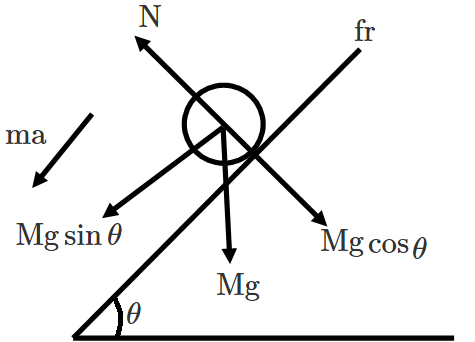
From the free body diagram, we have:

$\text{N}=\text{mg}\cos\theta\ \dots(\text{i})$

$\text{ma}=\text{mg}\sin\theta-\text{f}_{\text{r}}\ \dots(\text{ii})$

Putting $\text{f}_{\text{r}}=\mu\text{N}$ in (ii) we get,

$\text{a}=\text{g}(\sin\theta-\mu\cos\theta)$

The friction coefficients between the objects and the incline are same and not sufficient to allow pure rolling; therefore, all the bodies come down with the same acceleration.

Need a full question paper?

Generate a complete, print-ready paper with questions like this in minutes — across 16+ boards, with answer keys.

Start Generating Free

Similar questions

For one mole of gas, the dimensional formula of R in the equation PV = RT will be :
Two springs A and B(kA = 2kB) are stretched by applying forces of equal magnitudes at the four ends. If the energy stored in A is E, that in B is:
The decay constant of a radioactive sample is $\lambda.$ The half-life and the average-life of the sample are respectively:

  1. $\frac{1}{\lambda}$ and $\Big(\text{ln}\frac{2}{\lambda}\Big)$

  2. $\Big(\text{ln}\frac{2}{\lambda}\Big)$ and $\frac{1}{\lambda}$

  3. $\lambda(\text{ln}2)$ and $\frac{1}{\lambda}$

  4. $\frac{\lambda}{(\text{ln})2}$ and $\frac{1}{\lambda}$

A block of mass M is hanging over a smooth and light pulley through a light string. T he other end of the string is pulled by a constant force F. The kinetic energy of the block increases by 20J in 1s.
  1. The tension in the string is Mg.
  2. The tension in the string is F.
  3. The work one by the tension on the block is 20J in the above 1s.
  4. The work done by the force of gravity is -20J in the above 1s.
A force $F$ is applied on the wire of radius $r$ and length $L$ and change in the length of wire is $l.$ If the same force $F$ is applied on the wire of the same material and radius $2r$ and length $2L,$ Then the change in length of the other wire is
A particle revolves round a circular path. The acceleration of the particle is
A thin circular disc of mass $M$ and radius $R$ is rotating in a horizontal plane about an axis passing through its centre and perpendicular to its plane with angular velocity $\omega$. If another disc of same dimensions but of mass $\mathrm{M} / 2$ is placed gently on the first disc co-axially, then the new angular velocity of the system is :
Out of the following which quantity does not depend on path
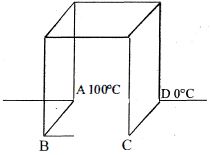
Find Temperature difference between $B$ and $C$ ? (All rods are identical)
Water drops are falling from a nozzle of a shower onto the floor, from a height of $9.8\, {m}$. The drops fall at a regular interval of time. When the first drop strikes the floor, at that instant, the third drop begins to fall. Locate the position of second drop from the floor when the first drop strikes the floor.  (In $m$)