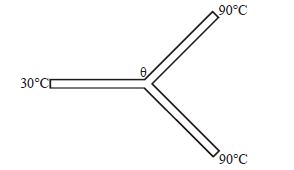
Which of the following statements is wrong
Easy
Download our app for free and get started
(b)Highly polished mirror like surfaces are good reflectors, but not good radiators.

Download our appand get started for free
Experience the future of education. Simply download our apps or reach out to us for more information. Let's shape the future of learning together!No signup needed.*
Similar Questions
- 1The two ends of a metal rod are maintained at temperatures $100 ^o C$ and $110^o C$. The rate of heat flow in the rod is found to be $4.0\ J/s$. If the ends are maintained at temperatures $200^o\ C$ and $210^o\ C$, the rate of heat flow will be.... $J/s$View Solution
- 2The rate of loss of heat from a body cooling under conditions of forced convection is proportional to its $(A)$ heat capacity $(B)$ surface area $(C)$ absolute temperature $(D)$ excess of temperature over that of surrounding : state ifView Solution
- 3View SolutionIn rainy season, on a clear night the black seat of a bicycle becomes wet because
- 4Temperature of a black body increases from ${327^o}C\,{\rm{to}}\,{\rm{92}}{{\rm{7}}^{\rm{o}}}C$, the initial energy possessed is $ 2KJ$ , what is its final energy ..... $KJ$View Solution
- 5An object is at a temperature of ${400^o}C$. At what temperature would it radiate energy twice as fast? The temperature of the surroundings may be assumed to be negligibleView Solution
- 6Two identical plates of different metals are joined to form a single plate whose thickness is double the thickness of each plate. If the coefficients of conductivity of each plate are $2$ and $3$ respectively, then the conductivity of composite plate will beView Solution
- 7A small object is placed at the center of a large evacuated hollow spherical container. Assume that the container is maintained at $0 K$. At time $t =0$, the temperature of the object is $200 K$. The temperature of the object becomes $100 K$ at $t = t _1$ and $50 K$ at $t = t _2$. Assume the object and the container to be ideal black bodies. The heat capacity of the object does not depend on temperature. The ratio $\left( t _2 / t _1\right)$ is. . . . .View Solution
- 8A body of area $1\, cm^2$ is heated to a temperature $1000\, K$. The amount of energy radiated by the body in $1\, second$ is .......... $Joule$ (Stefan's constant $\sigma = 5.67 \times 10^{-8}\, W\, m^{-2}K^{-4}$)View Solution
- 9Instantaneous temperature difference between cooling body and the surroundings obeying Newton's law of cooling is $\theta$. Which of the following represents the variation of $\ln \theta$ with time $t$ ?View Solution
- 10Three identical rods have been joined at a junction to make it a $Y$ shape structure. If two free ends are maintained at $90\,^oC$ and the third end is at $30\,^oC$ , then what is the junction temperature $\theta $ ?......... $^oC$View Solution