MCQ
Which of the following waves can not be polarised ?
  • A
    Radio waves
  • B
    Ultraviolet waves
  • C
    Infrared waves
  • Ultrasonic waves

Answer

Correct option: D.
Ultrasonic waves
d
because ultrasonic waves are sound waves and sound waves are longitudinal waves.

Need a full question paper?

Generate a complete, print-ready paper with questions like this in minutes — across 16+ boards, with answer keys.

Start Generating Free

Similar questions

The ratio of surface tensions of mercury and water is given to be $7.5$ while the ratio of their densities is $13.6$. Their contact angles, with glass, are close to $135^o$ and $0^o$, respectively. It is observed that mercury gets depressed by an amount $h$ in a capillary tube of radius $r_1$, while water rises by the same amount $h$ in a capillary tube of radius $r_2$. The ratio, $(r_1/r_2)$, is then close to
A hosepipe directs a horizontal jet of water moving with velocity of $20\, m/s$ on a vertical wall. The cross-sectional area of jet is $10^{-3}\,m^2$. If density of water is $1000\, kg/m^3$, then force acting on wall is ........... $N$ [Assuming water comes to rest after striking wall]
In a region of uniform magnetic induction $B = {10^{ - 2}}\,tesla$, a circular coil of radius $30\, cm$ and resistance $\pi^2 \;ohm$ is rotated about an axis which is perpendicular to the direction of $B$ and which forms a diameter of the coil. If the coil rotates at  $200\, rpm$ the amplitude of the alternating current induced in the coil is.....$mA$
A lift accelerated downward with acceleration $'a'$. A man in the lift throws a ball upward with acceleration ${a_0}({a_0} < a).$ Then acceleration of ball observed by observer, which is on earth, is
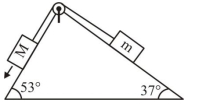
In the given arrangement of a doubly inclined plane two blocks of masses $\mathrm{M}$ and $\mathrm{m}$ are placed. The blocks are connected by a light string passing over an ideal pulley as shown. The coefficient of friction between the surface of the plane and the blocks is $0.25$ . The value of $\mathrm{m}$, for which $\mathrm{M}=10$ $\mathrm{kg}$ will move down with an acceleration of $2 \mathrm{~m} / \mathrm{s}^2$, is : (take $\mathrm{g}=10 \mathrm{~m} / \mathrm{s}^2$ and $\left.\tan 37^{\circ}=3 / 4\right)$
Two point charge $-q$ and $+q/2$ are situated at the origin and at the point $(a, 0, 0)$ respectively. The point along the $X$ - axis where the electric field vanishes is
particle is moving along $x-$ axis back and forth in a box of length $L$. Assuming de -broglie hypothesis applicable for the particle, and it is moving with constant speed in the box making perfectly elastic collisions to the walls. The possible value of momentum of the particle is (Note : $h$ is plank constant, $n$ is principal quantum number)
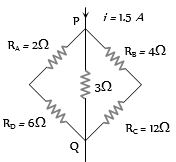
Potential difference between the points $P$ and $Q$ in the electric circuit shown is ................. $V$
Which of the following speed-time $(v-t)$ graphs is physically not possible?
If a wire of length $1\, meter$ placed in uniform magnetic field $1.5\, Tesla$ at angle ${30^o}$ with magnetic field. The current in a wire $10\, amp$. Then force on a wire will be.......$N$