MCQ
Which of the processes described below are irreversible?
  • A
    The increase in temprature of an iron rod by hammering it.
  • B
    A gas in a small cantainer at a temprature T1 is brought in contact with a big reservoir at a higher temprature T2 which increases the temprature of the gas.
  • C
    A quasi-static isothermal expansion of an ideal gas in cylinder fitted with a frictionless piston.
  • D
    An ideal gas is enclosed in a piston cylinder arrangement with adiabatic walls. A weight W is added to the piston, resulting in compression of gas.

Answer

  1. The increase in temprature of an iron rod by hammering it.
  2. A gas in a small cantainer at a temprature T1 is brought in contact with a big reservoir at a higher temprature T2 which increases the temprature of the gas.
  3. A quasi-static isothermal expansion of an ideal gas in cylinder fitted with a frictionless piston

Explanation:

Key concept: Reversible process: A reversible process is one which can be reversed in such a way that all changes occurring in the direct process are exactly repeated in the opposite order and inverse sense and no change is left in any of the bodies taking part in the process or in the surroundings.
The conditions for reversibility are:

  • There must be complete absence of dissipative forces such as friction, viscosity, electric resistance etc. ~
  • The direct and reverse processes must take place infinitely slowly.
  • The temperature of the system must not differ appreciably from its surroundings.

Irreversible process: Any process which is not reversible exactly is an irreversible process. All natural processes such as conduction, radiation, radioactive decay etc. are irreversible. All practical processes such as free expansion, Joule-Thomson expansion, electrical heating of a wire are also irreversible.

  1. In this case internal energy of the rod is increased from external work done by hammer which in turn increases its temperature. So, the process cannot be retraced itself.
  2. In this process energy in the form of heat is transferred to the gas in the small container by big reservoir at temperature T
  3. In a quasi-static isothermal expansion, the gas is ideal, this process is reversible because the cylinder is fitted with frictionless piston.
  4. As the weight is added to the cylinder arrangement in the form of external pressure hence, it cannot be reversed back itself.

Need a full question paper?

Generate a complete, print-ready paper with questions like this in minutes — across 16+ boards, with answer keys.

Start Generating Free

Similar questions

A gas is being compressed adiabatically. The specific heat of the gas during compression is
$A$ ball whose size is slightly smaller than width of the tube of radius $2.5 \,m$ is projected from bottommost point of a smooth tube fixed in a vertical plane with velocity of $10\, m/s$. If $N_1$ and $N_2$ are the normal reactions exerted by inner side and outer side of the tube on the ball
A planet in a distant solar system is $10$ times more massive than the earth and its radius is $10$ times smaller. Given that the escape velocity from the earth is $11$ $km/s$, the escape velocity from the surface of the planet would be ........  $kms^{-1}$.
Two masses $A$ and $B ,$ each of mass $M$ are fixed together by a massless spring. $A$ force acts on the mass $B$ as shown in figure. If the mass $A$ starts moving away from mass $B$ with acceleration $'a',$ then the acceleration of mass $B$ wil be :-
A bob of mass ' $m$ ' is suspended by a light string of length ' $L$ '. It is imparted a minimum horizontal velocity at the lowest point $A$ such that it just completes half circle reaching the top most position B. The ratio of kinetic energies $\frac{(\text { K.E. })_A}{(\text { K.E. })_B}$ is:
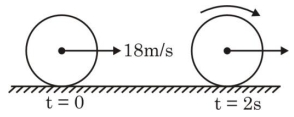
A uniform disc of mass $0.5\,kg$ and radius $r$ is projected with velocity $18\,m / s$ at $t =0\,s$ on a rough horizontal surface. It starts off with a purely sliding motion at $t =0\,s$. After $2\,s$ it acquires a purely rolling motion (see figure). The total kinetic energy of the disc after $2\,s$ will be $..............J$

(given, coefficient of friction is $0.3$ and $\left.g =10\,m / s ^2\right)$

A mercury drop of radius $10^{-3}\,m$ is broken into $125$ equal size droplets. Surface tension of mercury is $0.45\,Nm ^{-1}$. The gain in surface energy is $......\times 10^{-5}\,J$
A body of mass $5\,kg$ rests on a rough horizontal surface of coefficient of friction $0.2.$ The body is pulled through a distance of $10\,m$ by a horizontal force of $25\, N$. The kinetic energy acquired by it is ......... $J$
A ball of mass $( m )=0.5 \ kg$ is attached to the end of a string having length $(L)$ $=0.5 m$. The ball is rotated on a horizontal circular path about vertical axis. The maximum tension that the string can bear is $324 \ N$. The maximum possible value of angular velocity of ball (in radian/s) is
A ball of mass ${m_1}$ and another ball of mass ${m_2}$ are dropped from equal height. If time taken by the balls are ${t_1}$ and ${t_2}$ respectively, then