MCQ
Which of the reactions shown given will be faster?
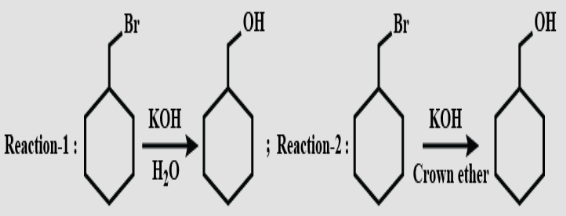
  • A
    Reaction $1$
  • Reaction $2$
  • C
    Both have equal rates of reaction.
  • D
    Cannot be predicted.

Answer

Correct option: B.
Reaction $2$
Since given reaction is $\ce{S_{N2}}$​ and we know that $\ce{S_{N2}}$​ favoured in presence of polar aprotic solvent like crown$-$ethers, $\ce{DMSO, DMF}$, etc not $\ce{H_2​O}$ which is polar protic solvent.
In reaction $2$ polar solvent $($crown ether$)$ is used.
Thus reaction $2$ is faster than reaction $1$.

Need a full question paper?

Generate a complete, print-ready paper with questions like this in minutes — across 16+ boards, with answer keys.

Start Generating Free

Similar questions

Anomalous pair among the following is :
Carbon atoms in benzene molecule is inclined at an angle of
Given below are two statements:

Statement- $I$: Along the period, the chemical reactivity of the element gradually increases from group $1$ to group $18$.

Statement - $II$: The nature of oxides formed by group $1$ element is basic while that of group $17$ elements is acidic.In the the light above statements, choose the most appropriate from the questions given below:
The partial pressures of $C{H_3}OH,\,CO$ and ${H_2}$ in the equilibrium mixture for the reaction $CO + 2{H_2}$ $\rightleftharpoons$ $CH_3OH$ at $427\,^oC$ are $2.0$, $1.0$ and $0.1$ $atm$ respectively. The value of ${K_P}$ for the decomposition of $C{H_3}OH$ to $CO$ and ${H_2}$ is
Amongst the following, the compound that can be most readily sulphonated is
An atom has the electronic configuration of $1{s^2},2{s^2}2{p^6}$, $3{s^2}3{p^6}3{d^{10}},4{s^2}4{p^5}$. Its atomic weight is $ 80.$  Its atomic number and the number of neutrons in its nucleus shall be
The hybridization states of the central atoms of the ions $I_3^-,\,ICl_4^-$ and $ICl_2^-$ are respectively
Product of the reacion is
The molar heat capacity $(C_p)$ of $CD_2O$ is $10$ cals at $1000\, K$. The change in entropy associated with cooling of $32\, g$ of $CD_2O$ vapour from $1000\, K$ to $100\, K$ at constant pressure will be.....$cal\, deg^{-1}$ ($D\, =$ deuterium, atomic mass $= 2\,u$)
Arrange the following according to the increasing order of stability :- Propene $(I)$, cis but $-2-$ ene $(II)$, trans-but $-2-$ ene $(III)$, $2,3-$ dimethylbut $-2-$ ene $(IV)$, ethene $(V)$