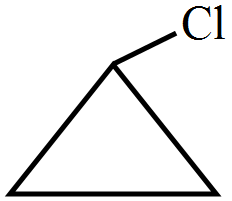
MCQ 11 Mark
$\text{HCHO}$ and $\text{HCOOH}$ are detected by:
AnswerCorrect option: A. $ \mathrm{NaHCO}_3 $
Both $\text{HCHO}$ and $\text{HCOOH}$ react with $\ce{AgNO_3/NH_4OH}$
$\ce{CuSO_4/NaOH}$ solution. But $\ce{HCOOH}$ gives effervescences of $\ce{CO_2}$ when reacts with $\ce{NaHCO_3}$, whereas $\ce{HCHO}$ does not give any effervescence of $\ce{CO_2}$ when reacts with $\ce{NaHCO_3}$.
$\ce{HCOOH + NaHCO_3 \rightarrow HCOONa + H_2O + CO_2 \uparrow}$
View full question & answer→MCQ 21 Mark
$\sigma_{\text{C}-\text{C}} :4 ;\ \sigma_{\text{C}-\text{H}}:6;\ \pi_{\text{C}=\text{C}}:1; \ \pi_{\text{C}\equiv\text{C}}:2$ These number of $\sigma$ and $\pi$-bonds are present in which of the following molecule?
- ✓
$\text{CH}\equiv\text{C} -\text{CH}=\text{CH}-\text{CH}_{3}$
- B
$\text{CH}_{2}=\text{C}=\text{CH}-\text{CH}_{3}$
- C
$\text{CH}_{2}=\text{CH}-\text{CH}=\text{CH}_{3}$
- D
AnswerCorrect option: A. $\text{CH}\equiv\text{C} -\text{CH}=\text{CH}-\text{CH}_{3}$
View full question & answer→MCQ 31 Mark
In which of the following inductive effect is possible:
AnswerTo show inductive effect compound must contain electronegative element$/$eletropositive element attatched to $C-$atom.
So that movement of electrons away from chain$/$towards chain would occur. This is possible only in case of Butanal among given options.
View full question & answer→MCQ 41 Mark
Sodium nitroprusside reacts with sodium sulphide formed in lassaigne's test to detect presence of sulphur gives violet colour due to:
- A
$\text{Na}_2\big[\text{Fe}(\text{CN})_5\text{NO}\big]$
- ✓
$\text{Na}_4\big[\text{Fe}(\text{CN})_5\text{NOS}\big]$
- C
$\text{Na}_2\big[\text{Fe}(\text{CN})_5\text{COS}\big]$
- D
AnswerCorrect option: B. $\text{Na}_4\big[\text{Fe}(\text{CN})_5\text{NOS}\big]$
$\text{Na}_2\text{S}+\text{Na}_2\big[\text{Fe}(\text{CN})_5\text{NO}\big]\xrightarrow{\ \ \ \ }\text{Na}_4\big[\text{Fe}(\text{CN})_5\text{NOS}\big]\\\ \ \ \ \ \ \ \ \ \ \ \ \ \ \ \ \ \ \ \ \ \ \ \ \ \ \ \ \ \ \ \ \ \ \ \ \ \ \ \ \ \ \ \ \ \ \ \ \ \ \ \ \ \ \ \ \ \ \ \ \text{Violet coloour}$
View full question & answer→MCQ 51 Mark
Consider the following compounds,
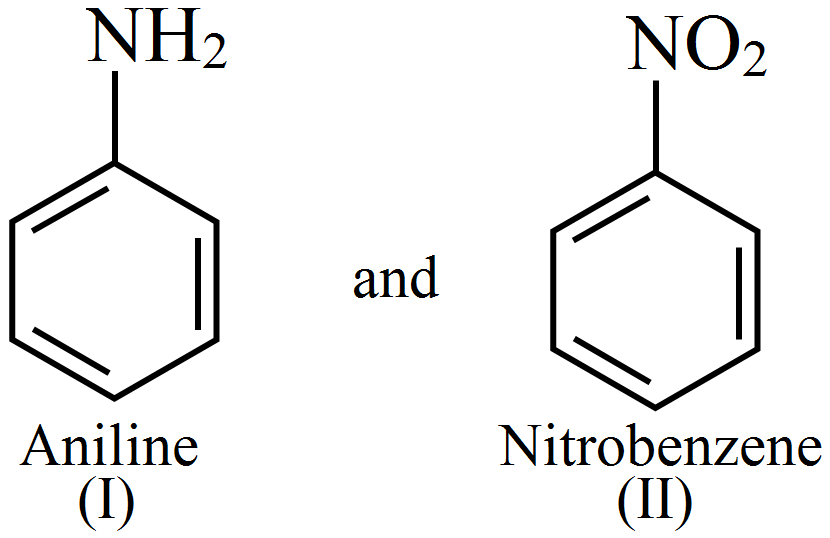
Which of the following statements is$/$ are true regarding $I$ and $II$? - ✓
I shows $+R-$effect, whereas $II$ shows $-R-$effect.
- B
I shows $-R-$effect, whereas $II$ shows $+R-$effect.
- C
Both $I$ and $II$ show $+R-$effect.
- D
Both $I$ and $II$ show $-R-$effect.
AnswerCorrect option: A. I shows $+R-$effect, whereas $II$ shows $-R-$effect.
View full question & answer→MCQ 61 Mark
The principle involved in paper chromatography is:
AnswerIn paper chromatography, separation of the components of a mixture depends upon their partitioning between water held in the stationary phase $($i.e. adsorbent paper$)$ and the liquid present in the mobile phase.
View full question & answer→MCQ 71 Mark
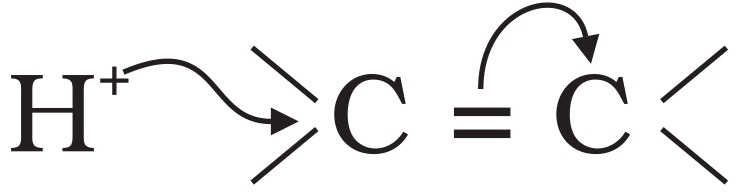
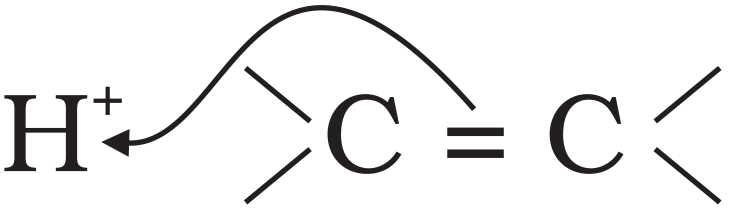
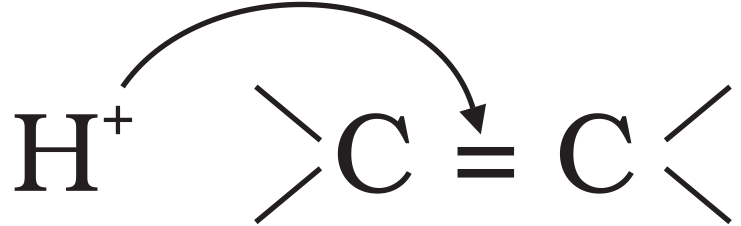
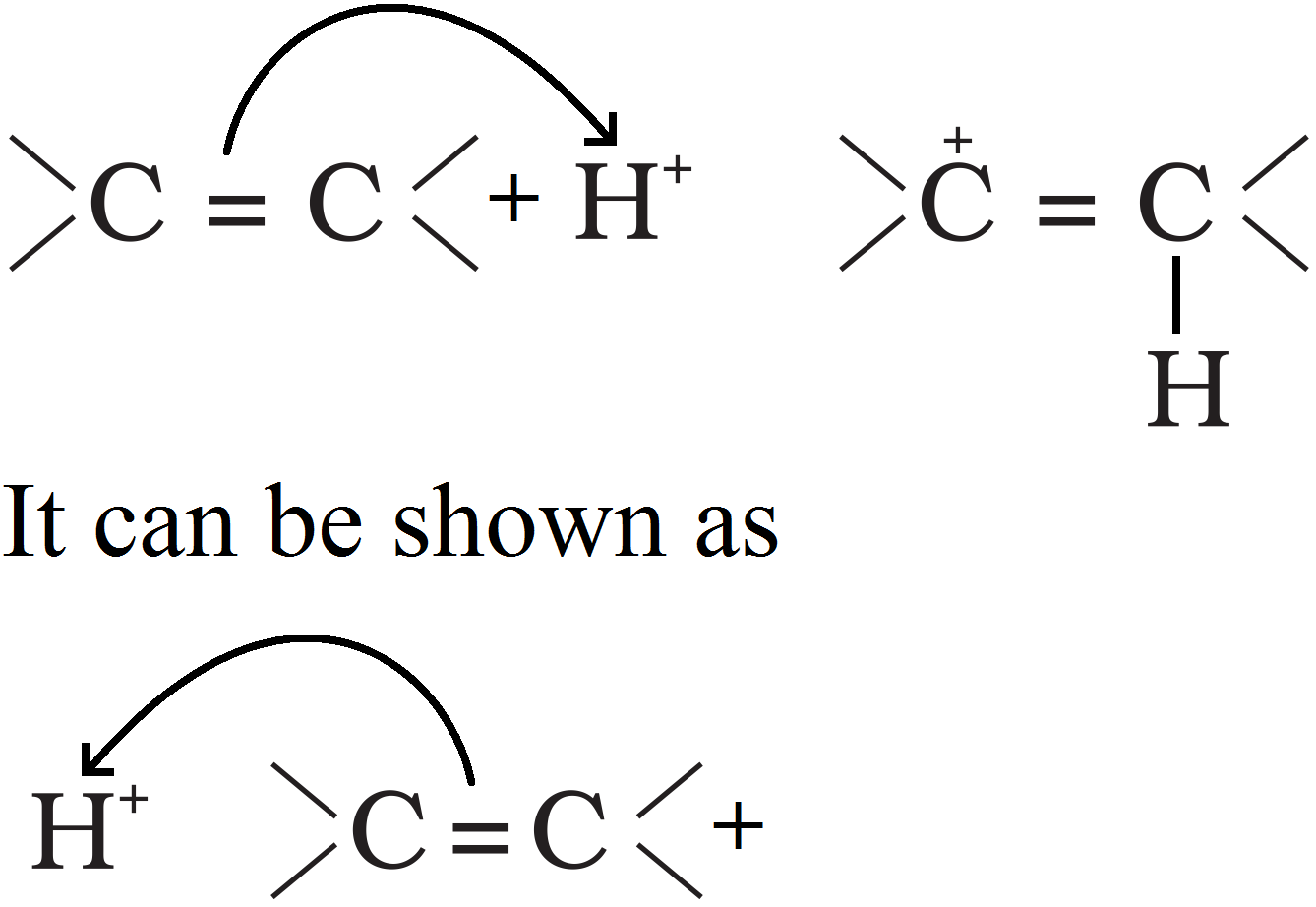
The addition of $\ce{HCl}$ to an alkene proceeds in two steps. The first step is the attack of $H^+$ ion to 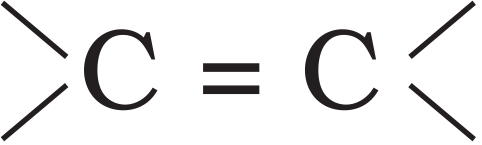 portion which can be shown as:
 - A
- ✓
- C
- D
All of these are possible.
AnswerSince double bond is a source of electrons and the charge flows from source of more electron density, therefore, $n$ electrons of the double bond attack the proton.
View full question & answer→MCQ 81 Mark
Which of the reactions shown given will be faster?
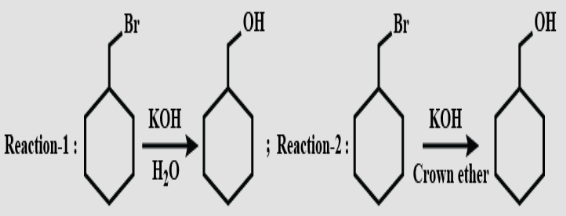
- A
Reaction $1$
- ✓
Reaction $2$
- C
Both have equal rates of reaction.
- D
AnswerCorrect option: B. Reaction $2$
Since given reaction is $\ce{S_{N2}}$ and we know that $\ce{S_{N2}}$ favoured in presence of polar aprotic solvent like crown$-$ethers, $\ce{DMSO, DMF}$, etc not $\ce{H_2O}$ which is polar protic solvent.
In reaction $2$ polar solvent $($crown ether$)$ is used.
Thus reaction $2$ is faster than reaction $1$.
View full question & answer→MCQ 91 Mark
Successive members of homologous series differ from one another in their mass by:
- A
$10$ units
- B
$15$ units
- C
$20$ units
- ✓
$14$ units
AnswerCorrect option: D. $14$ units
A series of organic compounds with the same general formula but differ from adjacent members by $\ce{"−CH_2v−"}$ group are referred to as homologous series of compounds. Successive members of homologous series differ from one another in their mass by $14$ units.
For example: $\ce{CH_4}$ and $\ce{C_2H_6}$ are homologous series. Its molar mass is 16 and 30gm/mole respectively.
Hence, it is differed by unit $14$.
View full question & answer→MCQ 101 Mark
Electronegativity of carbon atoms depends upon their state of hybridisation. In which of the following compounds, the carbon marked with asterisk is most electronegative?
- A
$ \mathrm{CH}_3-\mathrm{CH}_2-{ }^* \mathrm{CH}_2-\mathrm{CH}_3 $
- B
$ \mathrm{CH}_3-{ } ^*\mathrm{CH}=\mathrm{CH}-\mathrm{CH}_3 $
- ✓
$ \mathrm{CH}_3-\mathrm{CH}_2-\mathrm{C} \equiv{ }^* \mathrm{CH} $
- D
$ \mathrm{CH}_3-\mathrm{CH}_2-\mathrm{CH}={ }^* \mathrm{CH}_2$
AnswerCorrect option: C. $ \mathrm{CH}_3-\mathrm{CH}_2-\mathrm{C} \equiv{ }^* \mathrm{CH} $
Electronegativity increases as the state of hybridization changes from $sp^3$ to $sp^2$ and $sp^2$ to sp. Thus, sp hybridized carbon has the highest electronegativity.
View full question & answer→MCQ 111 Mark
Which term is the best match for the color of a chemical substance students make note of:
AnswerColor of the substance is the qualitative property. Qualitative properties are the properties which can be observed without making any measurements or calculations.
View full question & answer→MCQ 121 Mark
Yellow ammonium sulphide can separate:
- ✓
$\ce{CdS}$ and $\mathrm{As}_2 \mathrm{S}_3$
- B
$\mathrm{Bi}_2 \mathrm{S}_3$ and $\ce{CuS}$
- C
$\ce{PbS}$ and $\mathrm{Bi}_2 \mathrm{S}_3$
- D
$\ce{HgS}$ and $\ce{PbS}$
AnswerCorrect option: A. $\ce{CdS}$ and $\mathrm{As}_2 \mathrm{S}_3$
Since $\ce{CdS}$ belongs to $\ce{IIA}$ group and $\mathrm{As}_2 \mathrm{S}_3$ belongs to $\ce{IIB}$ group, they can be separated with yellow ammonium sulphide as only $\ce{IIB}$ group sulphides dissolve in yellow ammoium sulphide.
View full question & answer→MCQ 131 Mark
Which of the following pairs are members of a homologous series?
- A
$ \mathrm{CH}_3 \mathrm{OCH}_3 ; \mathrm{CH}_3 \mathrm{CH}_2 \mathrm{OH} $
- ✓
$ \mathrm{CH}_3 \mathrm{CHO} ; \mathrm{CH}_3 \mathrm{CH}_2 \mathrm{CHO} $
- C
$ \mathrm{CH}_3 \mathrm{CH}_2 \mathrm{COOH} ; \mathrm{CH}_3 \mathrm{COOCH}_3$
- D
$\left(\mathrm{CH}_3\right)_2 \mathrm{CHOH} ; \mathrm{CH}_3 \mathrm{CH}_2 \mathrm{OH} $
AnswerCorrect option: B. $ \mathrm{CH}_3 \mathrm{CHO} ; \mathrm{CH}_3 \mathrm{CH}_2 \mathrm{CHO} $
Acetaldehyde i.e $ \mathrm{CH}_3 \mathrm{CHO}$ and propionaldehyde i.e $\mathrm{CH}_3 \mathrm{CH}_2 \mathrm{CHO} $ belong from the aldehyde family hence they are homologous series.
View full question & answer→MCQ 141 Mark
The bond that consist of an upper and a lower sharing of electron orbitals is called as :
AnswerCorrect option: A. A $pi$ bond
The bond that consist of an upper and a lower sharing of electron orbitals is called as a $pi$ bond.
A pi bond is formed by lateral $($side ways$)$ overlap.
For example, two $\ce{2pz}$ orbitals of two $C$ atoms laterally overlap to for pi bond in ethene $\mathrm{CH}_2=\mathrm{CH}_2$.
View full question & answer→MCQ 151 Mark
In Kjeldahl's method for estimation of nitrogen, $\ce{CuSO_4}$ acts as:
AnswerIn Kjeldahl's method $($used for the estimation of nitrogen$)$ the organic compound is heated with conc. $\mathrm{H}_2 \mathrm{SO}_4$ in the presence of $\mathrm{K}_2 \mathrm{SO}_4 ($used to elevate boiling point of $\mathrm{H}_2 \mathrm{SO}_4 )$ and $\mathrm{CuSO}_4($used as catalyst$)$ to convert all the nitrogen into $\left(\mathrm{NH}_4\right)_2 \mathrm{SO}_4$
View full question & answer→MCQ 161 Mark
In each of the following, the carbonyl group is present except in:
- A
$\ce{HCHO}$
- B
$ \mathrm{CH}_3 \mathrm{COCH}_3 $
- ✓
$ \mathrm{HCH}_2 \mathrm{OH}$
- D
$\ \ \ \ \ \ \ \ \ \ \ \ \text{O}\\\ \ \ \ \ \ \ \ \ \ \ \ ||\\\text{CH}_3−\text{C}−\text{H}$
AnswerCorrect option: C. $ \mathrm{HCH}_2 \mathrm{OH}$
Carbonyl group is $−C = O$ group, which present in aldehydes and ketones but not present in alcohols.
View full question & answer→MCQ 171 Mark
In the detection test of carbon and hydrogen with cupric oxide, carbon is oxidized to:
AnswerThe given organic compound is mixed with dry copper oxide $\ce{(CuO)}$ and heated in a hard glass tube. The products of the reaction are passed over $($white$)$ anhydrous copper sulphate and then bubbled through lime water.
If copper sulphate turns blue due to the formation of $\mathrm{CuSO}_4 \cdot 5 \mathrm{H}_2 \mathrm{O} ($by water vapor$)$ then the compound contains hydrogen.
If lime water is turned milky by $\ce{CO_2}$, then the compound contains carbon.So, the carbon is oxidized to $\ce{CO_2}$.
View full question & answer→MCQ 181 Mark
In Dumas method, $0.25\ g$ of organic compound gave $40\ ml$ of $N$, at $300k$ and $725\ mm$ pressure. If aqueous tension at $300k$ is $25\ mm$, the percentage of nitrogen in compound is:
- ✓
$16.76\%$
- B
$15.76\%$
- C
$17.36\%$
- D
$18.20\%$
AnswerCorrect option: A. $16.76\%$
$\frac{\text{P}_1\text{V}_1}{\text{T}_1}=\frac{\text{P}_2\text{V}_2}{\text{T}_2}\Rightarrow \frac{40\times760}{300}=\frac{\text{V}_2\times760}{273}$
$\Rightarrow\text{V}_2=\frac{28\times273}{76\times3}$ $[\text{P}=725-25=700\text{mm}]$
$\text{V}_2=\frac{7644}{228}=33.53\ \text{mL}$
$\%\text{ of }\text{N}=\frac{\text{V}_2}{8\text{w}}=\frac{33.53}{8\times0.25}=16.76\%$
View full question & answer→MCQ 191 Mark
Covalent bond can undergo fission in two different ways. The correct representation involving a heterolytic fission of $\ce{CH_3—Br}$ is :
AnswerArrow denotes the direction of movement of electrons
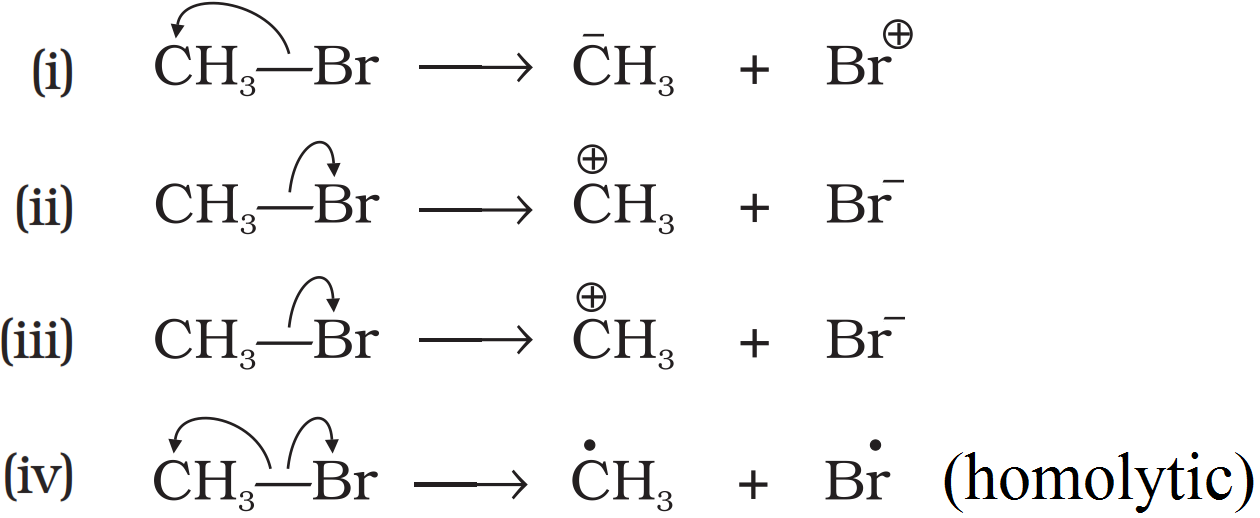
Since, $Br$ is more electronegative than carbon, hence heterolytic fission occurs in such a. View full question & answer→MCQ 201 Mark
Name the two types of chromatography techniques based on the principle of differential adsorption.
- A
Column chromatography and thick layer chromatography.
- B
Non-column chromatography and thin layer chromatography.
- ✓
Column chromatography and thin layer chromatography.
- D
Paper chromatography and thick layer chromatography.
AnswerCorrect option: C. Column chromatography and thin layer chromatography.
Two types of adsorption chromatography techniques are column chromatography and thin layer chromatography.
View full question & answer→MCQ 211 Mark
Homologous series is $.........$
- ✓
A series of compounds in which the same functional group substitutes for hydrogen in a carbon chain.
- B
A series of compounds in which different functional group substitutes for hydrogen in a carbon chain.
- C
A series of compounds with same molecular formula and different structural formulae.
- D
A series of compounds with same molecular formula but different functional groups.
AnswerCorrect option: A. A series of compounds in which the same functional group substitutes for hydrogen in a carbon chain.
Homologous series is a series of compounds in which the same functional group substitutes for hydrogen in a carbon chain. The chemical properties of the compounds are very similar.
Example of a homologous series : $\mathrm{CH}_3 \mathrm{OH}, \mathrm{C}_2 \mathrm{H}_5 \mathrm{OH}, \mathrm{C}_3 \mathrm{H}_7 \mathrm{OH}, \mathrm{C}_4 \mathrm{H}_9 \mathrm{OH}$.
View full question & answer→MCQ 221 Mark
$Pi$ bond is formed:
- A
By the overlapping of atomic orbitals on the axis of nuclei.
- B
By mutual sharing of $p -$ electrons.
- ✓
By sideways overlapping of half filled $p -$ orbitals.
- D
By overlapping of $s-$orbitals with $p -$ orbital.
AnswerCorrect option: C. By sideways overlapping of half filled $p -$ orbitals.
If a bond between two atoms is broken when one atom is rotated around the bond axis, that bond is called a $pi$ bond.
$Pi$ bonds are formed by the sideways overlap of parallel half filled $p−$orbitals on adjacent atoms as shown in the figure.
They are not formed from hybrid orbitals.
View full question & answer→MCQ 231 Mark
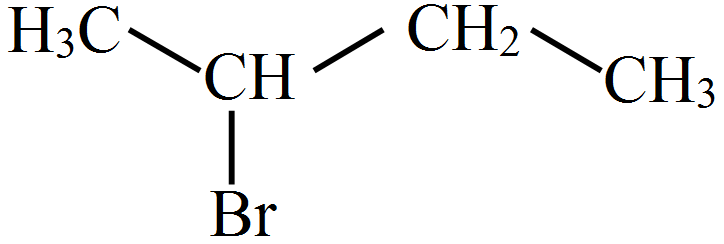
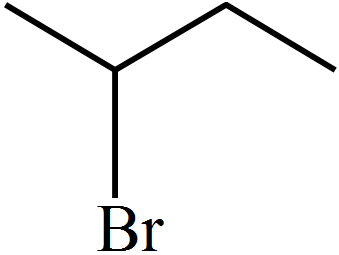
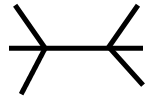
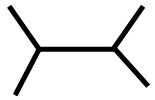
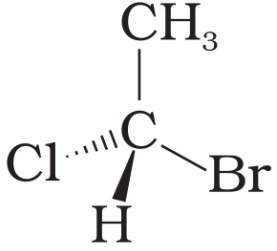
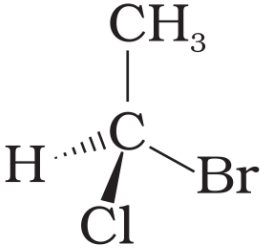
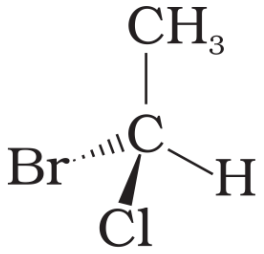
The correct way$(s)$ of representing $2-$bromobutane is$/$ are:
View full question & answer→MCQ 241 Mark
Which general formula represents the homologous series of hydrocarbons that includes the compound $1-$heptyne?
- A
$ \mathrm{C}_n \mathrm{H}_{2 n-6} $
- B
$ \mathrm{C}_n \mathrm{H}_{2 n} $
- ✓
$ \mathrm{C}_n \mathrm{H}_{2 n-2} $
- D
$ \mathrm{C}_n \mathrm{H}_{2 n+2}$
AnswerCorrect option: C. $ \mathrm{C}_n \mathrm{H}_{2 n-2} $
$1-$heptyne is alkyne. The general formula for alkyne is $ \mathrm{C}_n \mathrm{H}_{2 n-2}$.
View full question & answer→MCQ 251 Mark
Sodium extract gives blood red colour when treated with $\ce{FeCl_3}$. Formation of blood red colour confirms the presence of:
- A
- B
- C
- ✓
Both nitrogen and sulphur
AnswerCorrect option: D. Both nitrogen and sulphur
$Na + N + C + S \rightarrow \text{NaSCN} ($Sodium thiocyanate$)$
$\mathrm{SCN}^{-}+\mathrm{Fe}^{+} \rightarrow[\mathrm{Fe}(\mathrm{SCN})]^{2+} ($Ferric thiocyanate$) ($Blood$-$red colour$)$
It confirms the presence of both $N$ and $S$.
View full question & answer→MCQ 261 Mark
The number of structural isomers possible for the molecular formula $= \mathrm{C}_3 \mathrm{H}_9 \mathrm{N}$ is:
AnswerStructural isomers of $\mathrm{C}_3 \mathrm{H}_9 \mathrm{N}$ are
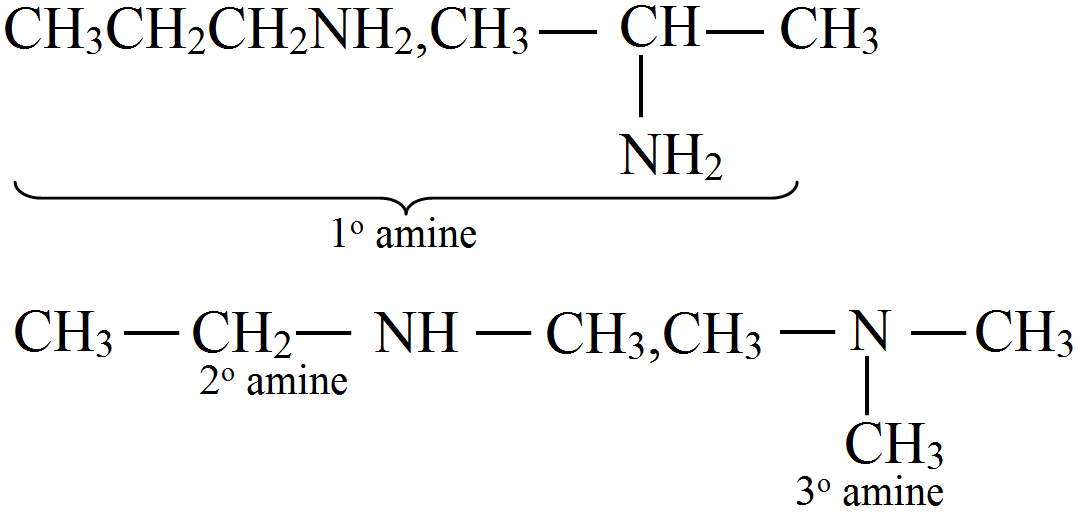
View full question & answer→MCQ 271 Mark
Which substance has the lowest boiling point?
- A
$ \mathrm{CH}_3 \mathrm{CH}_2 \mathrm{CH}_2 \mathrm{CH}_2 \mathrm{OCH}_3 $
- B
$ \mathrm{CH}_3 \mathrm{CH}_2 \mathrm{OCH}_2 \mathrm{CH}_3 $
- ✓
$ \mathrm{CH}_3 \mathrm{CH}_2 \mathrm{CH}_2 \mathrm{CH}_3 $
- D
$ \mathrm{CH}_3 \mathrm{CH}_2 \mathrm{C}=\mathrm{OCH}_3 $
AnswerCorrect option: C. $ \mathrm{CH}_3 \mathrm{CH}_2 \mathrm{CH}_2 \mathrm{CH}_3 $
$ \mathrm{CH}_3 \mathrm{CH}_2 \mathrm{CH}_2 \mathrm{CH}_3 (n−$butane$)$ has the lowest boiling point as it has lowest molecular weight and is non polar. It has weakest intramolecular forces of attraction.
All others are polar compounds and so has dipole$-$dipole inbteraction.
View full question & answer→MCQ 281 Mark
In which of the following, functional group isomerism is not possible?
AnswerAlkyl halides do not show functional isomerism. Alcohols and ethers; aldehydes and ketones; cyanides and isocyanides are functional isomers.
View full question & answer→MCQ 291 Mark
What is the correct $\text{IUPAC}$ name of the following?
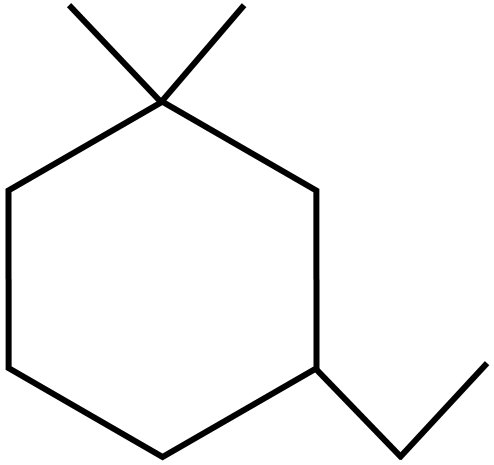
- ✓
$3-$ethyl$-1,1-$dimethylcyclohexane.
- B
$1-$ethyl$-3,3-$dimethylcyclohexane.
- C
$1,1-$dimethyl$-3-$ethylcyclohexane.
- D
AnswerCorrect option: A. $3-$ethyl$-1,1-$dimethylcyclohexane.
The correct $\text{IUPAC}$ name of the following structure is
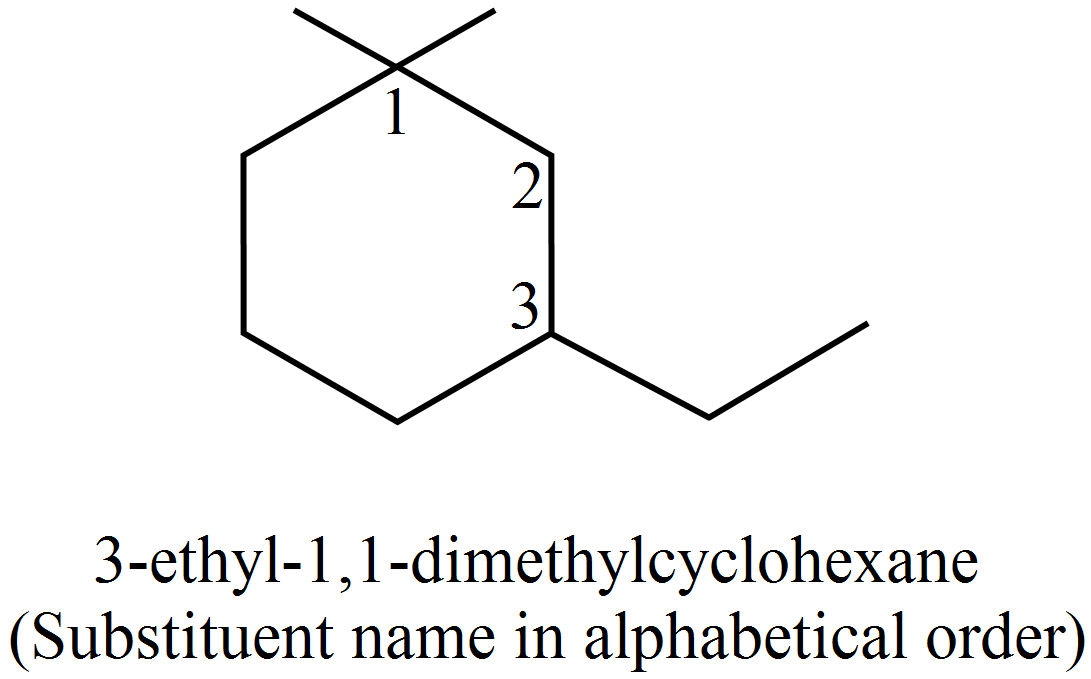
View full question & answer→MCQ 301 Mark
The functional group present in organic acid is :
- A
$\ce{−OH}$
- B
$\ce{−CHO}$
- ✓
$\ce{−COOH}$
- D
$\ce{> C = O}$
AnswerCorrect option: C. $\ce{−COOH}$
The functional group present every organic acid is $\ce{−COOH}$ as it dissociate in water as $\ce{−COO^-}$ and $H^+$.
View full question & answer→MCQ 311 Mark
The difference in energy between the actual structure and lowest energy canonical form is called:
- ✓
- B
- C
Both $(a)$ and $(b)$.
- D
View full question & answer→MCQ 321 Mark
Glycerol can be separated from spent$-$lye in soap industry by:
- A
- B
- C
- ✓
Distillaltion under reduced pressure.
AnswerCorrect option: D. Distillaltion under reduced pressure.
Glycerol decomposes at its boiling point is separated from spent$-$lye by using distillation under reduced pressure.
View full question & answer→MCQ 331 Mark
What is the technological applications of fractional distillation?
- ✓
To separate different fractions of crude oil in petroleum industry.
- B
To separate different fractions of volatile and non-volatile solvents.
- C
To separate mixture of amino acids.
- D
No technological application of fractional distillation.
AnswerCorrect option: A. To separate different fractions of crude oil in petroleum industry.
View full question & answer→MCQ 341 Mark
What does $A$ and $B$ refer to, in the figure of differential extraction? 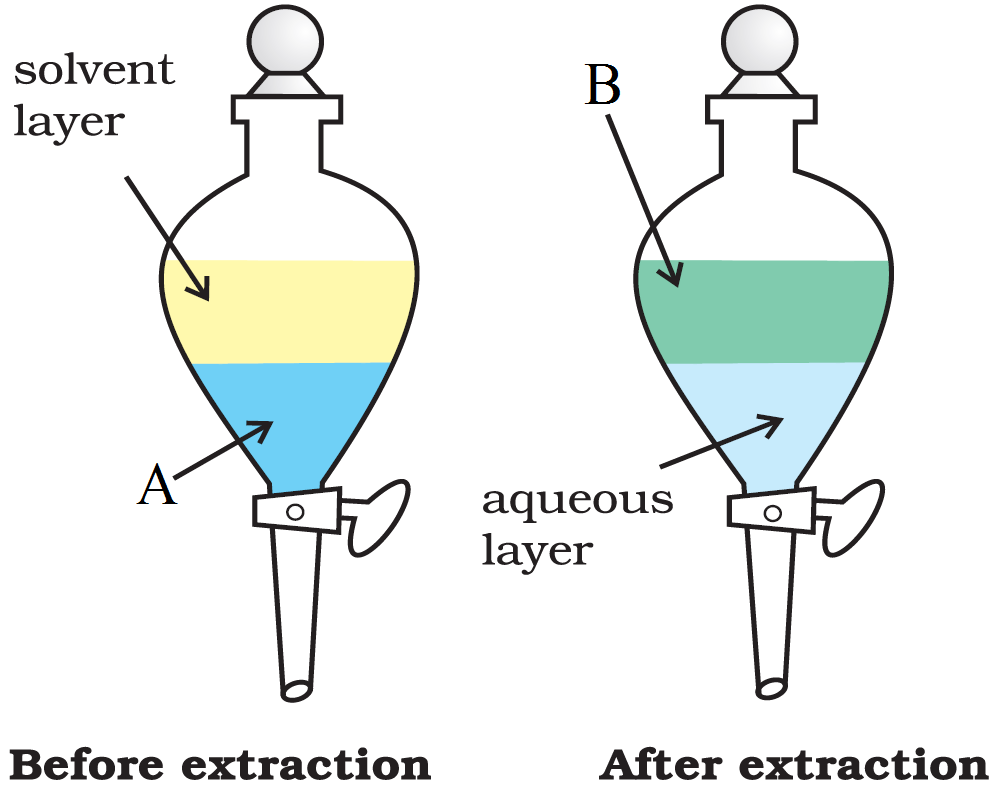 Choose the correct option.
 AnswerCorrect option: A. $A \rightarrow$ Organic compound in aqueous layer. $B \rightarrow$ Organic compound in solvent layer.
- $A \rightarrow$ Organic compound in aqueous layer.
- $B \rightarrow$ Organic compound in solvent layer.
View full question & answer→MCQ 351 Mark
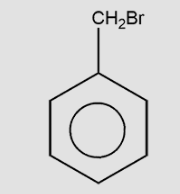
$\text{IUPAC}$ name of the above compound is:
View full question & answer→MCQ 361 Mark
In Carius method of estimation of halogens, $250\ mg$ of an organic compound gave $141\ mg$ of $\text{AgBr}$. The percentage of bromine in the compound is $($atomic mass $Ag = 108$ and $Br = 80)$
View full question & answer→MCQ 371 Mark
Give the functional group of the following. $-\text{OH}$
Answer$−\text{OH}$ represents an alcoholic group. It represents alcohols such as ethanol $\mathrm{CH}_3,-\mathrm{CH}_2,-\mathrm{OH}$.
The general formula of alcohols is $\text{R−OH}$.
View full question & answer→MCQ 381 Mark
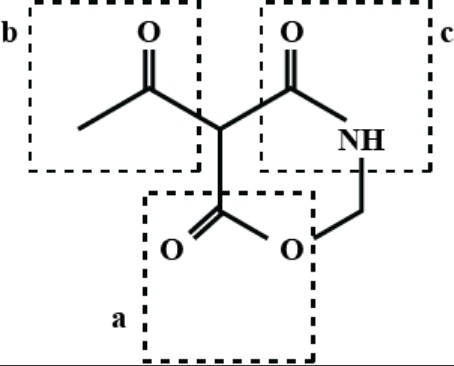
Identify which functional group are not present in the given compound?
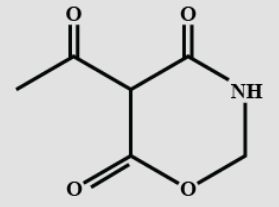
AnswerBox $a$ encloses ester group, $b$ encloses ketone group while $c$ encloses amide group.
Here ether group is not present.
View full question & answer→MCQ 391 Mark
Why does ethane have a higher boiling point than methane?
AnswerEthane have a higher boiling point than methane because molecules of ethane $(\left(\mathrm{C}_2 \mathrm{H}_6\right))$ have more Van der Waals forces $($intermolecular forces$)$ with neighboring molecules than methane $(\mathrm{CH}_4)$ due to the greater number of atoms present in the molecule of ethane compared to methane.
View full question & answer→MCQ 401 Mark
Which of the following should be added in the compound for the detection of carbon and hydrogen?
Answerb. Cu(II) oxide.
Explanation:
Carbon and hydrogen are detected by heating the compound with Cu(II) oxide. Carbon present in the compound is oxidised to carbon dioxide (tested with lime-water, which develop turbidity) and hydrogen to water (tested with anhydrous copper sulphate, which turns blue)
$\text{C}+ 2\text{CuO} \xrightarrow[]{\Delta}2\text{Cu + CO}_{2}\uparrow$
$\text{2H} + \text{CuO}\xrightarrow[]{\Delta} \text{Cu} + \text{H}_{2}\text{O}$
$\text{CO}_{2} + \text{Ca}(\text{OH})_{2} \xrightarrow{\ \ \ \ \ }\text{CaCO}_{3} \downarrow + \text{H}_{2}\text{O}\\ \ \ \ \ \ \ \ \ \ \ \ \ \ \ \ \ \ \ \ \ \ \ \ \ \ \ \ \ \ \ \ \ \ \ \ \ \text{White turbidity}$
View full question & answer→MCQ 411 Mark
Carbon and hydrogen are detected by heating the organic compound with $..........$
AnswerThe detection of various elements present in an organic compound is called qualitative analysis. Carbon and hydrogen are present in almost all the organic compounds.
Carbon and hydrogen are detected by heating the organic compound with cupric oxide $\text{(CuO)}$ strongly, where carbon is oxidized to carbon dioxide and hydrogen to water.
Carbon dioxide is tested by lime water test, whereas water is tested by anhydrous copper sulphate test.
View full question & answer→MCQ 421 Mark
Study the structures given below carefully and choose the type of isomerism they represent.
$ \ \ \ \ \ \ \ \ \ \ \ \ \text{CH}_3 \\ \ \ \ \ \ \ \ \ \ \ \ \ \ \ |\\\ \text{CH}_3-\text{C}-\text{CH}_3 \ \ \ \ \ \ \ \ \ \ \ \ \ \ \ \ \ \ \ \ \ \ \ \ \ \ \ \ \\ \ \ \ \ \ \ \ \ \ \ \ \ \ \ |\\ \ \ \ \ \ \ \ \ \ \ \ \ \ \text{CH}_3$
$ \ \ \ \ \ \ \ \ \ \ \ \ \text{CH}_3 \\ \ \ \ \ \ \ \ \ \ \ \ \ \ \ |\\\ \text{CH}_3-\text{CH}- \text{CH}_2-\text{CH}_3$
Answer$ \ \ \ \ \ \ \ \ \ \ \ \ \text{CH}_3 \\ \ \ \ \ \ \ \ \ \ \ \ \ \ \ |\\\ \text{CH}_3-\text{C}-\text{CH}_3 \ \ \ \ \ \ \ \ \ \ \ \ \ \ \ \ \ \ \ \ \ \ \ \ \ \ \ \ \\ \ \ \ \ \ \ \ \ \ \ \ \ \ \ |\\ \ \ \ \ \ \ \ \ \ \ \ \ \ \text{CH}_3 \ \ \ \ \ \ \ \ \ \ \ \ \text{CH}_3 \\ \ \ \ \ \ \ \ \ \ \ \ \ \ \ |\\\ \text{CH}_3-\text{CH}- \text{CH}_2-\text{CH}_3$
chain isomers as they have different carbon chains.
View full question & answer→MCQ 431 Mark
In the Kjeldahl's method for estimation of nitrogen present in a soil sample, ammonia evolved from $0.75g$ of sample neutralised $10\ mL$ of $1M\ \mathrm{H}_2 \mathrm{SO}$. The percentage of nitrogen in the soil is:
- ✓
$37.33$
- B
$45.33$
- C
$35.33$
- D
$45.33$
AnswerCorrect option: A. $37.33$
View full question & answer→MCQ 441 Mark
Generally pi bond is formed from the lateral overlap of :
- A
$s−s$ orbitals
- B
$p−p$ orbitals
- C
$d−d$ orbitals
- ✓
Both $B$ and $C$
AnswerCorrect option: D. Both $B$ and $C$
$\pi$ bond is formed by lateral $($side ways$)$ overlap of either $p−p, d−d$ or $d−p$ orbitals.
View full question & answer→MCQ 451 Mark
The formula of methane is $ \mathrm{CH}_2 $ and its succeeding member ethane is expressed in $ \mathrm{C_2H_6}$. The common difference of succession between them is:
AnswerCorrect option: A. $ \mathrm{CH}_2 $
Methane and ethane are alkanes. These are saturated carbon compounds.
They have the general formula $\mathrm{C}_n \mathrm{H}_\text{2 n+2}$.
All the alkanes differ by $ \mathrm{CH}_2 $ group successively in the series.
View full question & answer→MCQ 461 Mark
The $\text{IUPAC}$ name of the compound
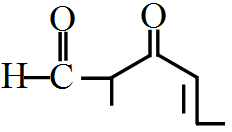
- ✓
$5-$ Formyl hex $-2-$ en $-3-$ one.
- B
$5-$ methyl $-4-$ oxohex $-2-$ en $-5-$ al.
- C
$3-$ keto $-2 $ methyl hex $-5-$ enal.
- D
$3-$ keto $-2-$ methyl hex $-4-$ enal.
AnswerCorrect option: A. $5-$ Formyl hex $-2-$ en $-3-$ one.
Aldehyde group is preferred over keto group.
View full question & answer→MCQ 471 Mark
Preceeding and succeeding homologous of $\mathrm{C}_{11} \mathrm{H}_{24} $ respectively :
- A
$ \mathrm{C}_9 \mathrm{H}_{20}, \mathrm{C}_{11} \mathrm{H}_{22} $
- ✓
$ \mathrm{C}_9 \mathrm{H}_{20}, \mathrm{C}_{11} \mathrm{H}_{24} $
- C
$ \mathrm{C}_{11} \mathrm{H}_{24}, \mathrm{C}_9 \mathrm{H}_{20} $
- D
$ \mathrm{C}_8 \mathrm{H}_{18}, \mathrm{C}_9 \mathrm{H}_{20} $
AnswerCorrect option: B. $ \mathrm{C}_9 \mathrm{H}_{20}, \mathrm{C}_{11} \mathrm{H}_{24} $
Preceeeding homologue is $ \mathrm{C}_9 \mathrm{H}_{20}$.
Succeeding homologue is $\mathrm{C}_{11} \mathrm{H}_{24} $.
View full question & answer→MCQ 481 Mark
Homologous have the same :
AnswerMembers of Homologous series have same chemical properties.
View full question & answer→MCQ 491 Mark
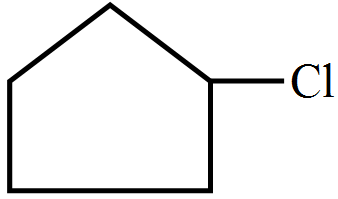
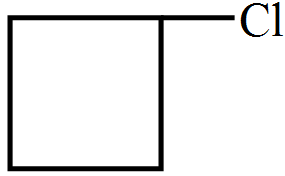
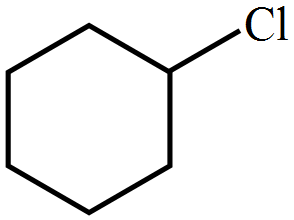
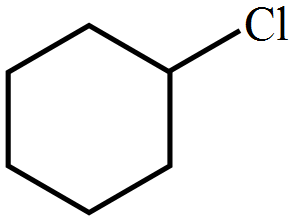
In cyclic compounds, the bond $-$ line formula for chlorocyclohexane is represented by which of the following representations?
AnswerStructure of chlorocyclohexane is :
View full question & answer→MCQ 501 Mark
What is the correct order of decreasing stability of the following cations.
- $\ \ \ \ \ \ \ \ \ \ \ +\\\text{CH}_3-\text{CH}-\text{OCH}_3$
- $\ \ \ \ \ \ \ \ \ \ \ +\\\text{CH}_3-\text{CH}-\text{OCH}_3$
- $\ \ \ \ \ \ \ \ \ \ \ +\\\text{CH}_3-\text{CH}-\text{CH}_2-\text{OCH}_3$
- ✓
$\text{II > I > III}$
- B
$\text{II > III > I}$
- C
$\text{III > I > II}$
- D
$\text{I > II > III}$
AnswerCorrect option: A. $\text{II > I > III}$
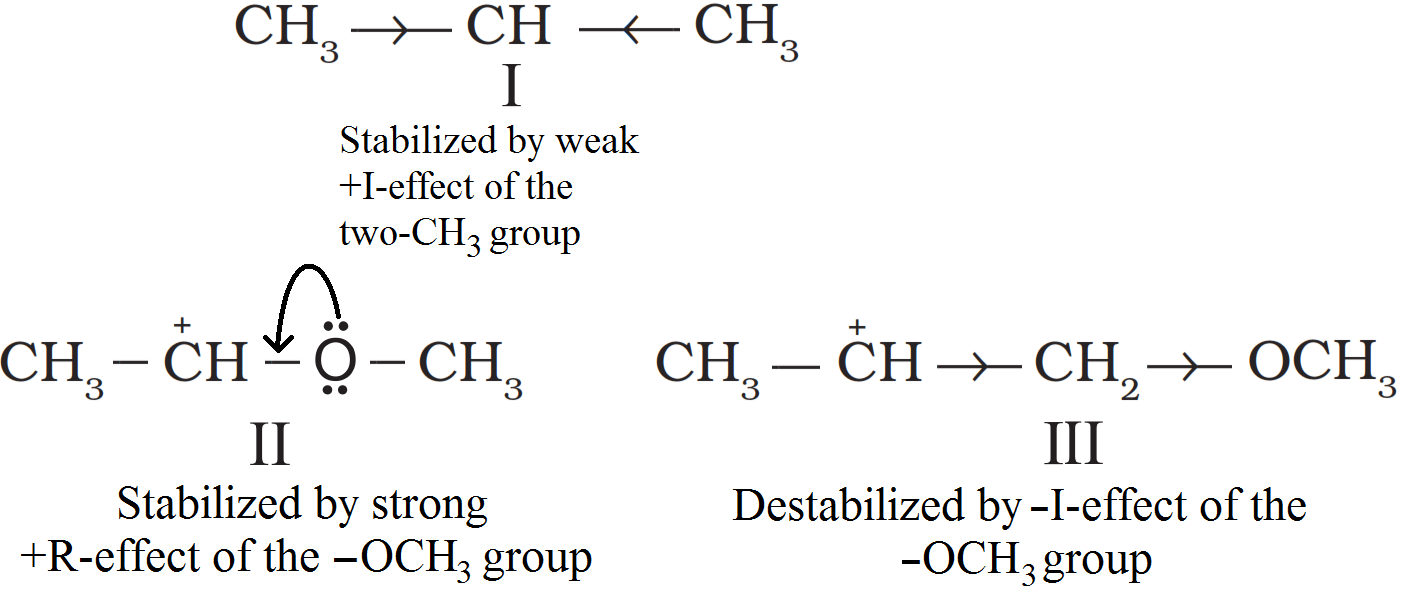
Thus, the stability of carbocation decreasws in the order : $\text{II > I >III}.$ View full question & answer→MCQ 511 Mark
The presence of carbon in an organic compound is detected by heating it with :
- A
Sodium metal to convert it to $\text{NaCN}.$
- B
$\text{CaO}$ to convert it into $\text{CO}$ which burns with a blue flame.
- ✓
$\text{CuO}$ to convert it into $\mathrm{CO}_2$ which turns lime water milky.
- D
$\text{Cu}$ wire to give a bluish $-$ green flame.
AnswerCorrect option: C. $\text{CuO}$ to convert it into $\mathrm{CO}_2$ which turns lime water milky.
The given organic compound is mixed with dry copper oxide $\text{(CuO)}$ and heated in a hard glass tube. The products of the reaction are passed over $($white$)$ anhydrous copper sulphate and then bubbled through lime water.
If copper sulphate turns blue due to the formation of $\mathrm{CuSO}_4 \cdot 5 \mathrm{H}_2 \mathrm{O}$
$($by water vapor$)$ then the compound contains hydrogen. If lime water is turned milky by $\mathrm{CO}_2$, then the compound contains carbon.
View full question & answer→MCQ 521 Mark
The order of $-I$ effect of orbitals is :
- A
$ s p^3 > s p^2 > s p $
- ✓
$ s p > s p^2 > s p^3 $
- C
$ s p^2 > s p^3 > s p $
- D
$ s p^2 > s p > s p^3 $
AnswerCorrect option: B. $ s p > s p^2 > s p^3 $
As $\%s$ character increases, electronegativity of orbitals increases which means its tendency to pull electron towards itself also increases hence $-I$ effect increases.
View full question & answer→MCQ 531 Mark
Linear combination of two hybridised orbitals belonging to two atoms and each having one electron leads to the formation of :
AnswerA sigma bond is a single bond formed by linear combination of hybridised orbitals.
View full question & answer→MCQ 541 Mark
Calculate the amount of $\text{NaOH}$ required to neutralise $\text{100 mL 0.1M} \ \ \mathrm{H}_2 \mathrm{SO}_4$ :
View full question & answer→MCQ 551 Mark
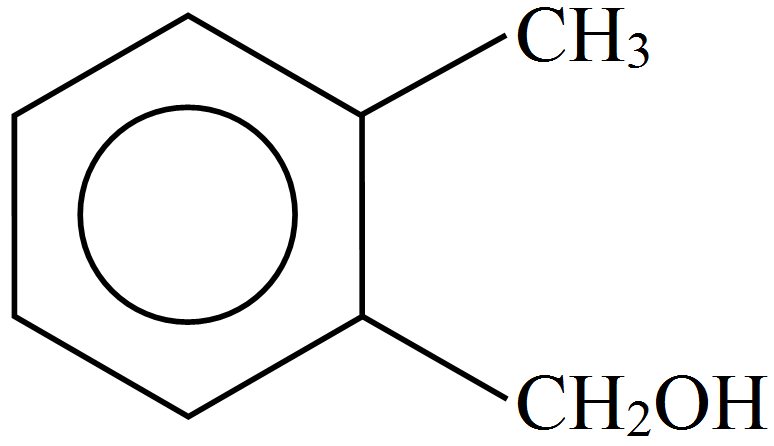
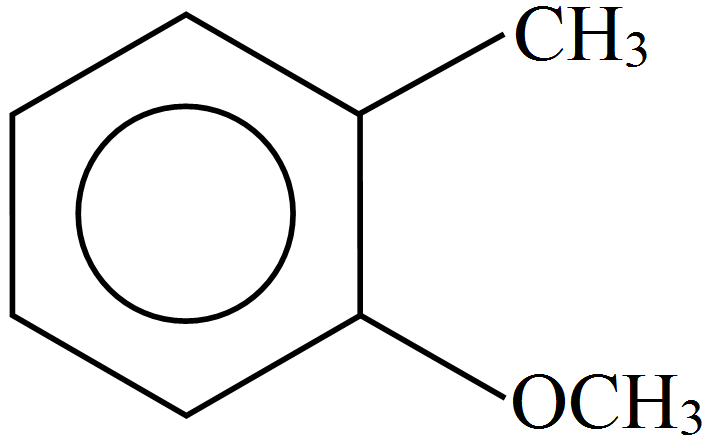
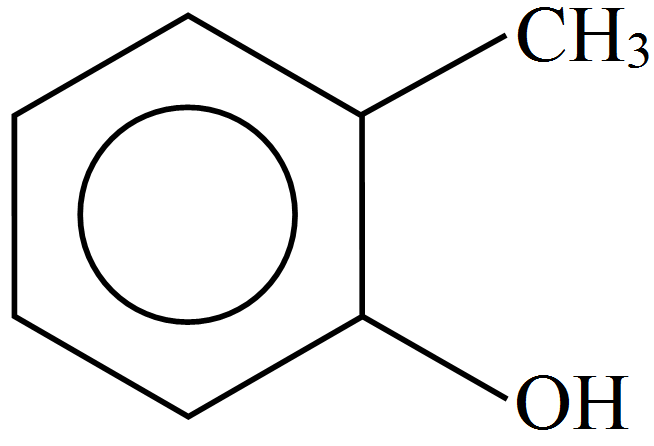
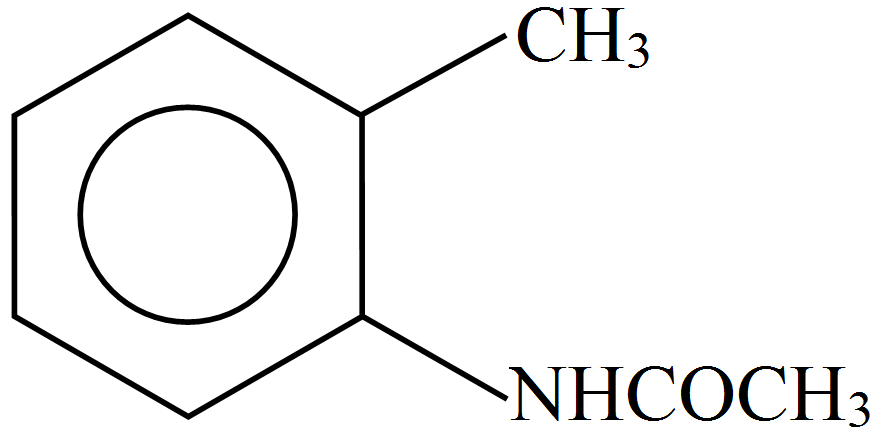
Which of the following is the most reactive towards electrophilic reagent?
Answer$+R-$ effect of $\mathrm{OH} > -\mathrm{CH}_3$
Hence $, 2-$ methyl phenol is more reattive towards electrophilic reagent.
View full question & answer→MCQ 561 Mark
Correct IUPAC name for $\text{H}_3\text{C}-\text{CH}-\text{CH}-\text{CH}_3\\\ \ \ \ \ \ \ \ \ \ \ \ \ \ | \ \ \ \ \ \ \ \ \ |\\\ \ \ \ \ \ \ \ \ \ \ \ \ \text{C}_2\text{H}_5\ \text{C}_2\text{H}_5$ ___________.
- A
2- Ethyl-3-methylpentane.
- B
- C
- ✓
View full question & answer→MCQ 571 Mark
Among the following which has greatest $-I$ effect?
- A
$−\text{OH}$
- B
$ -\mathrm{NH}_2$
- ✓
$ -\mathrm{NO}_2 $
- D
$ -\mathrm{F} $
AnswerCorrect option: C. $ -\mathrm{NO}_2 $
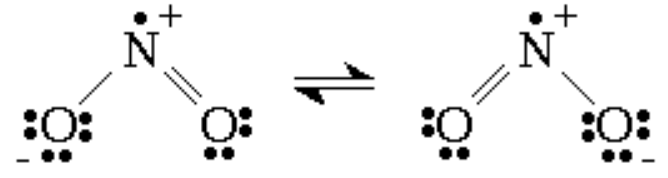
$ -\mathrm{NO}_2 $ is the strongest $-I $ group among all the neutral group because of the presence of $+$ charge on $N$ atom as shown in structure.
View full question & answer→MCQ 581 Mark
AnswerCorrect option: B. $ \mathrm{CH}_4 $
Marsh gas is methane, $ \mathrm{CH}_4 $.
It is called so because it is often obtained from marshy places.
View full question & answer→MCQ 591 Mark
The first three members of a homologous series are $\mathrm{CH}_4, \mathrm{C}_2 \mathrm{H}_6, \mathrm{C}_3 \mathrm{H}_8$. The fifth member of this series will be :
- A
$\mathrm{C}_5 \mathrm{H}_{10}$
- B
$\mathrm{C}_5 \mathrm{H}_{14}$
- ✓
$\mathrm{C}_5 \mathrm{H}_{12}$
- D
$\mathrm{C}_5 \mathrm{H}_8$
AnswerCorrect option: C. $\mathrm{C}_5 \mathrm{H}_{12}$
General formula of homologous series is $\mathrm{C}_n \mathrm{H}_\text{2 n+2}$.
First member is methane i.e. $\mathrm{CH}_4$
Second member is ethane i.e. $\mathrm{C}_2 \mathrm{H}_6$
Third member is propane i.e. $\mathrm{C}_3 \mathrm{H}_8$
Forth member is butane i.e. $\mathrm{C}_4 \mathrm{H}_{10}$
Similarly, fifth member is pentane i.e
View full question & answer→MCQ 601 Mark
What is a homologation reaction?
- A
Conversion of one member of a homologous series to the other compounds.
- B
Breakdown of compounds in a homologous series.
- ✓
Conversion of one member of a homologous series to the next member of homologous series.
- D
AnswerCorrect option: C. Conversion of one member of a homologous series to the next member of homologous series.
A homologation reaction is a chemical process that converts one member of a homologous series to the next member of the homologous series.
View full question & answer→MCQ 611 Mark
The following compounds show :

- A
- B
Conformationat isomerism.
- ✓
- D
View full question & answer→MCQ 621 Mark
Compounds belonging to a homologous series have the same :
AnswerCompounds within a homologous series typically have a fixed set of functional groups that gives them similar chemical and physical properties.
View full question & answer→MCQ 631 Mark
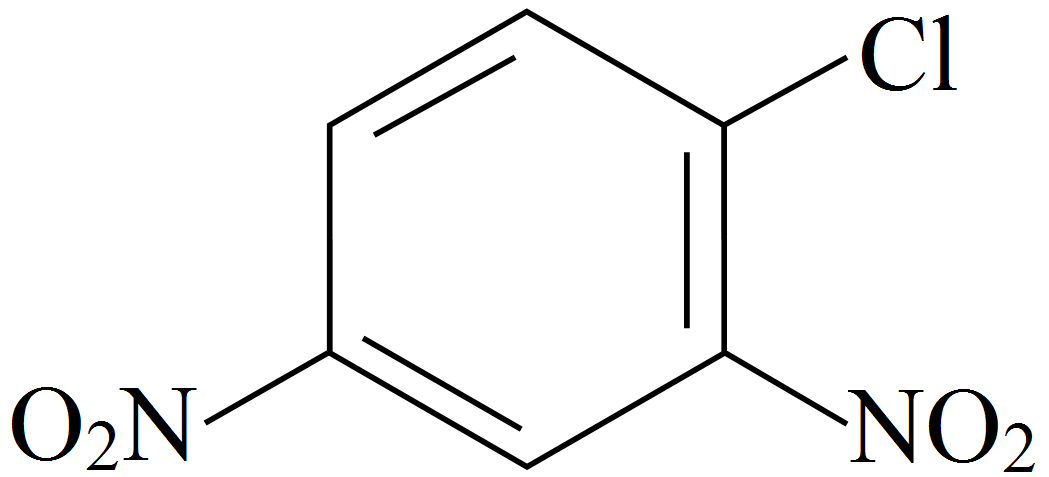
Write the correct $\text{IUPAC}$ name of the following.
- ✓
$1-$ chloro $-2, 4-$ dinitrobenzene.
- B
$6-$ chloro $-1, 3-$ dinitrobenzene.
- C
$1-$ chloro $-4, 6-$ dinitrobenzene.
- D
$2-$ chloro $-1, 5-$ dinitrobenzene.
AnswerCorrect option: A. $1-$ chloro $-2, 4-$ dinitrobenzene.
View full question & answer→MCQ 641 Mark
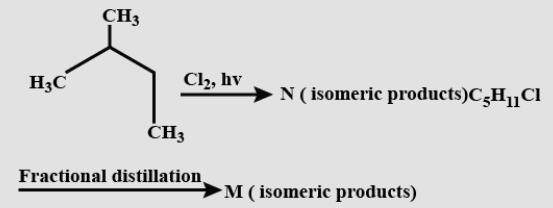
What are the values of $N$ and $M\ ?$
- A
$6, 6$
- B
$6, 4$
- ✓
$4, 4$
- D
$3, 3$
AnswerCorrect option: C. $4, 4$
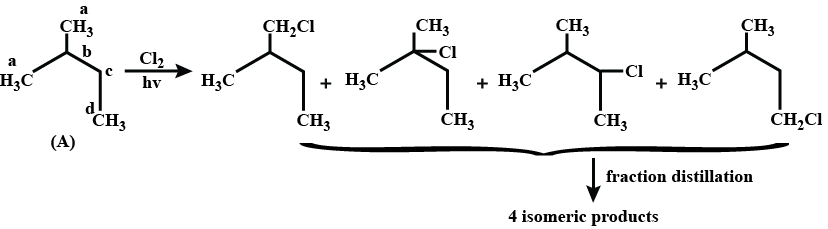
Since $A$ has four different types of $H$ atoms, so it on chlorinatives gives $4$ isomeric products.
Again as four products are chemically different, on fractional distillation they give $4$ isomeric products.
So $N = 4$ and $M = 4.$
View full question & answer→MCQ 651 Mark
During hearing of a court case, the judge suspected that some changes in the documents had been carried out. He asked the forensic department to check the ink used at two different places. According to you which technique can give the best results?
- A
- B
- C
- ✓
Thin layer chromatography.
AnswerCorrect option: D. Thin layer chromatography.
Thin layer Chomatography $\text{(TLC)}$ : itis a method for analyzing mixtures by separating the components of the mixture. $\text{TLC}$ can be used to determune the number of components in the mixture, the identity of compounds and the purity of compounds by observing the apperance of a product or the disppearance of areactant. it can also be used to monitor the progress of a reaction. $\text{TLC}$ is a sensitive technique $-$ microgram $(0.000001)g$ quantities can be analyzwd by $\text{TLC},$
View full question & answer→MCQ 661 Mark
Amongst the following elements present in an organic compound, the one which has no direct test for detection is :
- A
$\text{Cl}$
- B
$\text{N}$
- C
$\text{S}$
- ✓
$\text{O}$
AnswerCorrect option: D. $\text{O}$
There is no test that can directly indicate the presence of oxygen in an organic compound. The presence of oxygen is indicated indirectly by the presence of groups containing oxygen.
View full question & answer→MCQ 671 Mark
The correct order of electronegativity of carbon in ethane, ethene and ethyne is :
- ✓
Ethane ethene $ < $ ethyne.
- B
Ethyne $ < $ ethene $ < $ ethane.
- C
Ethene $ < $ ethyne $ < $ ethane.
- D
AnswerCorrect option: A. Ethane ethene $ < $ ethyne.
As we know that, electronegativity $\propto \% S-$ character $\propto$acidic character Hence, correct order is, ethane $ < $ ethene $ < $ ethyne.
|
Hydrocarbons
|
Molecular formula
|
$\% S-$Character
|
|
Ethane
|
$\ce{CH_3-CH_3}$
|
$25\%$ |
|
Ethene
|
$\ce{CH_2 = CH_2}$
|
$33\%$ |
|
Ethyne
|
$\text{CH}\equiv\text{CH}$
|
$50\%$ |
View full question & answer→MCQ 681 Mark
Which of the following ion is most resonance stabilized?
- A
$\text{C}_2\text{H}_5\text{O}^\ominus$
- ✓
$\text{C}_6\text{H}_5\text{O}^\ominus$
- C
$(\text{CH}_3)_3\text{CO}^\ominus$
- D
$(\text{CH}_3)_2\text{CHO}^\ominus$
AnswerCorrect option: B. $\text{C}_6\text{H}_5\text{O}^\ominus$
Phenoxide is stabilized by resonance.
View full question & answer→MCQ 691 Mark
Formation of which of the following complex indicates presence of sulphur in the organic compound when sodium nitroprusside is added to sodium extract of the compound?
- A
$\text{Fe}_{4}[\text{Fe}(\text{CN})_{6}]_{3}$
- B
$\text{Na}_{2} [\text{Fe}(\text{NO})(\text{CN})_{5}]$
- C
$\text{Fe}(\text{CNS)}$
- ✓
$\text{Na}_{4} [\text{Fe}(\text{CN})_{5}\text{NOS}]$
AnswerCorrect option: D. $\text{Na}_{4} [\text{Fe}(\text{CN})_{5}\text{NOS}]$
Formation of sodium thionitroprusside (purple) shows the presence of sulphur in organic compound.
$\text{Na}_{2}\text{S} \ \ \ \ + \ \ \ \ \ \text{Na}_{2}[\text{Fe}(\text{NO})(\text{CN})_{5}] \xrightarrow{\ \ \ \ \ \ }\text{Na}_{4}[\text{Fe}(\text{CN})_{5}\text{NOS}]$
$\text{Sodium extract}$
View full question & answer→MCQ 701 Mark
Which type of compound is shown by the following structure :
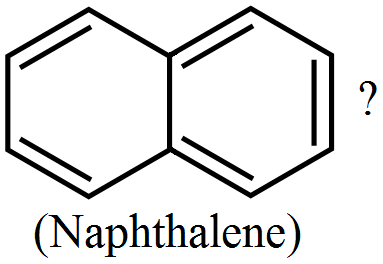
AnswerCorrect option: B. Benzenoid aromatic compound.
Since, the given compounds contain benzene nucleus so, naphthalene is a benzenoid aromatic compound.
View full question & answer→MCQ 711 Mark
The order if stability of carbocations is :
$\text{CH}_2=\text{CH}-\text{CH}^{\oplus}_2\\ \ \ \ \ \ \ \ \ \ \ \ \ \ \ \ \text{I}$
$\text{CH}_3-\text{CH}_2-\text{CH}^{\oplus}_2\\ \ \ \ \ \ \ \ \ \ \ \ \ \ \ \ \text{II}$
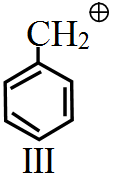
- ✓
$\text{III > I > II}$
- B
$\text{III > II > I}$
- C
$\text{II > III > I}$
- D
$\text{I > II > III}$
AnswerCorrect option: A. $\text{III > I > II}$
Benzyl Carbocation is most stable due to five resonating structures, $\text{I }\ ($Allyl carbocation is more stable than $\text{II (n}-$ propyl carbocation$)$ due to resonance.
View full question & answer→MCQ 721 Mark
Which one of the following can show $+\text{I}$ effect?
- A
$\text{CBr}_3$
- ✓
$\text{CH}_3$
- C
$\text{CCl}_3$
- D
$\text{CHO}$
AnswerCorrect option: B. $\text{CH}_3$
Only $\text{CH}_3$ shows $+\text{I}$ effect rest of them shows $-\text{I}$ effect, since other groups contain electronegative atom which will pull electrons towards it causing $-\text{I}$ effect.
View full question & answer→MCQ 731 Mark
Which of the following is the correct $\text{IUPAC}$ name?
- ✓
$3-$ Ethyl $-4, 4-$ dimethylheptane.
- B
$4, 4-$ Dimethyl $-3-$ ethylheptane.
- C
$5-$ Ethyl $-4, 4-$ dimethylheptane.
- D
$4, 4-$ Bis $($methyl$)-3-$ ethylheptane.
AnswerCorrect option: A. $3-$ Ethyl $-4, 4-$ dimethylheptane.
While writing $\text{IUPAC}$ name, the alkyl groups are written in alphabetical order. Thus lower locant $3$ is assigned to ethyl. Prefix, di, tri, and tetra are not included in alphabetical order.
The structure is $\ \ \ \ \ \ \ \ \ \ \ \ \ \ \ \ \ \ \ \ \ \ \ \ \ \ \ \ \ \ \ \ \ \ \ \text{CH}_3\\ \ \ \ \ \ \ \ \ \ \ \ \ \ \ \ \ \ \ \ \ \ \ \ \ \ \ \ \ \ \ \ \ \ \ \ \ \ \ |\\\text{CH}_3-\text{CH}_2-\text{CH}_2-\text{C}-\text{CH}-\text{CH}_2-\text{CH_3}\\ \ \ \ \ \ \ \ \ \ \ \ \ \ \ \ \ \ \ \ \ \ \ \ \ \ \ \ \ \ \ \ \ \ \ \ \ \ \ |\ \ \ \ \ \ \ |\\ \ \ \ \ \ \ \ \ \ \ \ \ \ \ \ \ \ \ \ \ \ \ \ \ \ \ \ \ \ \ \ \ \ \ \ \ \ \text{CH}\ \ \text{C}_2\text{H}_5$
View full question & answer→MCQ 741 Mark
All members of a homologous series have the same :
AnswerHomologous series differ by a $\ce{CH_2}$ group. It has a mass of $14$ units.
They can be represented by a common general formula for alkanes, alkenes, alkynes, and other functional groups. They can thus, be represented by a common empirical formula.
For example alkanes has empirical formula $\mathrm{C}_n \mathrm{H}_\text{2 n+2}$ and for alkenes it is $\mathrm{C}_n \mathrm{H}_\text{2 n}$ etc.
View full question & answer→MCQ 751 Mark
In Lassaigne's test, the organic compound is fused with a piece of sodium metal in order to :
- A
Increase the ionisation of the compound.
- B
Decrease the melting point of the compound.
- C
Increase the reactivity of the compound.
- ✓
Convert the covalent compound into a mixture of ionic compounds.
AnswerCorrect option: D. Convert the covalent compound into a mixture of ionic compounds.
Lassaigne's test is a general test for the detection of halogens, nitrogen and sulphur in an organic compound. These elements are covalently bonded to the organic compounds.
In order to detect them, these have to be converted into their ionic forms. This is done by fusing the organic compound with sodium metal.
The ionic compounds formed during the fusion are extracted in aqueous solution and can be detected by simple chemical tests. The extract is called sodium fusion extract or Lassaigne's extract.
View full question & answer→MCQ 761 Mark
Which of the following elements in an organic compound cannot be detected by Lassaigne's test?
AnswerLassaigne's test is the most reliable test for the detection of nitrogen, halogens and sulphur in an organic compound.
The compound is heated with sodium metal to convert the elements present in the organic compound into the water $-$ soluble salts of sodium.
View full question & answer→MCQ 771 Mark
Note : Consider the following four compounds for answering questions :
- $\ \ \ \ \ \ \ \ \ \ \ \ \ \ \ \ \ \ \ \ \ \ \ \ \ \ \ \ \ \ \ \ \ \ \ \ \ \ \ \ \ \ \ \ \ \ \ \ \ \ \text{O}\\\ \ \ \ \ \ \ \ \ \ \ \ \ \ \ \ \ \ \ \ \ \ \ \ \ \ \ \ \ \ \ \ \ \ \ \ \ \ \ \ \ \ \ \ \ \ \ \ \ \ ||\\\text{CH}_3-\text{CH}_2-\text{CH}_2-\text{CH}_2-\text{C}-\text{H}$
- $\ \ \ \ \ \ \ \ \ \ \ \ \ \ \ \ \ \ \ \ \ \ \ \ \ \ \ \ \ \ \ \ \ \ \ \ \ \ \ \ \ \ \ \ \ \text{O}\\\ \ \ \ \ \ \ \ \ \ \ \ \ \ \ \ \ \ \ \ \ \ \ \ \ \ \ \ \ \ \ \ \ \ \ \ \ \ \ \ \ \ \ \ \ ||\\\text{CH}_3-\text{CH}_2-\text{CH}_2\text{CH}_2-\text{C}-\text{CH}_3$
- $\text{CH}_3-\text{CH}_2-\text{C}-\text{CH}_2-\text{CH}_3\\\ \ \ \ \ \ \ \ \ \ \ \ \ \ \ \ \ \ \ \ \ \ \ \ \ ||\\\ \ \ \ \ \ \ \ \ \ \ \ \ \ \ \ \ \ \ \ \ \ \ \ \ \text{O}$
- $\text{CH}_3-\text{CH}-\text{CH}_2-\text{C}-\text{H}\\\ \ \ \ \ \ \ \ \ \ \ \ \ \ \ \ \ \ \ \ \ \ \ \ |\ \ \ \ \ \ \ \ \ \ \ ||\\\ \ \ \ \ \ \ \ \ \ \ \ \ \ \ \ \ \ \ \ \ \ \ \text{CH}_3\ \ \ \ \ \text{O}$
Which of the following pairs are position isomers?
- A
$\text{I}$ and $\text{II}$
- ✓
$\text{II}$ and $\text{III}$
- C
$\text{II}$ and $\text{IV}$
- D
$\text{III}$ and $\text{IV}$
AnswerCorrect option: B. $\text{II}$ and $\text{III}$
In position isomerism, two or more compounds differ in the position of substituent, functional group or multiple bonds but molecular formula is same. In pentanone $-2$ and pentanone $-3,$ position of ketonic group is different. $\mathrm{CH}_3-\mathrm{CH}_2 \mathrm{CH}_2-\mathrm{CO}-\mathrm{CH}_3$ and $\mathrm{CH}_3-\mathrm{CH}_2-\mathrm{CO}-\mathrm{CH}_2-\mathrm{CH}_3$
View full question & answer→MCQ 781 Mark
The number of sigma and pi bonds in a molecule of cyanogen are :
- A
$4, 3$
- ✓
$3, 4$
- C
$5, 2$
- D
$3, 5$
AnswerCorrect option: B. $3, 4$
Cyanogen, $\text{N}\equiv\text{C}-\text{C}\equiv\text{N}$ has three sigma and four $'\pi\ '$ bonds.
View full question & answer→MCQ 791 Mark
In the detection of carbon, lime water turns milky due to the formation of :
AnswerCorrect option: C. $ \mathrm{CaCO}_3 $
Carbon dioxide passes through limewater, giving a milky solution.
This is due to the insoluble suspension of calcium carbonate formed :
$\mathrm{Ca}(\mathrm{OH})_2(\mathrm{aq})+\mathrm{CO}_2(\mathrm{~g}) \rightarrow \mathrm{CaCO}_3(\mathrm{~s})+\mathrm{H}_2 \mathrm{O}(\mathrm{l})$
View full question & answer→MCQ 801 Mark
In the given potential energy diagram, the point $X$ represents :
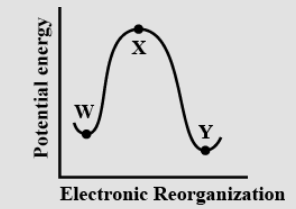
AnswerIn the given potential energy diagram, the point $\text{XX}$ represents the transition state.
It is the maximum energy state and below which reaction will not occur.
View full question & answer→MCQ 811 Mark
Groups that can show both $+\ M$ and $-\ M$ effect :
Answer$\mathrm{CH}_2 = \text{CH}− $ and phenyl both contain double bonds, Since we know $-\text{NO, C}=\text{C}$ both can show $+\ M$ and $-\ M$ effect both hence all of the above options are correct.
View full question & answer→MCQ 821 Mark
Which of the following represents ketones?
- ✓
$> \text{C = O}$
- B
$- \text{OH}$
- C
$- \text{CHO}$
- D
$- \text{COOH}$
AnswerCorrect option: A. $> \text{C = O}$
$\text{COOH} =$ carboxylic acid, $−\text{CHO} =$ aldehydes $> \text{C = O} =$ ketones, $\text{OH} =$ alcohol.
View full question & answer→MCQ 831 Mark
The $\text{IUPAC}$ name is :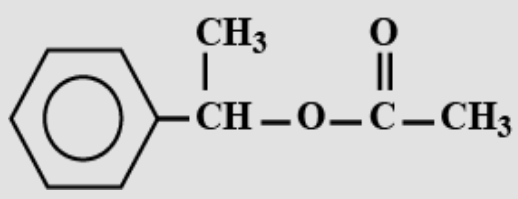
- A
$1-$ phenyl $-1-$ acetyloxyethane
- B
$1-$ acetoxyeihylbenzene
- ✓
$1-$ phenylethyl ethanoate
- D
$1-$ methylbenzyl acetate
AnswerCorrect option: C. $1-$ phenylethyl ethanoate
In the outside ring functional group present is an ester of ethyl ethonate at benzene ring position $1$ so by taking out one hydrogen it becomes $1-$ Phenyl ethylethanoate.
View full question & answer→MCQ 841 Mark
Acidified sodium fusion extract on addition of ferric chloride solution gives blood red colouration. This confirms the presence of which of the following element $(s)\ ?$
- A
Both $S$ and $cl.$
- ✓
Both $N$ and $S.$
- C
Only $N$.
- D
Only $S.$
AnswerCorrect option: B. Both $N$ and $S.$
Acidified sodium fusion extract on addition of ferric chloride solution gives blood red colouration, which confirms the presence of $N$ and $S$ both.
$\text{Na} + \text{C} + \text{N} + \text{S} \xrightarrow{\ \ \ \ \ \ } \text{NaSCN}$
$\text{Fe}^{+3} + \text{SCN}^{-} \xrightarrow{\ \ \ \ \ \ } [\text{Fe}(\text{SCN})]^{2+}\\ \ \ \ \ \ \ \ \ \ \ \ \ \ \ \ \ \ \ \ \ \ \ \ \ \ \ \ \ \ \ \ \ \ \ \ \text{Blood red}$
View full question & answer→MCQ 851 Mark
The order of relative stability of the contributing structures is :
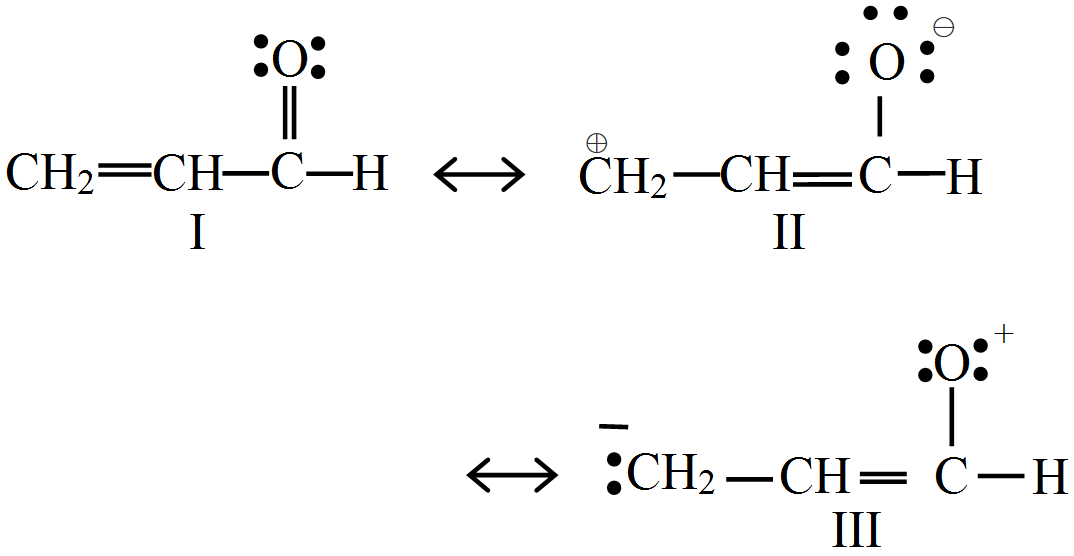
- A
$\text{II > I > III}$
- ✓
$\text{I > II > III}$
- C
$\text{III > II > I}$
- D
$\text{I = II = III}$
AnswerCorrect option: B. $\text{I > II > III}$
View full question & answer→MCQ 861 Mark
Which of the following does not belong to the same homologous series?
- A
$\mathrm{CH}_4$
- B
$\mathrm{C}_2 \mathrm{H}_6$
- C
$\mathrm{C}_3 \mathrm{H}_8$
- ✓
$\mathrm{C}_4 \mathrm{H}_6$
AnswerCorrect option: D. $\mathrm{C}_4 \mathrm{H}_6$
Methane, ethane, and propane $-\mathrm{CH}_4, \mathrm{C}_2 \mathrm{H}_6, \mathrm{C}_3 \mathrm{H}_8-\mathrm{C}_n \mathrm{H}_{2 \mathrm{n}+2}$ belong to alkane family with same general formula except $\mathrm{C}_4 \mathrm{H}_6$
View full question & answer→MCQ 871 Mark
The most common characteristics of homologous series is increase in the number of :
AnswerThe most common characteristic of homologous series is increase in the number of methylene $(-\mathrm{CH}_2-)$ units in saturated chain within the molecule.
View full question & answer→MCQ 881 Mark
In which of the following compounds the carbon marked with asterisk is expected to have greatest positive charge?
- ✓
${ }^*\mathrm{CH}_3-\mathrm{CH}_2-\mathrm{Cl} $
- B
$ { }^* \mathrm{CH}_3-\mathrm{CH}_2-\mathrm{Mg}^{+} \mathrm{Cl}^{-} $
- C
$ { }^* \mathrm{CH}_3-\mathrm{CH}_2-\mathrm{Br} $
- D
$ { }^* \mathrm{CH}_3-\mathrm{CH}_2-\mathrm{CH}_3 $
AnswerCorrect option: A. ${ }^*\mathrm{CH}_3-\mathrm{CH}_2-\mathrm{Cl} $
In $\mathrm{CH}_3-\mathrm{CH}_2-\mathrm{Cl},$ the carbon marked with asterisk has the greatest positive charge due to high electronegativity of $\text{Cl}.$
View full question & answer→MCQ 891 Mark
The product $(s)$ is / are :
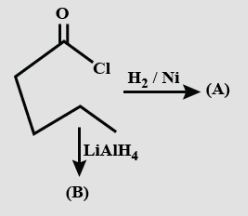
- A
$(A)$ is an alcohol; $(B)$ is an aldehyde
- B
$(A)$ is an aldehyde; $(B)$ is an alcohol
- ✓
$(A)$ and $(B)$ both are alcohols
- D
$(A)$ and $(B)$ both are aldehydes
AnswerCorrect option: C. $(A)$ and $(B)$ both are alcohols
A reagent used for both reactions is reducing, it will reduce the carbonyl $-$ chloride to the alcohol group.
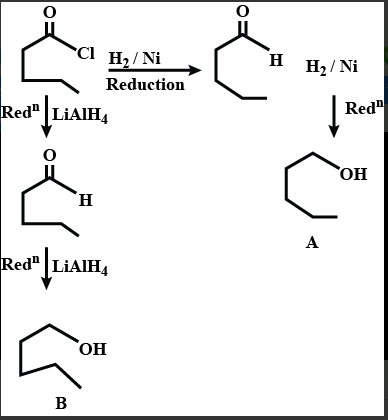
View full question & answer→MCQ 901 Mark
The chief source of aromatic compounds is :
AnswerThe hydrocarbons in crude oil are mostly alkanes, cycloalkanes and various aromatic hydrocarbons. Fruits contain fructose and glucose derivatives.
Oil of wintergreen is an organic ester with fragrance. Ants have formic acid.
View full question & answer→MCQ 911 Mark
Define homologous series.
- A
Compound with same melting point.
- B
Compound with same molecular mass.
- C
Compounds with different general formula.
- ✓
Compounds with same functional group substitutes for hydrogen in a carbon chain.
AnswerCorrect option: D. Compounds with same functional group substitutes for hydrogen in a carbon chain.
A homologous series is a series of compounds with the same general formula.
But they have different melting points $($physical properties$)$ and different molecular masses.
However, they have the same functional group substitutes for hydrogen in a carbon chain.
Example : $\mathrm{CH}_3 \mathrm{OH}, \mathrm{C}_2 \mathrm{H}_5 \mathrm{OH}, \mathrm{C}_3 \mathrm{H}_7 \mathrm{OH}$.
View full question & answer→MCQ 921 Mark
$\text{IUPAC}$ name of $\mathrm{CH}_3 \mathrm{OC}_2 \mathrm{H}_5$ is :
AnswerAccording to $\text{IUPAC}$ nomenclature system, ethers are known as alkoxy alkane.
The ether oxygen is taken with a smaller alkyl group and creates the alkoxy group while larger alkyl group is considered as a alkyl group.
So the name will be methoxy ethane.
View full question & answer→MCQ 931 Mark
The absorption of hydrogen by platinum is known as :
AnswerA huge amount hydrogen gas generally loosely bounds with the surface of the platinum metal.
This is known as occlusion and the hydrogen is known as occluded hydrogen.
View full question & answer→MCQ 941 Mark
During the fusion of an organic compound with sodium metal, nitrogen of the organic compound is converted into :
- A
$\text{NaNO}_2$
- B
$\text{NaNH}_2$
- ✓
$\text{NaCN}$
- D
$\text{NaNC}$
AnswerCorrect option: C. $\text{NaCN}$
View full question & answer→MCQ 951 Mark
Which of the following would be expected to be most highly ionised in water?
- A
$ \mathrm{CH}_3 \mathrm{CH}_2 \mathrm{CH}_2 \mathrm{COOH} $
- B
$ \mathrm{CH}_3 \mathrm{CHClCH}_2 \mathrm{COOH} $
- ✓
$ \mathrm{CH}_3 \mathrm{CH}_2 \mathrm{CCl}_2 \mathrm{COOH} $
- D
$ \mathrm{CH}_3 \mathrm{CH}_2 \mathrm{CHClCOOH}$
AnswerCorrect option: C. $ \mathrm{CH}_3 \mathrm{CH}_2 \mathrm{CCl}_2 \mathrm{COOH} $
Fast ionization is shown by strong acids. Chlorine atom has high $-I $ effect so when attached to nearly carbon, it increases acidity thus is more acidic.
View full question & answer→MCQ 961 Mark
Identify the correct statement.
AnswerCorrect option: C. Both $a$ and $b$ are correct.
Both $a$ and $b$ are correct.
- Reaction mechanisms are studied using isotopic labeling. One of the atoms of one reactant/ reagent is replaced with its isotope. Then, the product in which this labelled atom is present is determined. From this information, we can decide which atom of reactant goes to which product.
$\ce{CH_3−CO−O*H + CH_3−OH \xrightarrow{\text{H}^+} CH_3−COO−CH_3 + H_2O}*$
In the above reaction, O atom of $−\ce{OH}$ group of acetic acid is labelled. It is then observed that labelled $O$ atom is found in water. Hence, we can conclude that
$−\ce{OH}$ group of acetic acid combines with $H$ atom of methanol.
- Isolation of reactive intermediates is a method to establish reaction mechanism.
Consider the conversion $A \rightarrow D.$
It can proceed through following two different mechanisms.
$A \rightarrow B \rightarrow D.$
$A \rightarrow C \rightarrow D.$
Suppose that we are able to isolate intermediate $B$ but we cannot isolate intermediate $C$.
Hence, we can say that the reaction mechanism is $A \rightarrow B \rightarrow D.$ View full question & answer→MCQ 971 Mark
Choose the correct order of stability of carbocation using the concept of hyperconjugation.
$\begin{matrix}{\ \ \ \ \ \ \ \ \ \ \ \ \text{CH}_3\\ \ \ \ \ \ \ \ \ \ \ \ \ \ |\\\text{CH}_3-\text{C}^\oplus\\ \ \ \ \ \ \ \ \ \ \ \ \ \ |\\\ \ \ \ \ \ \ \ \ \ \ \ \text{CH}_3} & { \ \ \ \ \ \ \ \ \ \ \ \ \text{CH}_3\\ \ \ \ \ \ \ \ \ \ \ \ \ \ |\\\text{CH}_3-\text{C}^\oplus\\ \ \ \ \ \ \ \ \ \ \ \ \ \ |\\ \ \ \ \ \ \ \ \ \ \ \ \ \text{H} } & {\text{CH}_3\stackrel{{\oplus} }{\hbox{CH}_2}} & \stackrel{{\oplus} }{\hbox{CH}_3} \\ \ \ \ \ \ \ \ \ \text{I} & \ \ \ \ \ \ \ \text{II} & \ \ \text{III} & \text{IV} \end{matrix}$
- A
$\text{I < II < III < IV}$
- ✓
$\text{IV < III < II < I}$
- C
$\text{III < IV < II < I}$
- D
AnswerCorrect option: B. $\text{IV < III < II < I}$
Greater the number of alkyl groups attached to a positively charged carbon atom, the greater is the hyperconjugation interaction and stabilisation of the cation.
Thus, we have the following relative stability of carbocation :
$ \ \ \ \ \ \ \ \ \ \ \ \ \text{CH}_3\\ \ \ \ \ \ \ \ \ \ \ \ \ \ | \\\text{CH}_3-\stackrel{{+} }{\hbox{C}} > (\text{CH}_3)_2\stackrel{{+ \ \ \ \ } }{\hbox{CH}} > \text{CH}_3\stackrel{{+ \ \ \ \ \ \ } }{\hbox{CH}_2} > \stackrel{{+ \ \ \ \ \ } }{\hbox{CH}}_3\\ \ \ \ \ \ \ \ \ \ \ \ \ \ |\\ \ \ \ \ \ \ \ \ \ \ \ \ \text{CH}_3$
View full question & answer→MCQ 981 Mark
Which functional group is present in a molecule of $\mathrm{CH}_3 \mathrm{Cl}\ ?$
AnswerMethyl chloride, $\mathrm{CH}_3 \mathrm{Cl}$ is an alkyl chloride. The functional group present is chlorine atom $−\text{Cl}.$
Note: In general we can write alkyl halides as $\text{R-X}$ where $X$ is halogen atom $\ce{Cl, Br, I}$ or $F).$
View full question & answer→MCQ 991 Mark
Dumas method is used for estimation of :
AnswerThe Dumas method in analytical chemistry is a method for the quantitative determination of nitrogen in chemical substances based on a method first described by Jean $-$ Baptiste Dumas in $1826.$
View full question & answer→MCQ 1001 Mark
The elements always present in organic compounds are $C$ and $H$. In addition to these, name the other elements that may be present in it :
AnswerThe elements present in organic compounds are $C$ and $H,$ other elements are $\text{O, NS, X}\ ($halogen$).$
View full question & answer→MCQ 1011 Mark
The product will be :
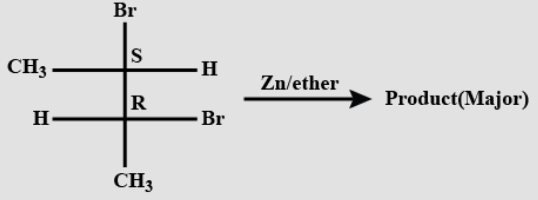
- A
Cis $- 2 -$ butene
- ✓
Trans $- 2 - $ butene
- C
$2 -$ butyne
- D
Buta $- 1 , 3 -$ diene
AnswerCorrect option: B. Trans $- 2 - $ butene
Since elimination is trans $-$ in nature so meso $-$ compound will give generally trans $-$ alkene as major.
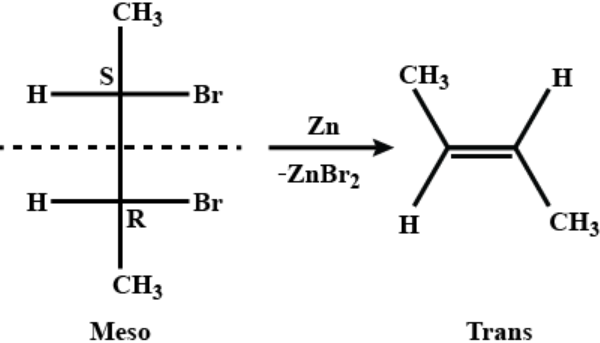
View full question & answer→MCQ 1021 Mark
The dark turquoise $-$ green solid copper $\text{(II)}$ carbonate dissolves in hydrochloric acid to form a:
- ✓
Green $-$ blue solution of copper $\text{(II)}$ chloride.
- B
Red solution of copper $\text{(II)}$ chloride.
- C
Green $-$ blue solution of copper $\text{(II)}$ chlorinate.
- D
Green $-$ blue solution of carbon dioxide.
AnswerCorrect option: A. Green $-$ blue solution of copper $\text{(II)}$ chloride.
The dark turquoise-green solid copper $\text{(II)}$ carbonate dissolves in hydrochloric acid to form a green $-$ blue solution of copper $\text{(II)}$ chloride and effervescence from carbon dioxide formed.
$\mathrm{CuCO}_3+2 \mathrm{HCl} \rightarrow \mathrm{CuCl}_2+\mathrm{H}_2 \mathrm{O}+\mathrm{CO}_2$
View full question & answer→MCQ 1031 Mark
The compound formed in the positive test for nitrogen and lassaigne's solution of an organic compound is :
- ✓
$ \mathrm{Fe}_4\left[\mathrm{Fe}(\mathrm{CN})_6\right]_3 $
- B
$ \mathrm{Na}\left[\mathrm{Fe}(\mathrm{CN})_6\right] $
- C
$\mathrm{Fe}(\mathrm{CN})_3 $
- D
$ \mathrm{Na}_4\left[\mathrm{Fe}(\mathrm{CN})_5 \mathrm{NOS}\right] $
AnswerCorrect option: A. $ \mathrm{Fe}_4\left[\mathrm{Fe}(\mathrm{CN})_6\right]_3 $
$4 \mathrm{Fe}^{3+}+3 \mathrm{Na}\left[\mathrm{Fe}(\mathrm{CN})_6\right] \rightarrow \mathrm{Fe}_4\left[\mathrm{Fe}(\mathrm{CN})_6\right]_3+12 \mathrm{Na}^{+}$
View full question & answer→MCQ 1041 Mark
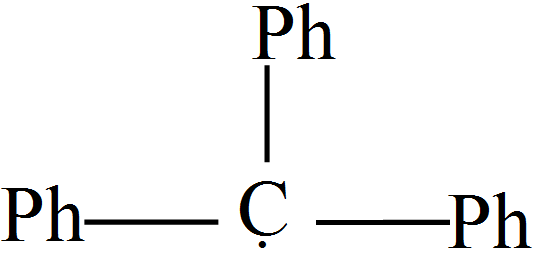
The increasing order of stability of the following free radicals :
- A
$(\text{C}_6\text{H}_5)_3\stackrel{\bf.}{\text{C}} < (\text{C}_6\text{H}_5)_2\stackrel{\bf.\ \ \ }{\text{CH}} < (\text{CH}_3)\stackrel{\bf.}{\text{C}} < (\text{CH}_3)_2\stackrel{\bf.\ \ \ }{\text{CH}}$
- B
$(\text{C}_6\text{H}_5)_2\stackrel{\bf.\ \ \ \ \ }{\text{CH}} < (\text{C}_6\text{H}_5)_3\stackrel{\bf.\ }{\text{C}} < \text{(CH}_3)_3\stackrel{\bf.}{\text{C}} < (\text{CH}_3)_2\stackrel{\bf.\ \ \ }{\text{CH}}$
- C
$(\text{CH}_3)_2\stackrel{\bf.\ \ \ \ }{\text{CH}} < (\text{CH}_3)_3\stackrel{\bf.}{\text{C}} < (\text{C}_6\text{H}_5)_3\stackrel{\bf.}{\text{C}} < (\text{C}_6\text{H}_5)_2\stackrel{\bf.\ \ \ \ \ }{\text{CH}}$
- ✓
$(\text{CH}_3)_2\stackrel{\bf.\ \ \ \ }{\text{CH}} < (\text{CH}_3)_3\stackrel{\bf.\ }{\text{C}} < (\text{C}_6\text{H}_5)_2\stackrel{\bf.\ \ \ \ \ }{\text{CH}} < (\text{C}_6\text{H}_5)_3\stackrel{\bf.}{\text{C}}$
AnswerCorrect option: D. $(\text{CH}_3)_2\stackrel{\bf.\ \ \ \ }{\text{CH}} < (\text{CH}_3)_3\stackrel{\bf.\ }{\text{C}} < (\text{C}_6\text{H}_5)_2\stackrel{\bf.\ \ \ \ \ }{\text{CH}} < (\text{C}_6\text{H}_5)_3\stackrel{\bf.}{\text{C}}$
View full question & answer→MCQ 1051 Mark
Ammonium nitrate on heating gives $ .........$
Answer$\mathrm{NH}_4 \mathrm{NO}_3 \xrightarrow{\text { onheating }} 2 \mathrm{H}_2 \mathrm{O}+\mathrm{N}_2 \mathrm{O} \ ($NItrous oxide$).$
View full question & answer→MCQ 1061 Mark
The $\text{IUPAC}$ name for,
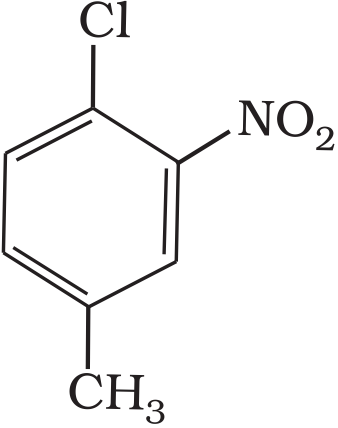
- A
$1-$ Chloro $-2-$ nitro $-4-$ methylbenzene.
- ✓
$1-$ Chloro $-4-$ methyl $-2-$ nitrobenzene.
- C
$2-$ Chloro $-1-$ nitro $-5-$ methylbenzene.
- D
$M-$ nitro $-p-$ chlorotoluene.
AnswerCorrect option: B. $1-$ Chloro $-4-$ methyl $-2-$ nitrobenzene.
View full question & answer→MCQ 1071 Mark
Glycerol is purified by :
AnswerBecause glycerol decomposes at its normal boiling point.
View full question & answer→MCQ 1081 Mark
In Duma's method for estimation of nitrogen, $0.3g$ of an organic compound gave $50\ mL$ of nitrogen collected at $300K$ temperature and $715\ mm$ pressure. The percentage composition of nitrogen in the compound $($Aqueous tension at $300K = 15\ mm)$ is :
- A
$15.46\%$
- ✓
$17.46\%$
- C
$18.36\%$
- D
$28\%$
AnswerCorrect option: B. $17.46\%$
View full question & answer→MCQ 1091 Mark
Chemical process that converts one member of a homologous series to the next member is called as :
AnswerA homologation reaction is a chemical process that converts one member of a homologous series to the next member.
View full question & answer→MCQ 1101 Mark
Which one of these shows least $-\ I$ effect :
- A
$−\text{OH}_2^+$
- B
$−\text{NH}_3^-$
- C
$−\text{NO}_2$
- ✓
$−\text{F}$
AnswerCorrect option: D. $−\text{F}$
Since $+$ charge is more electronegative than neutral atom therefore correct order is
$−\text{OH}_2^+ > −\text{NH}_3^- > −\text{NO}_2 > −\text{F}$. Hence least $−\text{I}$ effect is shown by $−\text{F}$.
View full question & answer→MCQ 1111 Mark
$\text{IUPAC}$ name of the compound: $\ \ \ \ \ \ \ \ \ \ \ \ \ \ \ \ \ \ \ \ \ \ \ \ \ \ \ \ \ \ \ \ \ \ \ \ \ \ \text{CH}_3\\\ \ \ \ \ \ \ \ \ \ \ \ \ \ \ \ \ \ \ \ \ \ \ \ \ \ \ \ \ \ \ \ \ \ \ \ \ \ \ \ \ \ |\\\text{CH}_3-(\text{CH}_2)_4-\text{CH}-\text{C}-\text{CH}_3\\\ \ \ \ \ \ \ \ \ \ \ \ \ \ \ \ \ \ \ \ \ \ \ \ \ \ \ \ \ \ \ \ \ \ \ \ \ \ \ \ \ \ |\\\ \ \ \ \ \ \ \ \ \ \ \ \ \ \ \ \ \ \ \ \ \ \ \ \ \ \ \ \text{C}_2\text{H}_5(\text{CH}_2)_2-\text{CH}_3$
- ✓
$5 −$ ethyl $−4, 4−$dimethyl decane.
- B
$4 −$ ethyl $4, 5$ dimethyl decane.
- C
$3, 4−$ dimethyl $− 3 −$ Hexane.
- D
$6, 7−$ dimethyl decane.
AnswerCorrect option: A. $5 −$ ethyl $−4, 4−$dimethyl decane.
- $5 −$ ethyl $− 4, 4 −$ dimethyl decane.
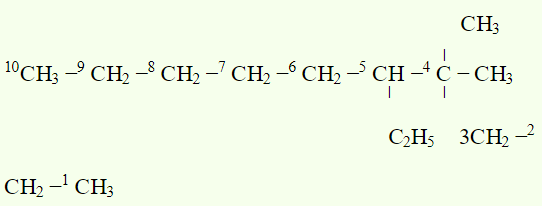
Numbering should be started from right side. $2$ methyl and one ethyl groups are attached $C_4$ and $C_5$ respectively.
So the $\text{IUPAC}$ name of this compound is $5 −$ ethyl $− 4, 4 −$ dimethyldecane. View full question & answer→MCQ 1121 Mark
In paper chromatography, chromatography paper contains water trapped in it, which acts as the :
AnswerIn paper chromatography, chromatography paper contains water trapped in it, which acts as the stationary phase.
View full question & answer→MCQ 1131 Mark
What is not true about homologous series?
- A
All members have similar chemical properties.
- ✓
They have identical physical properties.
- C
They can be represented by a general formula.
- D
AnswerCorrect option: B. They have identical physical properties.
Homologous series differ by a $\ce{CH_2}$ group.
They have similar chemical properties as they have a common functional group.
They can be represented by a general formula for alkanes, alkenes, alkynes, and other functional groups.
However, as the molecular mass increases in a homologous series, a gradation in physical properties is observed. So, they do not have identical physical properties.
View full question & answer→MCQ 1141 Mark
Which of the following best describe the given statement "an atom or group of atoms joined in a specific manner which is responsible for the characteristic chemical properties of the organic compounds?
- A
- ✓
- C
- D
Non $-$ aromatic group.
View full question & answer→MCQ 1151 Mark
All members of a homologous series differ by a :
AnswerHomologous series differ by a $\ce{CH_2}$ group known as the methylene group.
View full question & answer→MCQ 1161 Mark
What is qualitative analysis?
- A
Identification of unknown substance by direct observation.
- ✓
Identification of unknown substance by chemical tests.
- C
Both $a$ and $b$
- D
AnswerCorrect option: B. Identification of unknown substance by chemical tests.
Qualitative analysis includes identification of unknown substance by chemical tests.
Identification of substances by their physical and chemical properties.
View full question & answer→MCQ 1171 Mark
In homlogous series, successive members differ by :
- A
$\ce{CH_3}−$
- B
$\ce{CH_3 −CH_2}−$
- ✓
$−\ce{CH_2} −$
- D
$−\ce{H}$
AnswerCorrect option: C. $−\ce{CH_2} −$
A homologous series is a series of compounds in which each member differs from the next/previous by $−\ce{CH_2}−$ or $14$ mass units.
Physical properties change in members of homologous series but chemical properties remain almost the same because the functional group remains the same.
View full question & answer→MCQ 1181 Mark
Which of the following statements is incorrect regarding the naming of complex compounds?
- ✓
$\text{NH}^{2-,}$ will be named as 'amido'
- B
'en' will be named as 'ethylenediamine'
- C
$\text{C}_2\text{O}_2\text{S}_2^{2-}$ will be named as 'dithio oxalato'
- D
$\ce{CH}^{3-}$ will be named as 'methyl'
AnswerCorrect option: A. $\text{NH}^{2-,}$ will be named as 'amido'
$\ \ \ \ \ \ \ \ \ \ \ \ \text{O}\\\ \ \ \ \ \ \ \ \ \ \ \ \ ||\\ \text{NH}_2-\text{C}-\text{named as amido}$
$\text{NH}^{2-}$ will be named as amido is incorrect regarding the naming of complex.
View full question & answer→MCQ 1191 Mark
On complete combustion, 0.246g of an organic compound gave 0.198g of carbon dioxide and 0.1014g of water. The percentage composition of carbon and hydrogen in the compound respectively are:
AnswerGiven mass of $\mathrm{CO}_2$ = 0.198g and mass of $\mathrm{H}_2\mathrm{O}$ = 0.1014g
As we know % of $\text{C} = \frac{12}{44} \times\frac{\text{m}_{\text{CO}_{2}}}{\text{w}}\times 100$
Percentage of carbon $= \frac{12 \times 0.198\times 100}{44 \times 0.246} = 21.95\%$
Also, $\% \text{ of H} = \frac{2}{18} \times \frac{\text{m}_{\text{H}_{2}\text{O}}}{\text{w}}\times 100$
Percentage of hydrogen $= \frac{2\times 0.1014 \times100}{18 \times 0.246}= 4.58\%$
View full question & answer→MCQ 1201 Mark
Which techniques is based on the difference in the solubilities of the compound and the impurities in a suitable solvent?
AnswerCrystallisation process is based on the difference in the solubilities of the compound and the impurities in a suitable solvent. The impure compound is dissolved in a solvent in which it is sparingly soluble at room temperature but appreciably soluble at higher temperature.
View full question & answer→MCQ 1211 Mark
For the purification, isolation and separation of organic compounds, the latest technique is :
- ✓
- B
- C
Fractional crystallization.
- D
View full question & answer→MCQ 1221 Mark
$\text{IUPAC}$ name of $\text{CH}_3−\text{O}−\text{CH}−\text{CH}_3 \\ \ \ \ \ \ \ \ \ \ \ \ \ \ \ \ \ \ \ \ \ \ |\\ \ \ \ \ \ \ \ \ \ \ \ \ \ \ \ \ \ \ \ \text{CH}_3$ is $ ........$
AnswerThe $\text{IUPAC}$ name of the given compound is methoxy isopropane.
View full question & answer→MCQ 1231 Mark
Amongest the following, the acceptable name as per $\text{IUPAC}$ nomenclature is :
AnswerCorrect option: B. pent $-1-$ en $-4-$ yne
In naming hydrocarbons, alkenes gets position first priority as compared to alkynes so the correct name is pent $-1-$ en $-4-$ yne. But in numbering carbons, alkynes gets higher priority than alkenes.
View full question & answer→MCQ 1241 Mark
The $\text{IUPAC}$ name of the molecule :
$\ \ \ \ \ \ \ \ \ \ \ \ \ \text{O}\ \ \ \ \ \ \ \ \ \ \ \ \ \ \ \ \ \ \ \ \text{O}\\\ \ \ \ \ \ \ \ \ \ \ \ \ ||\ \ \ \ \ \ \ \ \ \ \ \ \ \ \ \ \ \ \ \ \ ||\\\text{CH}_3-\text{C}-\text{C}=\text{C}-\text{C}-\text{OH}\ \text{is }\\ \ \ \ \ \ \ \ \ \ \ \ \ \ \ \ \ \ \ \ \ \ |\ \ \ \ \ \ \ |\\ \ \ \ \ \ \ \ \ \ \ \ \ \ \ \ \ \ \ \ \ \text{CH}_3 \ \text{CH}_3$
- A
$4-$ oxo $-2,3-$ dimethyl pent $-2-$ en $-1-$ oic acid.
- B
$2-$ carboxy $-3-$ methyl pent $-2-$ en $-3-$ one.
- C
$4-$ carboxy $-3-$ methyl pent $-3-$ en $-2-$ one.
- ✓
$2,3-$ Dimethyl $-4-$ oxo $-$ pent $-2-$ en $-1-$ oic acid.
AnswerCorrect option: D. $2,3-$ Dimethyl $-4-$ oxo $-$ pent $-2-$ en $-1-$ oic acid.
$-\ce{COOH}$ is given more preference over keto, prefix for ketone group is oxo.
View full question & answer→MCQ 1251 Mark
Ethanol is also known as :
AnswerThe common name of ethanol is ethyl alcohol.
View full question & answer→MCQ 1261 Mark
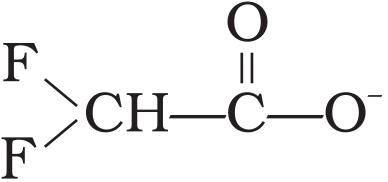
Ionic species are stabilised by the dispersal of charge. Which of the following carboxylate ion is the most stable?
- A
$\ \ \ \ \ \ \ \ \ \ \ \ \text{O}\\\ \ \ \ \ \ \ \ \ \ \ \ ||\\\text{CH}_3-\text{C}-\text{O}^-$
- B
$\ \ \ \ \ \ \ \ \ \ \ \ \ \ \ \ \ \ \ \ \ \text{O}\\\ \ \ \ \ \ \ \ \ \ \ \ \ \ \ \ \ \ \ \ \ \ ||\\\text{CI}-\text{CH}_2-\text{C}-\text{O}^-$
- C
$\ \ \ \ \ \ \ \ \ \ \ \ \ \ \ \ \ \ \ \ \text{O}\\\ \ \ \ \ \ \ \ \ \ \ \ \ \ \ \ \ \ \ \ ||\\\text{F}-\text{CH}_2-\text{C}-\text{O}^-$
- ✓
AnswerThe stabilsation of carboxylate ion depends on dispersal of negative charge. The negative charge is dispersed by two factors, i.e., $+ R$ effect of the carboxylate ion and Inductive effect of the halogens. In all the above structures, $R$ effect is common but halogen atoms are different. Therefore, dispersal of negative charge depends upon halogen atoms. $F$ is most electronegative, in structure $(iv)$ two Fatoms are present and more dispersal of negative charge is there.
View full question & answer→MCQ 1271 Mark
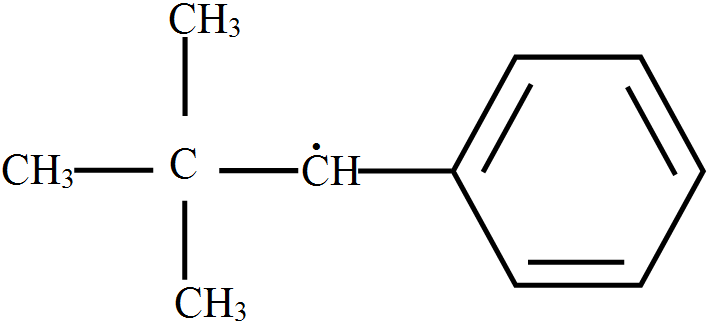
Consider the following compounds
-
-
-
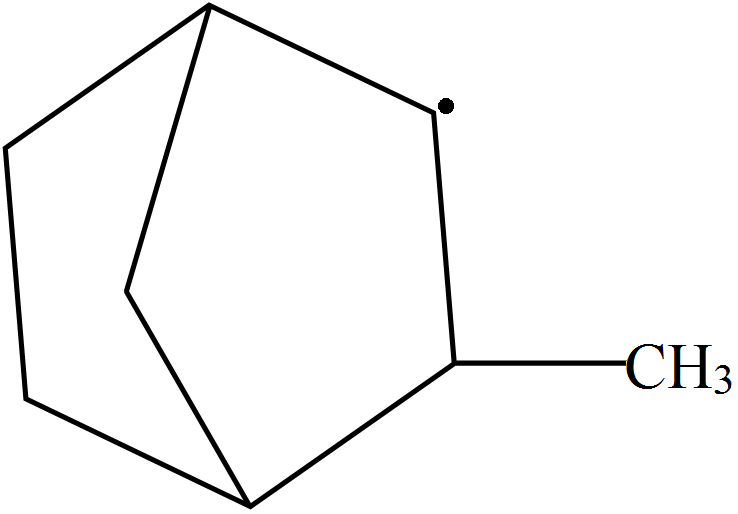
Hyper conjugation occurs in :
AnswerCorrect option: A. $\text{III}$
Because it has $'H\ '$ in conjugation with free radical.
OR
Hyperconjugation occurs through the $H-$ atoms present on the carbon atom next to the double bond i.e alpha hydrogen atoms. There is no alpha $-H$ in the structure $\text{I}$ and $\text{II}.$
So, hyperconjugation occurs in structure $\text{III}$ only ie.
View full question & answer→MCQ 1281 Mark
Group showing strongest $+\ M$ effect :
- A
$−\text{NH}_2$
- B
$−\text{N(CH}_3)_2$
- C
$−\text{NHCH}_3$
- ✓
$−\text{O}^-$
AnswerCorrect option: D. $−\text{O}^-$
$(-)$ charge is a stronger donor than lone pairs hence the strongest $+\ M$ effect is shown by $−\text{O}^-$.
Also, the other species does not contain any negative charge thus option $D$ is correct.
View full question & answer→MCQ 1291 Mark
The technique in which extraction of compound takes place on the basis of more solubility of one compound in another solvent, is :
MCQ 1301 Mark
The $\text{IUPAC}$ name of dimethyl ether is :
AnswerDimethyl ether is $\mathrm{CH}_3 \mathrm{OCH}_3$.
It's $\text{IUPAC}$ name is methoxymethane.
View full question & answer→MCQ 1311 Mark
How do we differentiate between $\mathrm{Fe}^{3+}$ and $\mathrm{Cr}^{3+}$ in group $\text{III}\ ?$
- A
By taking excess of $\ce{NH_4OH}$
- B
By increasing $\text{NH}_4^+$ ion cocentration
- C
By decreasing $\text{OH}^-$ ion concentration
- ✓
Both $(b)$ and $(c)$
AnswerCorrect option: D. Both $(b)$ and $(c)$
$\text{NH}_4^+$ ions are increased to suppress release of $\text{OH}^-$ ions, hence solubility product of $\text{Fe(OH)}_3$ is attained.
Colour of precipitate is different.
View full question & answer→MCQ 1321 Mark
The colour of bromine solution is :
AnswerBromine is a chemical element with symbol $\text{Br}$ and atomic number $35$.
It is the third $-$ lightest halogen, and is a fuming red-brown liquid at room temperature that evaporates readily to form a similarly coloured gas.
View full question & answer→MCQ 1331 Mark
The trends in physical properties of compounds within a homologous series are due to :
AnswerCorrect option: D. Both $a$ and $b$
The trends in physical properties of compounds within a homologous series are primarily due to the progression of sizes and therefore, weights of the molecules that form the homologous series.
View full question & answer→MCQ 1341 Mark
$'\text{I.U.P.A.C}.',$ stands for?
- A
- ✓
International Union of Pure and Applied Chemistry.
- C
International Units of Protein and Carbohydrates.
- D
International Understanding on Physical Aspects of Chemistry.
AnswerCorrect option: B. International Union of Pure and Applied Chemistry.
A chemical nomenclature is a set of rules to generate systematic names for chemical compounds.
The nomenclature used most frequently worldwide is the one created and developed by the International Union of Pure and Applied Chemistry.
The full form of $\text{IUPAC}$ is International Union for Pure and Applied Chemistry.
View full question & answer→MCQ 1351 Mark
The $\text{IUPAC}$ name of the compound is :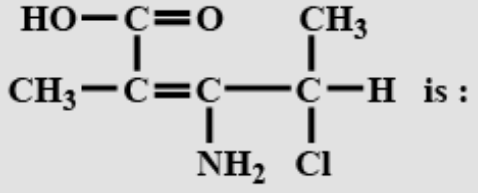
- A
$2 -$ Amino $- 3 - $ chloro $- 2 -$ methylpent $- 2 -$ enoic acid
- ✓
$3 -$ Amino $- 4 -$ chloro $- 2 -$ methylpent $- 2 -$ enoic acid
- C
$4-$ Amino $- 3 -$ chloro $- 2 -$ methylpent $- 2 -$ enoic acid
- D
AnswerCorrect option: B. $3 -$ Amino $- 4 -$ chloro $- 2 -$ methylpent $- 2 -$ enoic acid
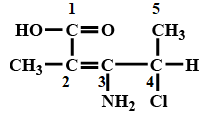
$3-$ amino $-4-$ chloro $-2-$ methylpent $-2-$ enoic acid.
In $\text{IUPAC}$ nomenclature carboxylic acid gets first priority, then $-$ ene, $-$ amino group, $-$ chloro group and $-$ methyl group.
View full question & answer→MCQ 1361 Mark
Choose the correct bond $-$ line formula for
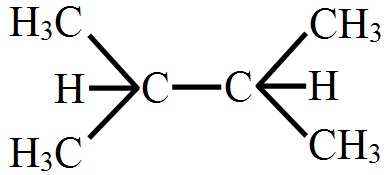
AnswerThe correct bond $-$ line formula for
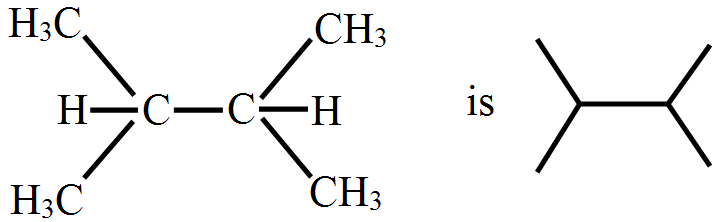
View full question & answer→MCQ 1371 Mark
AnswerNucleophiles are the electron rich species.
Nitrene is a nucleophile due to the lone pair electrons of Nitrogen.
View full question & answer→MCQ 1381 Mark
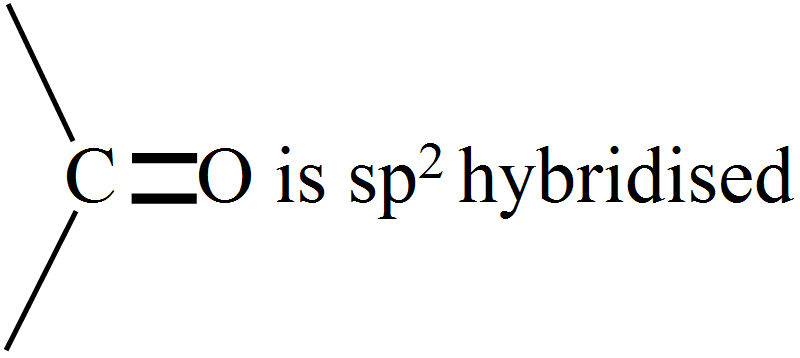
Look at the figure below and find the hybridisation of carbon atom.
AnswerCorrect option: B. $sp^2$
View full question & answer→MCQ 1391 Mark
In which of the following ways the structure $(s)$ of organic compounds is/ are represented?
- A
- B
- C
Condensed and bond-line structure.
- ✓
View full question & answer→MCQ 1401 Mark
Which of the following does not belong to homologous series of alkanes?
- A
$\mathrm{C}_2 \mathrm{H}_6$
- ✓
$\mathrm{C}_3 \mathrm{H}_4$
- C
$\mathrm{C}_4 \mathrm{H}_{10}$
- D
$\mathrm{C}_5 \mathrm{H}_{12}$
AnswerCorrect option: B. $\mathrm{C}_3 \mathrm{H}_4$
Alkanes have the general formula $\mathrm{C}_n \mathrm{H}_\text{2 n+2}$.
Thus, $\mathrm{C}_3 \mathrm{H}_4$
does not belong to homologous series of alkanes.
View full question & answer→MCQ 1411 Mark
The carbocation stability is : $\stackrel{{+}}{\hbox{ CH }_3}<\text{CH}_{3}\stackrel{{+}}{\hbox{ CH}_2}< (\text{CH}_{3})_{2}\stackrel{{+}}{\hbox{ CH }}<(\text{CH}_{3})_{3}\stackrel{{+}}{\hbox{C}}$
and alkyl radical stability is :
- A
$\stackrel{{\bullet}}{\hbox{ CH}}(\text{CH}_{3})_{2} < \stackrel{{\bullet}}{\hbox{ CH}}_{3} < \stackrel{{\bullet}}{\hbox{ CH}}_{2}\text{CH}_{3} < \stackrel{{\bullet}}{\hbox{C}}(\text{CH}_{3})_3$
- B
$\stackrel{{\bullet}}{\hbox{ CH}}(\text{CH}_{3})_{3} < \stackrel{{\bullet}}{\hbox{ CH}}_{}(\text{CH}_{3})_{2} < \stackrel{{\bullet}}{\hbox{ CH}}_{3} < \stackrel{{\bullet}}{\hbox{CH}}_{2}\text{CH}_{3}$
- C
$\stackrel{{\bullet}}{\hbox{ CH}}(\text{CH}_{3})_{3} < \stackrel{{\bullet}}{\hbox{ CH}}_{}(\text{CH}_{3})_{2} < \stackrel{{\bullet}}{\hbox{ CH}}_{2}\text{CH}_{3} < \stackrel{{\bullet}}{\hbox{CH}}_{3}$
- ✓
$\stackrel{{\bullet}}{\hbox{ CH}}_{3} < \stackrel{{\bullet}}{\hbox{ CH}}_{2}\text{CH}_{3} < \stackrel{{\bullet}}{\hbox{ CH}} (\text{CH}_{3})_{2} < \stackrel{{\bullet}}{\hbox{C}}(\text{CH}_{3})_{3}$
AnswerCorrect option: D. $\stackrel{{\bullet}}{\hbox{ CH}}_{3} < \stackrel{{\bullet}}{\hbox{ CH}}_{2}\text{CH}_{3} < \stackrel{{\bullet}}{\hbox{ CH}} (\text{CH}_{3})_{2} < \stackrel{{\bullet}}{\hbox{C}}(\text{CH}_{3})_{3}$
View full question & answer→MCQ 1421 Mark
Which is not the characteristic of $\pi−$ bond?
- A
$\pi$ bond is formed when a sigma bond already exists.
- ✓
$\pi$ bonds are formed from hybrid orbitals.
- C
$\pi$ bond may be formed by the overlapping of p orbitals.
- D
$\pi$ bond results from lateral overlap of atomic orbitals.
AnswerCorrect option: B. $\pi$ bonds are formed from hybrid orbitals.
$\pi$ bond is formed between two atoms if a sigma bond already exists between them.
$\pi$ bonds are formed only by pure orbitals $(p−$ orbitals$),$ not from hybrid orbitals.
They formed by lateral or sideways overlapping.
View full question & answer→MCQ 1431 Mark
In Lassaigne's test, a blue colour is obtained if the organic compound contains nitrogen. The blue colour is due to the formation of :
- A
$ \mathrm{K}_4\left[\mathrm{Fe}(\mathrm{CN})_6\right] $
- ✓
$\mathrm{Fe}_4\left[\mathrm{Fe}(\mathrm{CN})_6\right]_3 $
- C
$ \mathrm{Na}_3\left[\mathrm{Fe}(\mathrm{CN})_6\right] $
- D
$\mathrm{Cu}_2\left[\mathrm{Fe}(\mathrm{CN})_6\right] $
AnswerCorrect option: B. $\mathrm{Fe}_4\left[\mathrm{Fe}(\mathrm{CN})_6\right]_3 $
If nitrogen is present in the organic compound then sodium extract contains $\text{NaCN}.$
$\text{Na}+\text{C}+\text{N}\xrightarrow{\text{Fuse}}\text{NaCN}$
$\text{FeSO}_4+6\text{NaCN}\rightarrow\text{Na}_4[\text{Fe(CN)}_6]+\text{Na}_2\text{SO}_4$
It changes to prussian blue $\mathrm{Fe}_4\left[\mathrm{Fe}(\mathrm{CN})_6\right]_3$ on reaction with $\mathrm{FeCl}_3$.
$4\text{FeCl}_3+3\text{Na}_4[\text{Fe(CN)}_6]\rightarrow\text{Fe}_4[\text{Fe(CN)}_6]_3+12\text{NaCl}$
View full question & answer→MCQ 1441 Mark
Which one of the following is least stable?
- A
$\stackrel{{\ominus}}{\hbox{C}}\text{H}_3$
- B
$\text{HC}\equiv\stackrel{{\ominus}}{\hbox{C}}$
- C
$(\text{C}_6\text{H}_5)_3\stackrel{{\ominus}}{\hbox{C}}$
- ✓
$(\text{CH}_3)_3\stackrel{{\ominus}}{\hbox{C}}$
AnswerCorrect option: D. $(\text{CH}_3)_3\stackrel{{\ominus}}{\hbox{C}}$
It is least stable because $\text{C}^\ominus$ is attached to three electron releasing $\text{CH}_3$ groups.
View full question & answer→MCQ 1451 Mark
The order of priority in $\text{IUPAC}$ system :
- A
$-\text{CONH}_2,-\text{CHO},-\text{SO}_3\text{H},-\text{COOH}$
- B
$-\text{COOH},-\text{SO}_3\text{H},-\text{CONH}_2,-\text{CHO}$
- ✓
$-\text{SO}_3\text{H},-\text{COON},-\text{CONH}_2,-\text{CHO}$
- D
$-\text{CHO},-\text{COOH},-\text{SO}_3\text{H},-\text{CONH}_2$
AnswerCorrect option: C. $-\text{SO}_3\text{H},-\text{COON},-\text{CONH}_2,-\text{CHO}$
View full question & answer→MCQ 1461 Mark
Which of the following is not in accordance to $\text{IUPAC}$ system?
- ✓
$\text{Br}-\text{CH}_{2}- \text{CH}=\text{CH}_{2}\\ \ \ \ \ \ \ \ \ \text{1-bromoprop 2-ene}$
- B
$\text{CH}_{3}\\ |\\ \text{CH}_{3}-\text{CH}_{2}-\text{C}-\text{CH}_{2}-\text{CHCH}_{3}\\ \ \ \ \ \ \ \ \ \ \ \ \ \ \ \ \ \ \ \ \ \ \ \ \ \ \ |\ \ \ \ \ \ \ \ \ \ \ \ \ \ \ \ \ \ \ |\\\ \ \ \ \ \ \ \ \ \ \ \ \ \ \ \ \ \ \ \ \ \ \ \ \ \text{Br} \ \ \ \ \ \ \ \ \ \ \ \ \ \ \ \ \text{CH}_{3}\\ \ \ \ \ \ \ \ \ \ \ \ \ \ \ \ \text{4-bromo-2, 4-dimethyle hexane}$
- C
- D
$\text{CH}_{3}-\text{C}-\text{CH}_{3}-\text{CH}_{2}\text{CH}_{2}\text{COOH}\\ \ \ \ \ \ \ \ \ \ \ \ \ \ ||\\\ \ \ \ \ \ \ \ \ \ \ \ \ \text{O}\\ \ \ \ \ \ \ \ \ \ \ \ \ \ \ \ \ \ \ \text{5-oxohexanoic acid}$
AnswerCorrect option: A. $\text{Br}-\text{CH}_{2}- \text{CH}=\text{CH}_{2}\\ \ \ \ \ \ \ \ \ \text{1-bromoprop 2-ene}$
View full question & answer→MCQ 1471 Mark
Which of the following method is used to purify liquids having very high boiling points and those which decompose at or below their boiling points?
- A
- B
- ✓
Distillation under reduced pressure.
- D
AnswerCorrect option: C. Distillation under reduced pressure.
Distillation under reduced pressure method is used to purify liquids having very high boiling points and those, which decompose at or below their boiling points. Such liquids are made to boil at a temperature lower than their normal boiling points by reducing the pressure on their surface. A liquid boils at a temperature at which its vapour pressure is equal to the external pressure. The pressure is reduced with the help of a water pump or vacuum pump.
View full question & answer→MCQ 1481 Mark
The structure of iso $-$ butyl group in an organic compound is :
Answer'Iso' means one Me group is present in side chain. Hence, the structure of iso $-$ butyl group is
$ \ \ \ \ \ \ \ \ \ \ \ \ \text{CH}_3 \\ \ \ \ \ \ \ \ \ \ \ \ \ \ \ |\\\ \text{CH}_3-\text{C}-\text{CH}_2 \ \ \ \ \ \ \ \ \ \ \ \ \ \ \ \ \ \ \ \ \ \ \ \ \ \ \ \ \\ \ \ \ \ \ \ \ \ \ \ \ \ \ \ |\\ \ \ \ \ \ \ \ \ \ \ \ \ \ \text{C}$
View full question & answer→MCQ 1491 Mark
The indicator which is used to find the strength of caustic soda solution with the help of oxalic acid is :
AnswerAn indicator is a chemical substance that undergoes a colour change at the endpoint. The endpoint of an acid $-$ base titration can be determined using acid-base indicators.
Acid Base indicators are either weak organic acids or weak organic bases. The colour change of an indicator depends on the $\text{pH}$ of the medium.
The un $-$ ionized form of an indicator has one colour, but its ionized form has a different colour.
Phenolphthalein is used to find the strength of caustic soda solution with the help of oxalic acid.
View full question & answer→MCQ 1501 Mark
Passing $\ce{H_2S}$ gas into a mixture of $\mathrm{Mn}^{2+}, \mathrm{Ni}^{2+}, \mathrm{Cu}^{2+}, \mathrm{Hg}^{2+}$ ions in acidified aqueous solution precipitates :
- ✓
$\text{CuS}$ and $\text{HgS}$
- B
$\text{MnS}$ and $\text{CuS}$
- C
$\text{MnS}$ and $\text{NiS}$
- D
$\text{NiS}$ and $\text{HgS}$
AnswerCorrect option: A. $\text{CuS}$ and $\text{HgS}$
$\text{Cu}^{2+}$ and $\text{Hg}^{2+}$ lie in $\text{II}^{nd}$ group of qualitative analysis $\ce{H_2S}$ in acid medium is reagent for it.
$\text{HCl} \rightarrow\ \ce{H^+ + Cl}^-$
$\ce{H_2S}\ \leftrightharpoons \ 2H^+ + S^{2-}$
View full question & answer→MCQ 1511 Mark
identify the rate of reaction of given compounds in $E_2$ reaction : 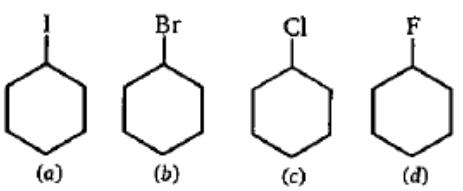
- ✓
$\text{a > b > c > d}$
- B
$\text{a > c > b > d}$
- C
$\text{b > a > c > d}$
- D
$\text{b > d > a > c}$
AnswerCorrect option: A. $\text{a > b > c > d}$
The rate of reaction depends on the leaving ability of halide ions.
Leaving Ability : $\mathrm{I}^{-} > \mathrm{Br}^{-} > \mathrm{Cl}^{-} > \mathrm{F}^{-}\ ($Acidic nature$).$
Strong acids act as a strong leaving groups.
View full question & answer→MCQ 1521 Mark
Which of the following compounds will not give Lassaigne's test for nitrogen?
- ✓
$\text{NH}_2-\text{NH}_2$
- B
$\text{C}_6\text{H}_5\text{NHNH}_2$
- C
$\text{C}_6\text{H}_5-\text{N}=\text{N}-\text{C}_6\text{H}_5$
- D
$\text{NH}_2\text{CONH}_2$
AnswerCorrect option: A. $\text{NH}_2-\text{NH}_2$
Because it does not have carbon.
View full question & answer→MCQ 1531 Mark
Arrange the above in the decreasing order of reactivity towards $\text{HBr}$ : 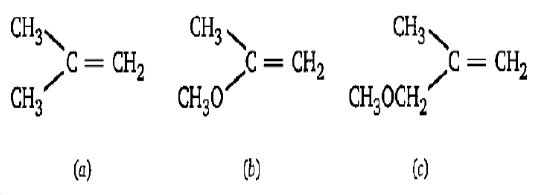
- A
$\text{a > b > c}$
- ✓
$\text{b > a > c}$
- C
$\text{b > c > a}$
- D
$\text{a > c > b}$
AnswerCorrect option: B. $\text{b > a > c}$
Among $\text{a, b}$ and $\text{c}$ electron donating ability order is $-\mathrm{OCH}_3 > -\mathrm{CH}_3 > -\mathrm{CH}_2 \mathrm{OCH}_3$ more the electron donating ability of substituent more is the stability of carbocation.
View full question & answer→MCQ 1541 Mark
The main source of organic compounds is :
AnswerCorrect option: C. Both $(a)$ and $(b)$
Petroleum and coaltar are the main sources of organic compounds.
View full question & answer→MCQ 1551 Mark
Which one of the following has the most nucleophilic nitrogen?
Answer$\because$ Lone pair of electrons are easily available. In $(b)$ lone pair is delocalised, in $(c) -\ce{COCH}_3$ is electron withdrawing, in $(d)\ \ce{C_6H_{5^-}}$ is electron withdrawing.
View full question & answer→MCQ 1561 Mark
The fruity smell is of a/an :
AnswerEsters have a fruity smell due to their volatile nature caused by their chemical composition and conformations.
View full question & answer→MCQ 1571 Mark
Which of the following compounds will exhibit geometrical isomerism?
- ✓
In which of the following representations given below spatial arrangement of group/ atom different from that given in structure $'A\ ’\ ?$
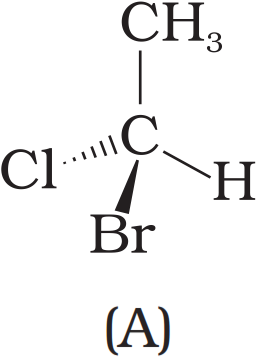
- B
$3-$ phenyl $-1-$ butene.
- C
$2-$ phenyl $-1-$ butene.
- D
$1, 1-$ diphenyl $-1-$ propane.
AnswerCorrect option: A. In which of the following representations given below spatial arrangement of group/ atom different from that given in structure $'A\ ’\ ?$
View full question & answer→MCQ 1581 Mark
In which of the following representations given below spatial arrangement of group/ atom different from that given in structure ‘A’?
Answer
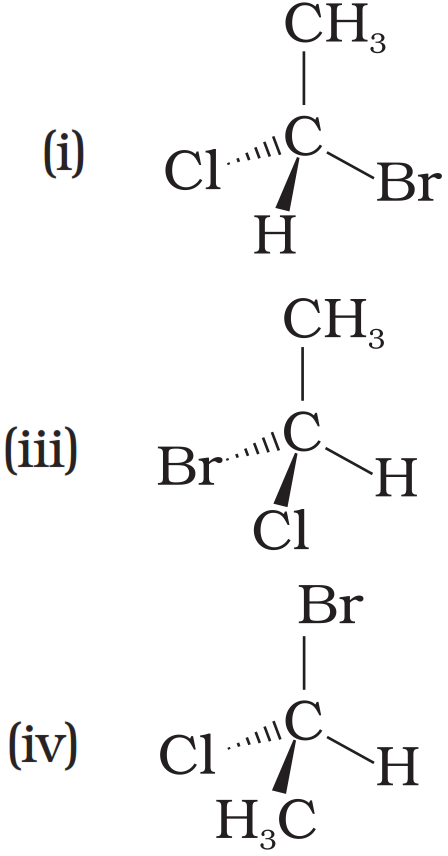 Explanation:
The spatial arrangement of groups or atoms can be checked by doing two interchange and bringing H below the plane of the paper. Find out the sequence of the remaining groups in a particular order whether clockwise or anticlockwise starting from atom with highest atomic number to atom with lower atomic numbers. Hence, option (ii) has same spatial arrangement as (A) while in rest three is different.
View full question & answer→MCQ 1591 Mark
The compound of the molecular formula, $\ce{C_6H_{14}}$ has two tertiary carbons. Its $\text{IUPAC}$ name is :
- A
$n-$ hexane
- B
$2−$ methylpentane
- ✓
$2, 3−$ dimethylbutane
- D
AnswerCorrect option: C. $2, 3−$ dimethylbutane
Molecular formula of the compound is $\ce{C_6H_{14}}$. The compound has $2$ tertiary carbon.
Then the probable structure of the compound will be $\mathrm{CH}_3-\mathrm{CH}(\mathrm{Me})-\mathrm{CH}(\mathrm{Me})-\mathrm{CH}_3$.
Name of this compound is $2, 3-$ dimethylbutane.
View full question & answer→MCQ 1601 Mark
Identify the correct decreasing order of priority of the functional groups from the following :
- A
$ -\mathrm{CONH}_2,-\mathrm{C}=\mathrm{O},-\mathrm{HC}=\mathrm{O},-\mathrm{CN} $
- ✓
$ -\mathrm{CONH}_2,-\mathrm{CN},-\mathrm{HC}=\mathrm{O},-\mathrm{C}=\mathrm{O} $
- C
$ -\mathrm{CN},-\mathrm{CONH}_2,-\mathrm{C}=\mathrm{O},-\mathrm{HC}=\mathrm{O} $
- D
$ -\mathrm{CN},-\mathrm{CONH}_2,-\mathrm{HC}=\mathrm{O},-\mathrm{C}=\mathrm{O} $
AnswerCorrect option: B. $ -\mathrm{CONH}_2,-\mathrm{CN},-\mathrm{HC}=\mathrm{O},-\mathrm{C}=\mathrm{O} $
Amides $ > $ Nitriles $ > $ Aldehydes $ > $ ketones
View full question & answer→MCQ 1611 Mark
What is the name of tube in which a known mass of an organic compound is heated for the quantitative analysis of sulphur?
AnswerTube in which a known mass of an organic compound is heated for the quantitative analysis of $S$ is known as Carius tube.
View full question & answer→MCQ 1621 Mark
The molecular formulae for phosgene and tear gas are $.......... $ and $......... $ respectively.
- ✓
$ \mathrm{COCl}_2 $ and $\mathrm{CCl}_3 \mathrm{NO}_2 $
- B
$ \mathrm{SOCl}_2 $ and $ \mathrm{CCl}_3 \mathrm{NO}_2 $
- C
$\mathrm{COCl}_2 $ and $ \mathrm{CCI}_3 \mathrm{NO}_2 $
- D
$ \mathrm{SOCl}_2 $ and $ \mathrm{CCI}_3 \mathrm{NO}_2$
AnswerCorrect option: A. $ \mathrm{COCl}_2 $ and $\mathrm{CCl}_3 \mathrm{NO}_2 $
View full question & answer→MCQ 1631 Mark
Given two compounds, one more polar than the other, which one will move up the silica stationery phase higher than the other in $\text{TLC}\ ?$
AnswerPolar compounds will have more interaction with silica gel and hence polar compounds won't move much in the stationery phase.
Non polar compounds will have lesser interaction with the silica or the stationery phase and will move higher than the polar compound.
View full question & answer→MCQ 1641 Mark
Which of the following is a correct representation of condensed formula for $\text{HOCH}_2\text{CH}_2\text{CH}_2\text{CH(CH}_3)\text{CH(CH}_3)\text{CH(CH}_3)\text{CH}_3\ ?$
- A
$\text{HO(CH}_2)_2\text{CHCH}_3\text{CH(CH}_3)_2$
- ✓
$\text{HO(CH}_2)_2\text{CH(CH}_3)\text{CH(CH}_3)_2$
- C
$\text{HOCH}_2\text{CHCH}_3\text{CH(CH}_3)_2$
- D
AnswerCorrect option: B. $\text{HO(CH}_2)_2\text{CH(CH}_3)\text{CH(CH}_3)_2$
The correct condensed formula for $\text{HOCH}_2\text{CH}_2\text{CH}_2\text{CH(CH}_3)\text{CH(CH}_3)\text{CH(CH}_3)\text{CH}_3$
is $\text{HO(CH}_2)_3\text{CHCH}_3\text{CH(CH}_3)_2$
View full question & answer→MCQ 1651 Mark
How many pi bonds are present in phosgene?
AnswerFrom the image we can see that there is only $1$ pi $-$ bond present in phosgene $($cabonyl chrolide$).$
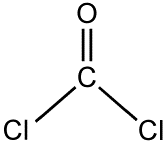
View full question & answer→MCQ 1661 Mark
The $\text{IUPAC}$ name of iso $-$ octane is :
- A
$2, 2-$ dimethylpentane.
- B
$2, 3-$ dimethylpentane.
- C
$2, 3, 3-$ trimethylpentane.
- ✓
$2, 2, 4-$ trimethylpentane.
AnswerCorrect option: D. $2, 2, 4-$ trimethylpentane.
View full question & answer→MCQ 1671 Mark
Which method of estimation is shown in the figure given below?
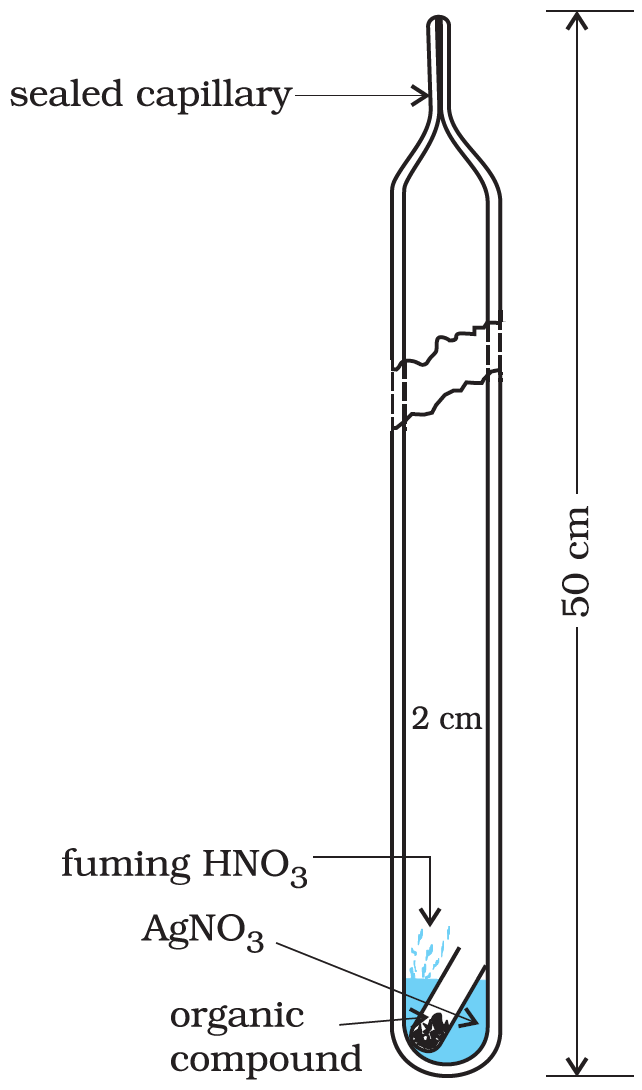
MCQ 1681 Mark
Which one is a nucleophilic substitution reaction among the following?
- A
$\text{CH}_3\text{CHO}+\text{HCN}\rightarrow\text{CH}_3\text{CH(OH)CN}$
- B
$\text{CH}_3-\text{CH}=\text{CH}_2+\text{H}_2\text{O}\xrightarrow{\text{H}^+}\text{CH}_3-\text{CH}-\text{CH}_3\\ \ \ \ \ \ \ \ \ \ \ \ \ \ \ \ \ \ \ \ \ \ \ \ \ \ \ \ \ \ \ \ \ \ \ \ \ \ \ \ \ \ \ \ \ \ \ \ \ \ \ \ \ \ \ \ \ \ \ \ \ \ \ \ \ \ \ |\\\ \ \ \ \ \ \ \ \ \ \ \ \ \ \ \ \ \ \ \ \ \ \ \ \ \ \ \ \ \ \ \ \ \ \ \ \ \ \ \ \ \ \ \ \ \ \ \ \ \ \ \ \ \ \ \ \ \ \ \ \ \ \ \ \ \text{OH}$
- C
$\text{RCHO}+\text{R}'\text{MgX}\rightarrow\text{R}-\text{CH}-\text{R}'\\ \ \ \ \ \ \ \ \ \ \ \ \ \ \ \ \ \ \ \ \ \ \ \ \ \ \ \ \ \ \ \ \ \ \ \ \ \ \ \ \ \ \ \ \ \ |\\ \ \ \ \ \ \ \ \ \ \ \ \ \ \ \ \ \ \ \ \ \ \ \ \ \ \ \ \ \ \ \ \ \ \ \ \ \ \ \ \ \ \ \ \ \text{OH}$
- ✓
$ \ \ \ \ \ \ \ \ \ \ \ \ \ \ \ \ \ \ \ \ \ \ \ \ \ \text{CH}_3\\ \ \ \ \ \ \ \ \ \ \ \ \ \ \ \ \ \ \ \ \ \ \ \ \ \ \ |\\\text{CH}_3-\text{CH}_2-\text{CH}-\text{CH}_2\text{Br}+\text{NH}_3\rightarrow\\ \ \ \ \ \ \ \ \ \ \ \ \ \ \ \ \ \ \ \ \ \ \ \ \ \ \text{CH}_3\\ \ \ \ \ \ \ \ \ \ \ \ \ \ \ \ \ \ \ \ \ \ \ \ \ \ \ |\\\text{CH}_3-\text{CH}_2-\text{CH}-\text{CH}_2\text{NH}_2$
AnswerCorrect option: D. $ \ \ \ \ \ \ \ \ \ \ \ \ \ \ \ \ \ \ \ \ \ \ \ \ \ \text{CH}_3\\ \ \ \ \ \ \ \ \ \ \ \ \ \ \ \ \ \ \ \ \ \ \ \ \ \ \ |\\\text{CH}_3-\text{CH}_2-\text{CH}-\text{CH}_2\text{Br}+\text{NH}_3\rightarrow\\ \ \ \ \ \ \ \ \ \ \ \ \ \ \ \ \ \ \ \ \ \ \ \ \ \ \text{CH}_3\\ \ \ \ \ \ \ \ \ \ \ \ \ \ \ \ \ \ \ \ \ \ \ \ \ \ \ |\\\text{CH}_3-\text{CH}_2-\text{CH}-\text{CH}_2\text{NH}_2$
View full question & answer→MCQ 1691 Mark
Which type of bond is formed between carbon atom and nitrogen atom?
AnswerA covalent bond is formed between carbon and nitrogen atom. If duplet $(2)$ or octet $(8)$ is completed by sharing of electrons between two electronegative elements, the bond formed is called covalent bond.
View full question & answer→MCQ 1701 Mark
Which of the following is correct about the number of bonds formed by atoms of different elements in acetaldehyde? $($Report your answer in the ratio of $\text{H:O:C})$
- A
$4:2:2$
- ✓
$4:1:2$
- C
$4:1:3$
- D
$3:3:3$
AnswerCorrect option: B. $4:1:2$
$\ce{CH_3CHO}\ −$ Acetaldehyde
No of atoms of $\text{H:O:C} = 4:1:2$
View full question & answer→MCQ 1711 Mark
$\text{CH}_3−\text{CH}=\text{CH}−\text{C}\equiv\text{CH}$ has $\text{lUPAC}$ name :
- A
pent $- 2 -$ en $- 4 -$ yne
- B
pent $- 4 -$ yn $- 2 -$ ene
- C
pent $- 1 -$ yn $- 3 -$ ene
- ✓
pent $- 3 -$ en $- 1 -$ yne
AnswerCorrect option: D. pent $- 3 -$ en $- 1 -$ yne
View full question & answer→MCQ 1721 Mark
Which of the statements below best describes a functional group?
AnswerCorrect option: C. It is an atom or a group of atoms which determines the chemical properties of a compound.
Functional groups are specific groups or recognizable group of atoms or bonds within molecules that are responsible for the characteristic chemical reactions of those molecules.
These functional group give characteristic properties to the carbon chain to which it is attached, e.g., aldehydic group or carboxylic group.
View full question & answer→MCQ 1731 Mark
Which one of the following is not an alcohol?
- A
$ \left(\mathrm{CH}_3\right)_2 \mathrm{CHCH}_2 \mathrm{CH}_2 \mathrm{OH} $
- B
$ \left(\mathrm{CH}_3\right)_3 \mathrm{C}-\mathrm{CH}_2 \mathrm{OH} $
- C
$ \left(\mathrm{CH}_3\right)_2-\mathrm{CH}-\mathrm{OH} $
- ✓
$ \mathrm{CH}_3 \mathrm{CH}_2 \mathrm{CH}_2 \mathrm{CH}_2 \mathrm{COOH} $
AnswerCorrect option: D. $ \mathrm{CH}_3 \mathrm{CH}_2 \mathrm{CH}_2 \mathrm{CH}_2 \mathrm{COOH} $
$(d)$ is the correct answer as the group associated with it is carboxylic acid group.
View full question & answer→MCQ 1741 Mark
Which of the following are members of same homologous series?
- ✓
$\mathrm{HCOOCH}_3$ and $\mathrm{CH}_3 \mathrm{COOCH}_3$
- B
$\text{HCOOH}$ and $\mathrm{HCOOCH}_3$
- C
$\mathrm{CH}_3 \mathrm{COCH}_3$ and $\mathrm{CH}_3 \mathrm{CH}_2 \mathrm{CHO}$
- D
$\mathrm{C}_2 \mathrm{H}_5 \mathrm{OH}$ and $\mathrm{CH}_3 \mathrm{OCH}_3$
AnswerCorrect option: A. $\mathrm{HCOOCH}_3$ and $\mathrm{CH}_3 \mathrm{COOCH}_3$
A homologous series is a family of hydrocarbons with similar chemical properties that share the same general formula.
Both given compound $\mathrm{HCOOCH}_3$ and $\mathrm{CH}_3 \mathrm{COOCH}_3$ are homologous series of a simple ester group $\text{RCOOH},$ where a successive methyl group $−\ce{CH}_3$ added to previous one.
View full question & answer→MCQ 1751 Mark
In presence of $\ce{HCl(aq.);H_2S}$ gas results the precipitation of group $-2$ cations but not of group $-4$ cations during qualitative analysis. It is due to :
- A
Lower concentration of $\mathrm{S}^{2-}$
- ✓
Higher concentration of $\mathrm{S}^{2-}$
- C
Lower concentration of $\mathrm{H}^{+}$
- D
Higher concentration of $\mathrm{H}^{+}$
AnswerCorrect option: B. Higher concentration of $\mathrm{S}^{2-}$
Due to common ion effect, the ionisation of $\ce{H_2S}$ is suppressed and at low concentration of $S^{2-}$ ions, the second group sulphides are precipitated.
View full question & answer→MCQ 1761 Mark
The fragrance of flowers is due to the presence of some steam volatile organic compounds called essential oils. These are generally insoluble in water at room temperature but are miscible with water vapour in vapour phase. A suitable method for the extraction of these oils from the flowers is :
- A
- B
- C
Distillation under reduced pressure.
- ✓
AnswerEssential oils are insoluble in water, soluble in steam and have high vapour pressure.
Therefore, they can be separated by steam distillation.
View full question & answer→MCQ 1771 Mark
Which of the following is a homocyclic alicyclic compound?
- A
- ✓
- C
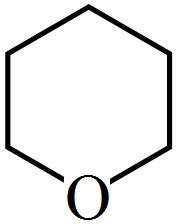
- D
AnswerAlicyclic $($aliphatic cyclic$)$ compounds contain carbon atoms joined in the form of a ring. Homocyclic means it contains only $C-$ atoms in the ring, e.g.
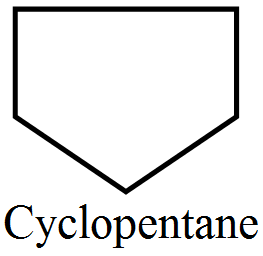
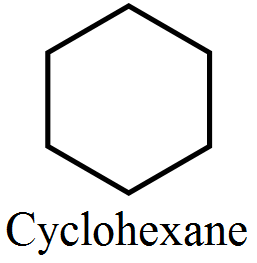
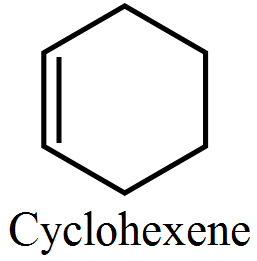
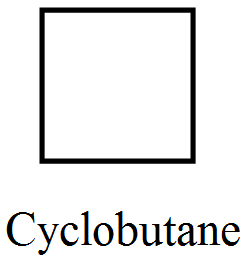
View full question & answer→MCQ 1781 Mark
Pick out the wrong statement.
AnswerIt is aromatic
$\because$ it has $(4\text{n}+2)\pi,$ i.e., $6\pi$ electrons which are delocalised.
View full question & answer→MCQ 1791 Mark
Electrophilic addition reactions proceed in two steps. The first step involves the addition of an electrophile. Name the type of intermediate formed in the first step of the following addition reaction. $\text{H}_3\text{C}-\text{H}\text{C}=\text{CH}_2+\text{H}^+\rightarrow?$
- A
$2^\circ$ Carbanion
- B
$1^\circ $ Carbocation
- ✓
$2^\circ $ Carbocation
- D
$1^\circ $ Carbanion
AnswerCorrect option: C. $2^\circ $ Carbocation
When the electrophile attacks $\ce{CH_3 – CH = CH_2}$, delocalisation of electrons can take place in two possible ways

As $2^\circ $ carbocation is more stable than $1^\circ $ carbocation, the first addition is more feasible. View full question & answer→MCQ 1801 Mark
The atom or the group of atoms by which the characteristic reactions of organic compounds are determined, that atom or group of atoms is called $ ........$
AnswerFunctional groups are specific substituents or moieties within molecules that are responsible for the characteristic chemical reactions of those molecules.
Examples : $\ce{−OH, −COOH, −COOR}$ etc.
Hence, the atom or the group of atoms by which the characteristic reactions of organic compounds are determined, that atom or group of atoms is called functional group.
View full question & answer→MCQ 1811 Mark
Which functional group is present in a molecule of $\mathrm{CH}_3 \mathrm{OCH}_2 \mathrm{CH}_3\ ?$
AnswerThe functional group present in $\mathrm{CH} 3-\mathrm{O}-\mathrm{CH}_2 \mathrm{CH}_3$ is an ether group $−O−.$
Note: In general, ethers can be represented as $\ce{R−O−R}\ '.$
View full question & answer→MCQ 1821 Mark
Homolyte fission leads to formation of :
Answer$\text{cl}-\text{cl}\xrightarrow{\ \ \text{hv}\ \ \ }2\text{c}\dot{\text{l}}$
View full question & answer→