MCQ
Which of the sets given below may represent the magnitudes of three vectors adding to zero?
- A$2, 4, 8$
- B$4, 8, 16$
- ✓$1, 2, 1$
- D$0.5, 1, 2$
Generate a complete, print-ready paper with questions like this in minutes — across 16+ boards, with answer keys.
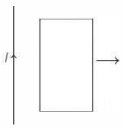
| Induced current | Force on left side | Force on right side | |
| $a.$ | Counter clockwise | To the left | To the right |
| $b.$ | clockwise | To the left | To the right |
| $c.$ | Counter clockwise | To the right | To the left |
| $d.$ | clockwise | To the right | To the left |
$V(z)=\frac{\sigma}{2 \in_0}\left(\sqrt{R^2+z^2}-z\right)$
A particle of positive charge $q$ is placed initially at rest at a point on the $z$ axis with $z=z_0$ and $z_0>0$. In addition to the Coulomb force, the particle experiences a vertical force $\vec{F}=-c \hat{k}$ with $c>0$. Let $\beta=\frac{2 c \in_0}{q \sigma}$. Which of the following statement($s$) is(are) correct?
$(A)$ For $\beta=\frac{1}{4}$ and $z_0=\frac{25}{7} R$, the particle reaches the origin.
$(B)$ For $\beta=\frac{1}{4}$ and $z_0=\frac{3}{7} R$, the particle reaches the origin.
$(C)$ For $\beta=\frac{1}{4}$ and $z_0=\frac{R}{\sqrt{3}}$, the particle returns back to $z=z_0$.
$(D)$ For $\beta>1$ and $z_0>0$, the particle always reaches the origin.
Given : dimension of spider and fly is very small $w.r .t.$ to sphere $RI$ of glass $μ_g = \sqrt 2$