MCQ
Which one is not the correct statement
  • A
    $1\,volt \times 1\,coulomb = 1\,joule$
  • B
    $1\,volt \times 1\,ampere = 1\,joule/second$
  • $1\,volt \times 1\,watt = 1\,H.P.$
  • D
    Watt-hour can be expressed in $eV$

Answer

Correct option: C.
$1\,volt \times 1\,watt = 1\,H.P.$
c
(c) Because $1\, H.P. = 746\, J/s$ $=$ $746\, watt$

Need a full question paper?

Generate a complete, print-ready paper with questions like this in minutes — across 16+ boards, with answer keys.
Start Generating Free

Similar questions

The current flowing through a lamp marked as 50 W and 250 V is
The frequency of $K_{\alpha} , K_{\beta}$ and $L_{\alpha}$ $X-$ rays of a material are $\gamma _1, \gamma _2$ and $\gamma _3 $ respectively. Which of the following relations holds good ?
A coil of inductance $40 \,henry$ is connected in series with a resistance of $8\,\Omega$ and the combination is joined to the terminals of a $2\,volt$ battery. The time constant of the circuit is......$seconds$
Two coherent sources of different intensities send waves which interfere. The ratio of maximum intensity to the minimum intensity is $25$. The intensities of the sources are in the ratio
One of the two identical conducing wires of length $L$ is bent in the form of a circular loop and the other one into a circular coil of $N$ identical turns. If the same current is passed in both, the ratio of the magnetic field at the central of the loop $(B_L)$ to that at the centre of the coil $(B_C),$; $.\,\frac {B_L}{B_C}$ will be
Missing lines in a continuous spectrum reveal
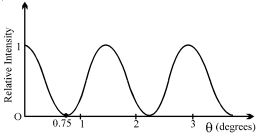
Light of wavelength $520\, nm$ passing through a double slit, produces interference pattern of relative intensity versus deflection angle $\theta$ as shown in the figure. The separation $d$ between the slits is
Starting with a sample of pure $66_{\mathrm{Cu}}, \frac{7}{8}$ of it decays into Zn in 15 min. The corresponding half-life is
Consider an optical communication system operating at $\mathrm{I} \sim 800 \mathrm{~nm}$. Suppose, only $1 \%$ of the optical source frequency is the available channel bandwidth for optical communication. How many channels can be accommodated for transmitting audio signals requiring a bandwidth of $8 \ \ce{KHz}$
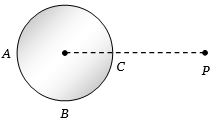
A hollow conducting sphere is placed in an electric field produced by a point charge placed at $P$ as shown in figure. Let ${V_A},{V_B},{V_C}$ be the potentials at points $A,B$ and $C$ respectively. Then