MCQ
Which one is strongest electrolyte in the following
  • $NaCl$
  • B
    $C{H_3}COOH$
  • C
    $N{H_4}OH$
  • D
    ${C_6}{H_{12}}{O_6}$

Answer

Correct option: A.
$NaCl$
(a)$NaCl$, being a salt, is a strong electrolyte.

Need a full question paper?

Generate a complete, print-ready paper with questions like this in minutes — across 16+ boards, with answer keys.

Start Generating Free

Similar questions

The most common oxidation states of the most electronegative elements in their compounds are :
The energy required to remove an electron of a gaseous atom from its ground state is called
The structure of silicon$(IV)$ oxide belongs to the type:
Which of the following alkenes on ozonolysis give mixture of ketones only ?
The exothermic formation of $ClF_3$ is represented by the equation

$C{l_{2\left( g \right)}} + 3{F_2}_{\left( g \right)} \rightleftharpoons 2C{l_3}_{\left( g \right)};\Delta {H_r} =  - 329\,kJ$ 

Which of the following will increase the quantity of $ClF_3$ in an equilibrium mixture of $Cl_2, F_2$ and $ClF_3$ ?

The correct sequence which shows decreasing order of the ionic radii of the elements is
Given below are two statements : one is labelled as Assertion $A$ and the other is labelled as Reason $R$:

Assertion $A$: In the photoelectric effect, the electrons are ejected from the metal surface as soon as the beam of light of frequency greater than threshold frequency strikes the surface.

Reason $R$ : When the photon of any energy strikes an electron in the atom, transfer of energy from the photon to the electron takes place.

In the light of the above statements, choose the most appropriate answer from the options given below :
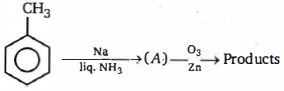
Which of the following product cannot be obtained in above reaction ?
An organic compound $P$ having molecular formula $C _6 H _6 O _3$ gives ferric chloride test and does not have intramolecular hydrogen bond. The compound $P$ reacts with $3$ equivalents of $NH _2 OH$ to produce oxime $Q$. Treatment of $P$ with excess methyl iodide in the presence of $KOH$ produces compound $R$ as the major product. Reaction of $R$ with excess iso-butylmagnesium bromide followed by treatment with $H _3 O ^{+}$gives compound $S$ as the major product.

The total number of methyl $\left(- CH _3\right)$ group($s$) in compound $S$ is. . . . 

The atomic number of an element is determined by :