MCQ
Which one of the following aqueous solutions will exhibit highest boiling point
  • A
    $0.015 M$  urea
  • B
    $0.01\,M\,KN{O_3}$
  • $0.01\,M\,N{a_2}S{O_4}$
  • D
    $0.015\,M\,$glucose

Answer

Correct option: C.
$0.01\,M\,N{a_2}S{O_4}$
c
(c)Elevation in boiling point is a colligative property which depends upon the number of solute particles. Greater the number of solute particle in a solution higher the extent of elevation in boiling point.
$N{a_2}S{O_4} \to 2N{a^ + } + SO_4^{2 - }$

Need a full question paper?

Generate a complete, print-ready paper with questions like this in minutes — across 16+ boards, with answer keys.
Start Generating Free

Similar questions

$(i)$ chlorobenzene is mono-nitrated to $M$
$(ii)$ nitrobenezene is mono-chlorinated to $N$
$(iii)$ anisole is mono-nitrated to $P$
$(iv)\, 2-$ nitrochlorobenzene is mono-nitrated to $Q.$
Out of $M, N, P$ and $Q$ the compound that undergoes reaction with $aq. NaOH$ fastest is
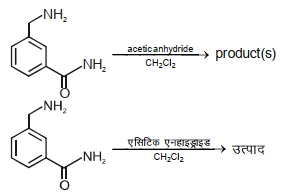
In the reaction shown below, the major product$(s)$ formed is/are
The oxidation sate of phosphorus in hypophosphoric acid is $+......$
The vapour pressures of $A$ and $B$ at $25^{\circ} \mathrm{C}$ are $90\, \mathrm{~mm}\, \mathrm{Hg}$ and $15\, \mathrm{~mm} \,\mathrm{Hg}$ respectively. If $\mathrm{A}$ and $\mathrm{B}$ are mixed such that the mole fraction of $A$ in the mixture is $0.6$, then the mole fraction of $B$ in the vapour phase is $x \times 10^{-1}$. The value of $x$ is $.....$ (Nearest integer)
Which of the following compounds react with $NaHCO _3$ :
$S{O_2}$ acts as temporary bleaching agent but $C{l_2}$ acts as permanent bleaching agent. Why
Glucose molecule reacts with $X$ number of molecules of phenylhydrazine to yield osazone. The value of $X$ is
Which one of the following statements for the order of a reaction is incorrect?
The total number of possible isomers of the complex compound  is

$\overset{\left( II \right)}{\mathop{\left[ Cu{{\left( N{{H}_{3}} \right)}_{4}} \right]}}\,$     $\overset{\left( II \right)}{\mathop{\left[ PtC{{l}_{4}} \right]}}\,$

For the reduction of $\mathrm{NO}_3^{-}$ion in an aqueous solution, $\mathrm{E}^0$ is $+0.96 \mathrm{~V}$. Values of $\mathrm{E}^0$ for some metal ions are given below

$\mathrm{V}^{2+}(\mathrm{aq})+2 \mathrm{e}^{-} \rightarrow \mathrm{V} \ \ \ \ \mathrm{E}^0=-1.19 \mathrm{~V} $

$\mathrm{Fe}^{3+}(\mathrm{aq})+3 \mathrm{e}^{-} \rightarrow \mathrm{Fe} \ \ \ \ \mathrm{E}^0=-0.04 \mathrm{~V} $

$\mathrm{Au}^{3+}(\mathrm{aq})+3 \mathrm{e}^{-} \rightarrow \mathrm{Au} \ \ \ \ \mathrm{E}^0=+1.40 \mathrm{~V} $

$\mathrm{Hg}^{2+}(\mathrm{aq})+2 \mathrm{e}^{-} \rightarrow \mathrm{Hg} \ \ \ \ \mathrm{E}^0=+0.86 \mathrm{~V}$

The pair$(s)$ of metals that is$(are)$ oxidized by $\mathrm{NO}_3^{-}$in aqueous solution is$(are)$

$(A)$ $\mathrm{V}$ and $\mathrm{Hg}$ $(B)$ $\mathrm{Hg}$ and $\mathrm{Fe}$

$(C)$ $\mathrm{Fe}$ and $\mathrm{Au}$ $(D)$ $Fe$ and $V$