MCQ
Which one of the following compound will give addition reaction?
- ACH4
- BC2H6
- CC2H4
- DC3H8
Explanation:
CH4, C2H6 and C3H8 are saturated hydrocarbons.
Hence, they will give substitution reaction.
C2H4 on the other hand is an unsaturated hydrocarbon.
It will give addition reaction.
For example, catalytic hydrogenation of ethylene gives ethane. A molecule of hydrogen is added across C=C double bond.
C2H4 + H2 $\xrightarrow{\text{Ni/Pt/Pd}}$ C2H6
Generate a complete, print-ready paper with questions like this in minutes — across 16+ boards, with answer keys.
$A$. Compound ' $B$ ' is aromatic
$B$. The completion of above reaction is very slow
$C$. '$A$' shows tautomerism
$D$. The bond lengths $C - C$ in compound $B$ are found to be same
Choose the correct answer from the options given below :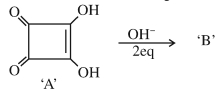
$\Delta_{ I } G ^{\circ}=-9.478\, kJ\, mol ^{-1}$
If we start the reaction in a closed container at $495\, K$ with $22$ millimoles of $A ,$ the amount of $B$ is the equilibrium mixture is millimoles ..............
(Round off to the Nearest Integer).
$\left[ R =8.314 J mol ^{-1} K ^{-1} ; \ell n 10=2.303\right]$
$NO _{3}^{-}, H _{2} O _{2}, BF _{3}, PCl _{3}, XeF _{4},SF _{4}, XeO _{3}, PH _{4}^{+}, SO _{3},\left[ Al ( OH )_{4}\right]^{-}$
$\begin{array}{*{20}{c}}
{\,\,\,\,\,\,\,\,\,\,\,\,\,\,\,\,\,\,\,\,\,\,\,\,\,\,\,\,\,\,\,\,\,\,\,\,\,\,\,\,C{H_3}} \\
{\,\,\,\,\,\,\,\,\,\,\,\,\,\,\,\,\,\,\,\,\,\,\,\,\,\,\,\,\,\,\,\,\,\,\,|} \\
{C{H_3} - CH - C{H_2} - C - C{H_3}} \\
{\,\,\,|\,\,\,\,\,\,\,\,\,\,\,\,\,\,\,\,\,\,\,\,\,\,\,\,\,\,\,\,\,\,\,\,|} \\
{\,\,\,\,\,\,\,OH\,\,\,\,\,\,\,\,\,\,\,\,\,\,\,\,\,\,\,\,\,\,\,\,\,\,OH\,}
\end{array}$ and $\begin{array}{*{20}{c}}
{C{H_2} - CH - C{H_2}} \\
{|\,\,\,\,\,\,\,\,\,\,\,\,\,\,|\,\,\,\,\,\,\,\,\,\,\,\,\,\,|\,\,\,\,\,} \\
{CN\,\,\,\,\,\,\,\,CN\,\,\,\,\,\,\,\,CN\,\,}
\end{array}$