MCQ
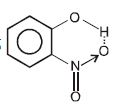
Which one of the following does not have intermolecular $H-$ bonding ?
  • A
    $H_2O$
  • $O-$ nitro phenol
  • C
    $HF$
  • D
    $CH_3COOH$

Answer

Correct option: B.
$O-$ nitro phenol
b
It has intramolecular $H-$ bonding (figure)

Need a full question paper?

Generate a complete, print-ready paper with questions like this in minutes — across 16+ boards, with answer keys.

Start Generating Free

Similar questions

A completely filled $d$ orbital $({d^{10}})$
In which of the following compounds, is the oxidation number of iodine is fractional
The first ionization potentials $\left( {eV} \right)$ of $Be$ and $B$ respectively are
The bond dissociation energies of $H _2, Cl _2$ and HCl are 104,58 and $103 kcal mol ^{-1}$ respectively. The enthalpy of formation of HCl would be
Which of the following is weakly acidic
The molality of a $10 \%( v / v )$ solution of di-bromine solution in $CCl _4$ (carbon tetrachloride) is $x$. $x=$ $......\times 10^{-2}\,M$. (Nearest integer)

[Given : molar mass of $Br _2=160\,g\,mol ^{-1}$

atomic mass of $C =12\,g\,mol ^{-1}$

atomic mass of $Cl =35.5\,g\,mol ^{-1}$

density of dibromine $=3.2\,g\,cm ^{-3}$

density of $\left.CCl _4=1.6\,g\,cm ^{-3}\right]$

Which of the following is non-polar bond
Tin is obtained from cassiterite by reduction with coke. Use the data given below to determine the minimum temperature (in $K$ ) at which the reduction of cassiterite by coke would take place.

At $ 298 K : \Delta_{ f } H ^{\circ}\left( SnO _2( s )\right)=-581.0 kJ mol ^{-1}, \Delta_{ fH } H ^{\circ}\left( CO _2( g )\right)=-394.0 kJ mol ^{-1}$

$S ^{\circ}\left( SnO _2( s )\right)=56.0 J K ^{-1} mol ^{-1}, S ^{\circ}( Sn ( s ))=52.0 J K ^{-1} mol ^{-1}$

$S ^{\circ}( C ( s ))=6.0 J K ^{-1} mol ^{-1}, S ^{\circ}\left( CO _2( g )\right)=210.0 J K ^{-1} mol ^{-1}$

Assume that the enthalpies and the entropies are temperature independent.

When enthalpy and entropy change for a chemical reaction are $ - 2.5\, \times {10^3}\,cal$ and $7.4\,cal$ ${\deg ^{ - 1}}$ respectively. Predict the reaction at $298\,K$ is
“The resultant heat change in a reaction is the same whether it takes place in one or several stages.” This statement is called