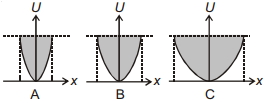
Which one of the following equations of motion represents simple harmonic motion ?
Where $k,k_0,k_1$ and $a$ are all positive
AIPMT 2009, Easy


Download our appand get started for free
Experience the future of education. Simply download our apps or reach out to us for more information. Let's shape the future of learning together!No signup needed.*
Similar Questions
- 1The displacements of two particles executing $S.H.M.$ on the same line are given. as $y_1=a \sin \left(\frac{\pi}{2} t+\phi\right)$ and $y_2=b \sin \left(\frac{2 \pi}{3} t+\phi\right)$. The phase difference between them at $t=1 \,s$ is .........View Solution
- 2View SolutionSelect wrong statement about simple,harmonic motion
- 3View SolutionThe velocity of a particle performing simple harmonic motion, when it passes through its mean position is
- 4A body is vibrating in simple harmonic motion with an amplitude of $0.06\, m$ and frequency of $15\, Hz$. The velocity and acceleration of body isView Solution
- 5A particle executes a simple harmonic motion of time period $T$. Find the time taken by the particle to go directly from its mean position to half the amplitudeView Solution
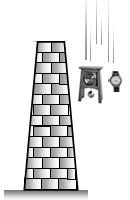
- 6A man having a wrist watch and a pendulum clock rises on a $TV$ tower. The wrist watch and pendulum clock per chance fall from the top of the tower. ThenView Solution
- 7Four simple harmonic vibrations:View Solution
${y_1} = 8\,\cos\, \omega t;\,{y_2} = 4\,\cos \,\left( {\omega t + \frac{\pi }{2}} \right)$ ;
${y_3} = 2\cos \,\left( {\omega t + \pi } \right);\,{y_4} = \,\cos \,\left( {\omega t + \frac{{3\pi }}{2}} \right)$ ,
are superposed on each other. The resulting amplitude and phase are respectively;
- 8The velocity vector $v$ and displacement vector $x$ of a particle executing SHM are related as $\frac{v d v}{d x}=-\omega^2 x$ with the initial condition $v=v_0$ at $x=0$. The velocity $v$, when displacement is $x$, isView Solution
- 9An oscillator of mass $M$ is at rest in its equilibrium position in a potential $V\, = \,\frac{1}{2}\,k{(x - X)^2}.$ A particle of mass $m$ comes from right with speed $u$ and collides completely inelastically with $M$ and sticks to it . This process repeats every time the oscillator crosses its equilibrium position .The amplitude of oscillations after $13$ collisions is: $(M = 10,\, m = 5,\, u = 1,\, k = 1 ).$View Solution
- 10The variations of potential energy $(U)$ with position $x$ for three simple harmonic oscillators $A, B$ and $C$ are shown in figure. The oscillators have same mass. The time period of oscillation is greatest forView Solution