Select wrong statement about simple,harmonic motion
Easy


Download our appand get started for free
Experience the future of education. Simply download our apps or reach out to us for more information. Let's shape the future of learning together!No signup needed.*
Similar Questions
- 1A body of mass $m $ is attached to the lower end of a spring whose upper end is fixed. The spring has negligible mass. When the mass $m$ is slightly pulled down and released , it oscillates with a time period of $3\,s$ . When the mass $m$ is increased by $1\,kg$ , the time period of oscillations becomes $5\,s$ . The value of $m$ in $kg$ isView Solution
- 2A particle of mass $m$ undergoes oscillations about $x=0$ in a potential given by $V(x)-\frac{1}{2} k x^2-V_0 \cos \left(\frac{x}{a}\right)$, where $V_0, k, a$ are constants. If the amplitude of oscillation is much smaller than $a$, the time period is given byView Solution
- 3A body is executing simple harmonic motion with frequency $'n',$ the frequency of its potential energy is :View Solution
- 4A mass $M$ is suspended from a light spring. An additional mass m added displaces the spring further by a distance $x$. Now the combined mass will oscillate on the spring with periodView Solution
- 5If $A$ is the area of cross-section of a spring $L$ is its length $E$ is the Young's modulus of the material of the spring then time period and force constant of the spring will be respectivelyView Solution
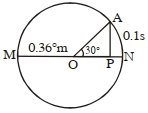
- 6The point $A$ moves with a uniform speed along the circumference of a circle of radius $0.36\, m$ and covers $30^{\circ}$ in $0.1\, s$. The perpendicular projection $'P'$ from $'A'$ on the diameter $MN$ represents the simple harmonic motion of $'P'.$ The restoration force per unit mass when $P$ touches $M$ will be ...... $N$View Solution
- 7The equation of a simple harmonic motion is $X = 0.34\cos (3000t + 0.74)$ where $X$ and $t$ are in $mm$ and $sec$. The frequency of motion isView Solution
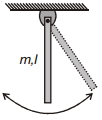
- 8A uniform rod of mass $m$ and length $I$ is suspended about its end, Time period of small angular oscillations is ..........View Solution
- 9A particle executes simple hormonic motion between $x =\, -A$ and $x = +A$ . It starts from $x = 0$ moves in $+x-$ direction. The time taken for it to move from $x = 0$ to $x = \frac {A}{2}$ is $T_1$ and to move from $\frac {A}{2}$ to $\frac {A}{\sqrt 2}$ is $T_2$ , thenView Solution
- 10Two pendulums of length $121\,cm$ and $100\,cm$ start vibrating in phase. At some instant, the two are at their mean position in the same phase. The minimum number of vibrations of the shorter pendulum after which the two are again in phase at the mean position is :View Solution