MCQ
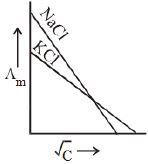
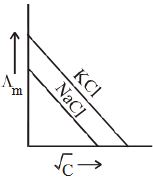
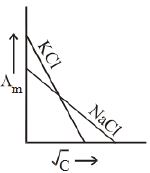
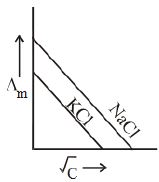
Which one of the following graphs between molar conductivity $({\Lambda _m})$ versus $\sqrt C$ is correct?
  • A


  • C

  • D

Answer

Correct option: B.

b
Both $NaCl$ and $KCl$ are strong electrolytes and as $Na^+(aq.)$ has less conductance than $K^+ (aq.)$ due to more hydration therefore the graph of option $(B)$ is correct.

Need a full question paper?

Generate a complete, print-ready paper with questions like this in minutes — across 16+ boards, with answer keys.

Start Generating Free

Similar questions

$\begin{matrix}
   O\,\,\,\,\,\,\,\,\,\,\,\,\,\,\,\,\,\,\,\,\,\,\,\,\,\,\,\,\,\,\,\,\,\,O\,\,\,\,\,\,\,\,\,\,\,\,\,\,\,\,\,\,\,\,\,\,\,\,\,\,\,\,\,  \\
   ||\,\,\,\,\,\,\,\,\,\,\,\,\,\,\,\,\,\,\,\,\,\,\,\,\,\,\,\,\,\,\,\,\,\,\,||\,\,\,\,\,\,\,\,\,\,\,\,\,\,\,\,\,\,\,\,\,\,\,\,\,\,\,\,\,\,  \\
   H-O-C-{{(C{{H}_{2}})}_{n}}-C-O-H\xrightarrow[\Delta ]{}product  \\
\end{matrix}$ ,

At what value of $(n)$ given compound will not evolve $CO_2$ gas ?

Which of the following is decreasing order of $I.P_2$ ?
For a dilute solution containing $2.5\, g$ of a nonvolatile non-electrolyte solute in $100\, g$ of water, the elevation in boiling point at $1$ atm pressure is $2\,^oC$. Assuming  amount of solute is much lower than the amount of solvent, the vapour pressure ($mm$ of  $Hg$) of the solution is :- 

(take $K_b = 0.76\, K \,kg \,mol^{-1}$)

The $\text{CFSE}$ for octahedral $\left[\mathrm{CoCl}_6\right]^{4-} 18,000 \ cm^{-1}$ . The $\text{CFSE}$ for tetrahedral $\left[\mathrm{CoCl}_4\right]^{2-}$ will be:
Product $(A)$ is
The correct match between Item $I$ and Item $II$ is
Item $I$  Item $II$
$A$ Allosteric effect $P$ Molecule binding to the active site of enzyme
$B$ Competitive inhibitor $Q$ Molecule crucial for communication in the body
$C$ Receptor $R$ Molecule binding to a site other than the active site of enzyme
$D$ Poison $S$ Molecule binding to the enzyme covalently
For a complex reaction $A\,\xrightarrow{K}$ products $Ea_1=180\,KJ/mol$ ,   $Ea_2 = 80\,KJ/mol$,    $Ea_3 = 50\,KJ/mol$ overall rate constant $K$ is related to individual rate constant by the equation $K\, = \,\,{\left( {\frac{{{K_1}.{K_2}}}{{{K_3}}}} \right)^{2/3}}$. Activation energy $(KJ/mol)$ for the overall reaction is
A first order reaction has the rate constant $10^{-2}\, sec^{-1}$. If the initial concentration of reactant is $1\, M$ then what will be the rate of reaction after $1\, minute$ ?
A current being passed for two hour through a solution of an acid liberating $11.2$ litre of oxygen at $NTP $ at anode. What will be the amount of copper deposited at the cathode by the same current when passed through a solution of copper sulphate for the same time ........... $\mathrm{g}$
Which molecule is polar ?