MCQ
Which one of the following has maximum penetrating power ?
- A$\alpha$-rays
- B$\beta$-rays
- CCathode rays
- ✓$\gamma$-rays
Generate a complete, print-ready paper with questions like this in minutes — across 16+ boards, with answer keys.
If the mass number of an atom is A = 40 and its electron configuration is  , the number of neutrons and protons in its nucleus will be
| (a) 22, 18 | (b) 18, 22 |
(c) 20, 20 |
(d) 18, 18 |
If m is mass of electron, v its velocity, r the radius of stationary circular orbit around a nucleus with charge Ze, then from Bohr's first postulate, the kinetic energy K =  of the electron in C.G.S. system is equal to
|
(a) |
(b) |
(c) |
(d) |
The correct graph between the maximum energy of a photoelectron and the inverse of wavelength of the incident radiation is given by the curve
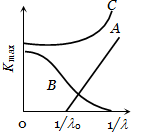
|
(a) A |
(b) B |
(c) C |
(d) None of the above |
When the reflecting or refracting rays do not actually intersect but appear to intersect when produced backwards,
What is immaterial for an electric fuse wire
|
(a) Specific resistance of the wire |
(b) Radius of the wire |
|
(c) Length of the wire |
(d) Current flowing through the wire |
A short magnet oscillates with a time period 0.1 s at a place where horizontal magnetic field is 24μT. A downward current of 18 A is established in a vertical wire 20 cm east of the magnet. The new time period of oscillator
|
(a) 0.1 s |
(b) 0.089 s |
(c) 0.076 s |
(d) 0.057 s |

In Young's double slit experiment, if the slit widths are in the ratio 1 : 9, then the ratio of the intensity at minima to that at maxima will be
|
(a) 1 |
(b) 1/9 |
(c) 1/4 |
(d) 1/3 |


