Which one of the following is not used to reduce friction
Easy


Download our appand get started for free
Experience the future of education. Simply download our apps or reach out to us for more information. Let's shape the future of learning together!No signup needed.*
Similar Questions
- 1View SolutionThe force required to keep a body in uniform circular motion is
- 2Two balls of masses ${m_1}$ and ${m_2}$ are separated from each other by a powder charge placed between them. The whole system is at rest on the ground. Suddenly the powder charge explodes and masses are pushed apart. The mass ${m_1}$ travels a distance ${s_1}$ and stops. If the coefficients of friction between the balls and ground are same, the mass ${m_2}$ stops after travelling the distanceView Solution
- 3View SolutionA metal block is resting on a rough wooden surface. A horizontal force applied to the block is increased uniformly. Which of the following curves correctly represents velocity of the block ?
- 4View SolutionIt is easier to roll a barrel than pull it along the road. This statement is
- 5$A$ block of mass $M$ is placed on $a$ horizontal surface and it is tied with an inextensible string to $a$ block of mass, as shown in figure. A block of mass $m_0$ is also placed on $M$ In previous problem, the tension in the string will beView Solution

- 6A block of mass $10\, kg$ is placed on an inclined plane. When the angle of inclination is $30°$, the block just begins to slide down the plane. The force of static friction is ....... $kg\, wt$View Solution
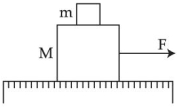
- 7A system of two blocks of masses $m =2 \; kg$ and $M=8 \; kg$ is placed on a smooth table as shown in figure. The coefficient of static friction between two blocks is $0.5$. The maximum horizontal force $F$ that can be applied to the block of mass $M$ so that the blocks move together will be $\dots \; N$View Solution
- 8View SolutionA homogeneous rectangular brick lies on a rough inclined plane of very small inclination. Which half part of brick exters greater contact force on plane
- 9A stone of mass of $16\, kg$ is attached to a string $144 \,m$ long and is whirled in a horizontal circle. The maximum tension the string can withstand is $16$ Newton. The maximum velocity of revolution that can be given to the stone without breaking it, will be ....... $ms^{-1}$View Solution
- 10A car of $800 \mathrm{~kg}$ is taking turn on a banked road of radius $300 \mathrm{~m}$ and angle of banking $30^{\circ}$. If coefficient of static friction is $0.2$ then the maximum speed with which car can negotiate the turn safely : $\left(\mathrm{g}=10 \mathrm{~m} / \mathrm{s}^2, \sqrt{3}=1.73\right)$View Solution