A block of mass $10\, kg$ is placed on an inclined plane. When the angle of inclination is $30°$, the block just begins to slide down the plane. The force of static friction is ....... $kg\, wt$
Easy
Download our app for free and get started
(d)$F = mg\sin 30^\circ = 50N = 5kg{\rm{ - }}wt$.

Download our appand get started for free
Experience the future of education. Simply download our apps or reach out to us for more information. Let's shape the future of learning together!No signup needed.*
Similar Questions
- 1View SolutionA stone tied to a string is rotated in a circle. If the string is cut, the stone flies away from the circle because
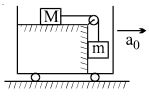
- 2Imagine the situation in which the given arrangement is placed inside a trolley that can move only in the horizontal direction, as shown in figure. If the trolley is accelerated horizontally along the positive $x$ -axis with $a_0$, then Identify the correct statement $(s)$ related to the tension $T$ in the stringView Solution
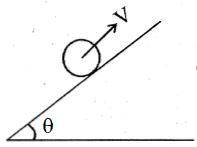
- 3View SolutionThe sphere is performing rolling up an inclined plane, the frictional force is
- 4A railway line is taken round a circular arc of radius $1000\ m$, and is banked by raising the outer rail $h\ m$ above the inner rail. If the lateral force on the inner rail when a train travels round the curve at $10 \ ms^{-1}$ is equal to the lateral force on the outer rail when the train's speed is $20\ ms^{-1}$. The value of $4g\ tan\theta$ is equal to : (The distance between the rails is $1.5 \ m$).View Solution
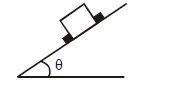
- 5View SolutionWhen a bicycle is in motion, the force of friction exerted by the ground on the two wheels is such that it acts
- 6A body is sliding down an inclined plane (angle of inclination $45^o$). If the coefficient of friction is $0.5$ and $g = 9.8\, m/s^2$. then the acceleration of the body downwards in $m/s^2$ isView Solution
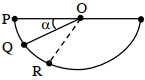
- 7A ball is released from rest from point $P$ of a smooth semi-spherical vessel as shown in figure. The ratio of the centripetal force and normal reaction on the ball at point $Q$ is $A$ while angular position of point $Q$ is $\alpha$ with respect to point $P$. Which of the following graphs represent the correct relation between $A$ and $\alpha$ when ball goes from $Q$ to $R$ ?View Solution
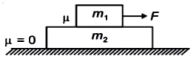
- 8In the given arrangement the maximum value of $F$ for which there is no relative motion between the blocksView Solution
- 9A body of weight $64\, N$ is pushed with just enough force to start it moving across a horizontal floor and the same force continues to act afterwards. If the coefficients of static and dynamic friction are $0.6$ and $0.4$ respectively, the acceleration of the body will be (Acceleration due to gravity $= g$)View Solution
- 10View SolutionThe limiting friction between two bodies in contact is independent of